
The Apollo 11 Moon Landing Mystery
How one of humanity’s greatest achievements became the center of enduring skepticism

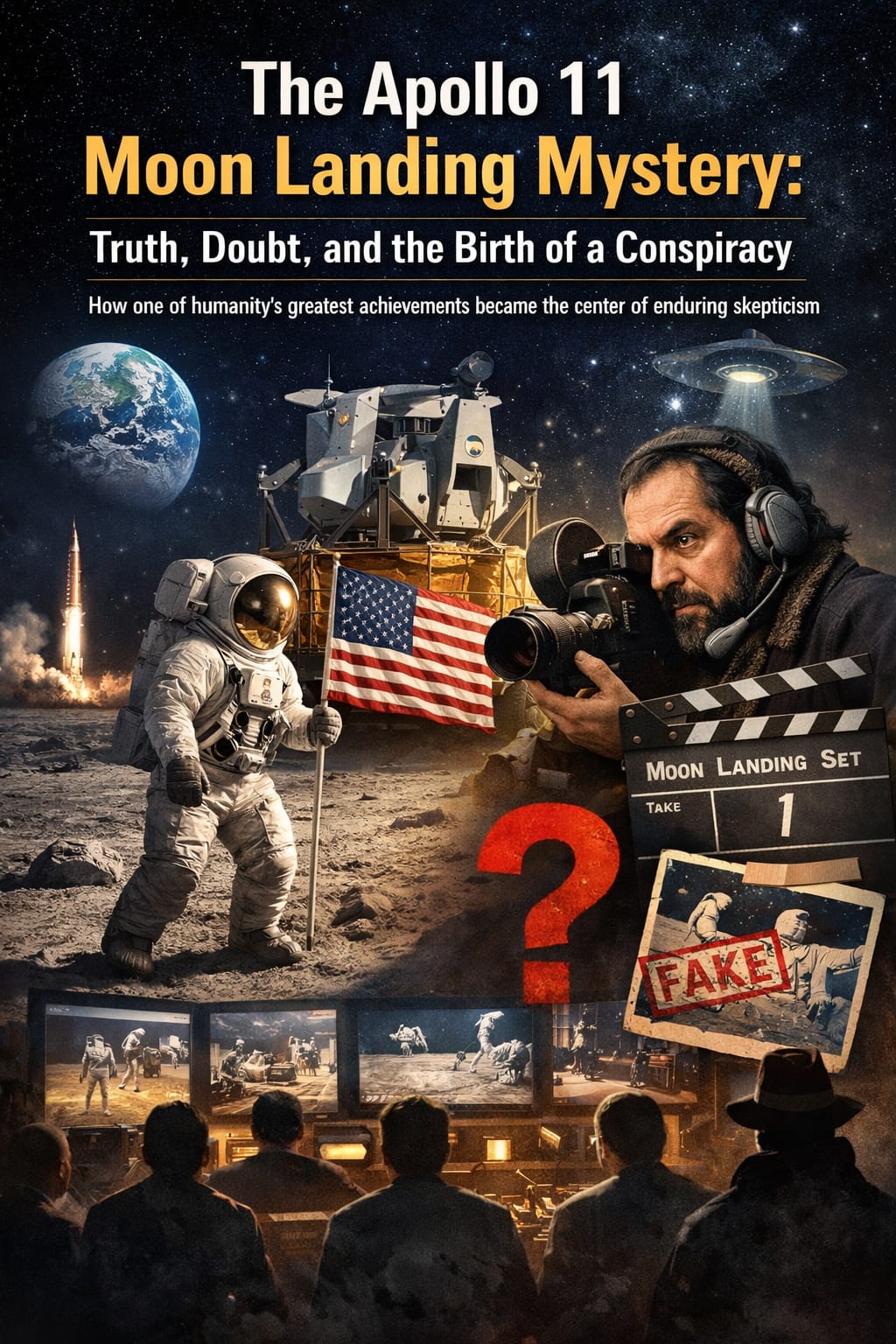
On July 20, 1969, the world watched in awe as Neil Armstrong stepped onto the surface of the Moon, declaring it “one small step for man, one giant leap for mankind.” Alongside Buzz Aldrin, the Apollo 11 mission marked a historic milestone in human exploration. Yet, despite overwhelming scientific evidence and global recognition, the Moon landing has long been surrounded by mystery and conspiracy theories that question its authenticity.
The roots of the so-called “Moon landing mystery” lie not in the event itself, but in the cultural and political climate of the time. The late 1960s were dominated by the Cold War, a period of intense rivalry between the United States and the Soviet Union. The space race was a critical front in this competition, and landing a man on the Moon was seen as a decisive victory. For some skeptics, this raised the possibility that the event was staged as propaganda to assert technological superiority.
One of the most common arguments among conspiracy theorists is that the Moon landing footage was fabricated in a studio. They point to perceived anomalies in photographs and videos, such as the American flag appearing to “wave” despite the Moon’s lack of atmosphere. Others question the absence of visible stars in the lunar sky or the unusual shadows cast by astronauts and equipment. These claims have been widely circulated, especially with the rise of the internet, fueling ongoing debate.
However, scientists and experts have repeatedly addressed these concerns with clear explanations grounded in physics and photography. The flag appeared to move because it was mounted on a horizontal rod and was being handled by astronauts, causing it to ripple. The lack of visible stars is due to camera exposure settings optimized for the brightly lit lunar surface, making distant stars too faint to capture. Similarly, shadows appear distorted because of the uneven terrain and multiple light reflections from the Moon’s surface.
Another layer of the mystery involves the belief that the footage was directed by filmmaker Stanley Kubrick, known for his work on 2001: A Space Odyssey. This theory suggests that Kubrick’s expertise in visual effects made him the ideal candidate to stage the landing. However, there is no credible evidence to support this claim, and it remains a popular but unfounded piece of speculation.
The role of NASA has also been scrutinized by skeptics. Some argue that the agency had both the motive and the resources to orchestrate such a deception. Yet, this perspective overlooks the vast number of people involved in the Apollo program—over 400,000 engineers, scientists, and technicians. Maintaining a secret of such magnitude across so many individuals for decades would be nearly impossible.
In addition to human testimony, there is substantial physical evidence supporting the Moon landing. Astronauts brought back approximately 382 kilograms of lunar rocks, which have been studied by scientists worldwide. These samples possess unique characteristics that differ significantly from Earth rocks. Moreover, retroreflectors placed on the Moon’s surface during the mission are still used today in experiments to measure the distance between the Earth and the Moon with remarkable precision.
International tracking data further corroborates the mission. Observatories and space agencies around the world, including those in rival nations, monitored the spacecraft’s journey. If the landing had been faked, it is highly unlikely that competing countries would have remained silent, especially during a time of geopolitical tension.
Despite the evidence, the Moon landing mystery persists, largely fueled by a broader distrust in institutions and the human tendency to question extraordinary claims. The rise of digital media has amplified these doubts, allowing misinformation to spread rapidly and reach global audiences.
Ultimately, the story of the Apollo 11 Moon landing is not just about a journey to another world, but also about how truth can be challenged in the face of skepticism. While conspiracy theories may continue to circulate, the overwhelming consensus among scientists, historians, and experts affirms that the Moon landing was real—a testament to human ingenuity, determination, and the spirit of exploration.
About the Creator
Irshad Abbasi
Ali ibn Abi Talib (RA) said 📚
“Knowledge is better than wealth, because knowledge protects you, while you have to protect wealth.
Keep reading
More stories from Irshad Abbasi and writers in History and other communities.
Powerful Women of the Mughal Empire
The Mughal Empire, often remembered for its grand architecture, powerful emperors, and cultural achievements, was not solely shaped by men. Behind the imposing walls of royal courts and harems, several women wielded remarkable authority, influencing politics, administration, and even imperial succession. These women were not mere spectators of history—they were active participants who exercised power in ways that challenged the norms of their time.
By Irshad Abbasi 6 days ago in History
Emperor of Nothing, King of Everything: The Strange Reign of Norton I
In the fall of 1859, in a city still finding its footing at the edge of a restless continent, a man walked into the offices of the San Francisco Bulletin and made a declaration that, by all conventional standards, should have been dismissed outright. He declared himself: “Norton I, Emperor of the United States.” He would later add, with equal authority: “Protector of Mexico.”
By The Iron Lighthouse7 days ago in History




Comments
There are no comments for this story
Be the first to respond and start the conversation.