Ancient
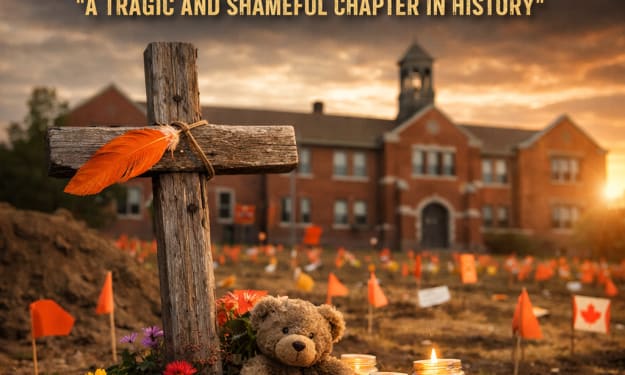
215 Children’s Remains Found at Former Residential School
In a sorrowful revelation that has shaken Canada and the world, the remains of 215 children were recently discovered buried on the grounds of a former residential school in British Columbia. This discovery has reignited the painful conversation about Canada’s colonial past and the systemic mistreatment of Indigenous peoples, particularly children, within the residential school system.
By Irshad Abbasi about 4 hours ago in History
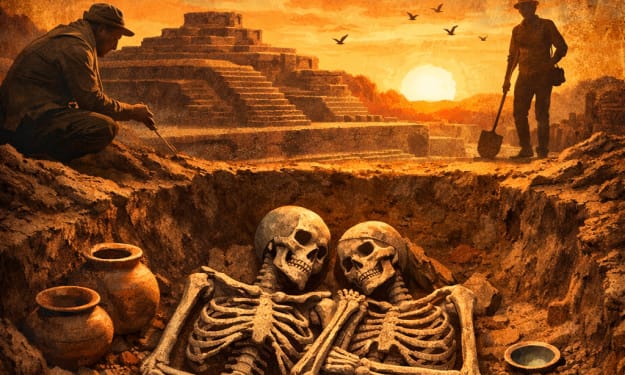
The Mysterious Couple of Harappa
The ancient city of Harappa, once a thriving center of the Indus Valley Civilization, continues to reveal remarkable stories from humanity’s distant past. Among its many discoveries, one of the most intriguing is the burial of a mysterious couple found lying side by side in a grave that dates back more than 4,000 years. This unusual discovery has sparked debate among archaeologists and historians, raising questions about love, ritual, and social customs in one of the world’s earliest urban societies.
By Irshad Abbasi about 4 hours ago in History
Mysteries in the Mirror
Mirrors are ordinary objects found in almost every home. We use them to check our appearance, decorate our rooms, and brighten spaces by reflecting light. Yet despite their everyday usefulness, mirrors have long been surrounded by mystery, superstition, and strange legends. For centuries, people across the world have believed that mirrors hold supernatural power — perhaps even acting as gateways between the physical world and the spiritual realm.
By Irshad Abbasi about 7 hours ago in History
“Sacred Land”
Argentina has long been known for its vibrant culture, natural beauty, and rich history, but now it has added a unique attraction to its growing tourism portfolio: “Sacred Land”, the country’s first religious-themed park. Located in the outskirts of Buenos Aires, this ambitious project aims to blend spirituality, education, and entertainment in a way that has never been attempted in South America. Visitors from across the globe are flocking to witness a place where sacred stories, religious traditions, and immersive experiences converge.
By Irshad Abbasi about 7 hours ago in History
Cleopatra's Strategic Mind
BEYOND THE MYTH Cleopatra VII, born in 69 BCE, has been remembered primarily for her romantic relationships with Julius Caesar and Mark Antony, but this focus on her love life obscures the reality that she was one of antiquity's most sophisticated political strategists, a polyglot who spoke at least nine languages, a patron of learning who transformed Alexandria into the intellectual capital of the Mediterranean world, and a skilled diplomat who kept Egypt independent for decades while rival powers consumed every other Hellenistic kingdom. She was born into the Ptolemaic dynasty, Greek rulers who had controlled Egypt since the death of Alexander the Great, and she received an exceptional education in mathematics, philosophy, astronomy, and languages, and uniquely among Ptolemaic rulers, she bothered to learn Egyptian and present herself to her subjects as a true pharaoh rather than a foreign occupier.
By The Curious Writerabout 14 hours ago in History
Egypt's Female Pharaoh Who Ruled as a King
THE RISE OF A QUEEN Hatshepsut was born into royalty as the daughter of Pharaoh Thutmose I around 1507 BCE, and she received an education typically reserved for male heirs including instruction in reading hieroglyphics, mathematics, religious rituals, and governance, preparing her for a role that women of ancient Egypt rarely occupied but that she would ultimately claim with unprecedented success. When her father died, Hatshepsut married her half-brother Thutmose II following Egyptian royal tradition designed to keep power within the family, and she became queen consort, a position of significant influence but not ultimate authority, and she bore a daughter but no male heir, which would prove crucial to her eventual path to power when Thutmose II died after a relatively brief reign.
By The Curious Writerabout 14 hours ago in History
From Sanctuary to Symbol of Fear
Article (≈700 words): There are places in the world that once stood as powerful symbols of peace, unity, and human connection. These were spaces where communities gathered not only to worship or reflect, but also to find comfort, belonging, and hope. Over time, however, some of these sanctuaries have undergone tragic transformations. What was once a center of harmony has, in certain cases, become a symbol of fear—its meaning reshaped by conflict, violence, or neglect.
By Irshad Abbasi about 17 hours ago in History
The Lost Greek Monastery
For over a century, historians, archaeologists, and adventurers have been captivated by the mystery of a “lost” Greek monastery said to be hidden in a remote and rugged landscape. The story began with a fragile, hand-drawn map believed to date back several hundred years. Passed through generations and rediscovered in the early 20th century, the map pointed to a secluded location where a once-thriving monastic community was thought to have vanished without a trace. However, after decades of tireless searching, a surprising conclusion has emerged: the map that inspired the quest was wrong.
By Irshad Abbasi about 20 hours ago in History
The Baghdad Battery
Archaeologists found clay jars in Iraq containing copper cylinders and iron rods that produce electrical current when filled with acidic liquid, and if they're really batteries, they prove ancient civilizations had technology we thought was impossible until the modern era.
By The Curious Writerabout 22 hours ago in History
The Book Nobody Can Read
Yale University's library contains a 240-page medieval manuscript filled with unknown plants, bizarre astronomical diagrams, and mysterious text written in a language that has defeated every code-breaker, linguist, and artificial intelligence program ever created.
By The Curious Writerabout 22 hours ago in History
The Antikythera Mechanism
Greek sponge divers found a corroded lump of bronze in an ancient shipwreck in 1901, and when scientists finally X-rayed it in the 1970s, they discovered gears and mechanisms so advanced that nothing like it would appear again for 1,000 years.
By The Curious Writerabout 22 hours ago in History