
The Mysterious Couple of Harappa
Archaeologists uncover a fascinating burial from the Indus Valley Civilization, shedding new light on relationships, rituals, and life in one of the world’s oldest urban cultures.

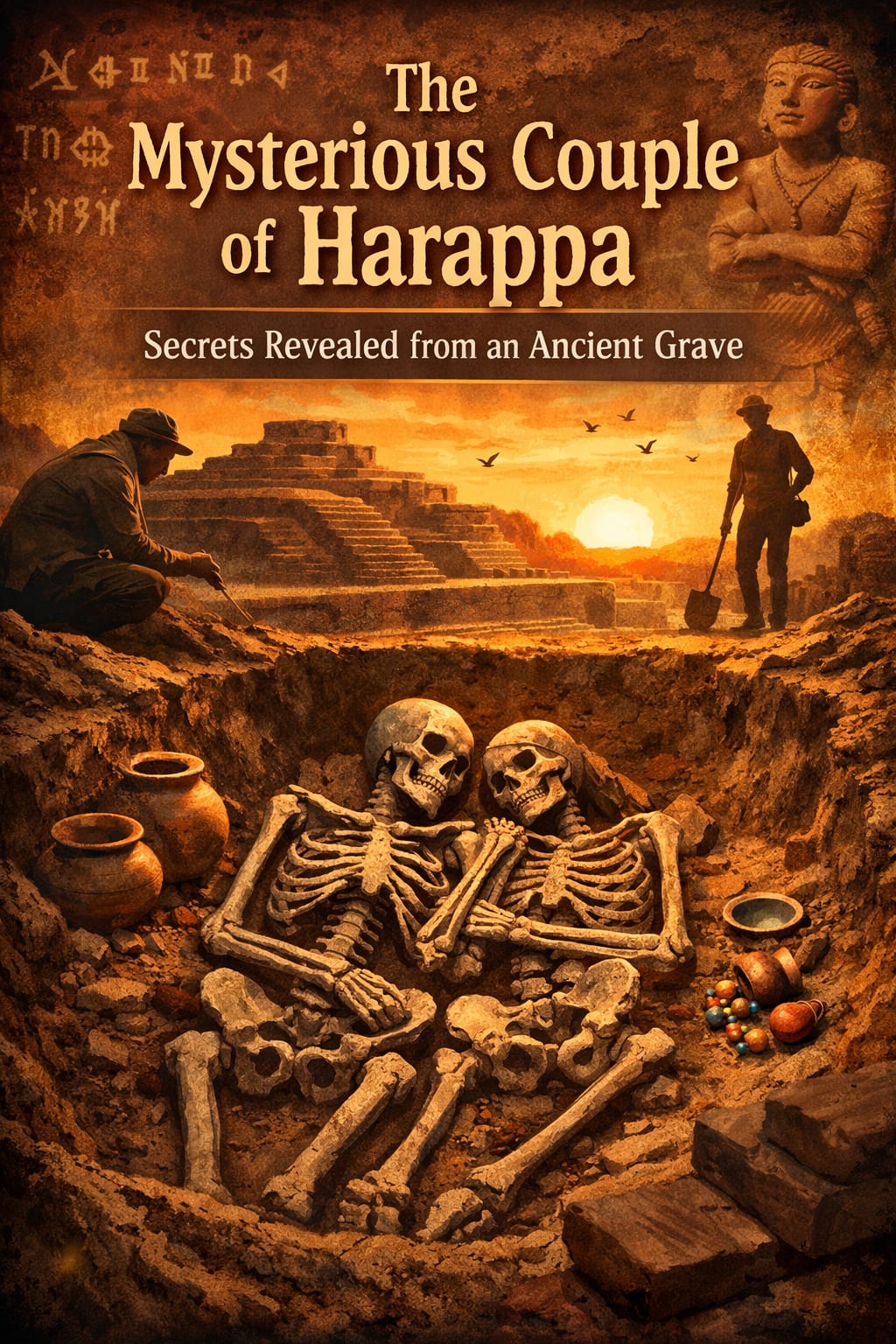
The ancient city of Harappa, once a thriving center of the Indus Valley Civilization, continues to reveal remarkable stories from humanity’s distant past. Among its many discoveries, one of the most intriguing is the burial of a mysterious couple found lying side by side in a grave that dates back more than 4,000 years. This unusual discovery has sparked debate among archaeologists and historians, raising questions about love, ritual, and social customs in one of the world’s earliest urban societies.
A Discovery that Captured Attention
Harappa, located in present-day Pakistan, was one of the major cities of the Indus Valley Civilization, alongside sites such as Mohenjo-daro. The civilization flourished between roughly 2600 BCE and 1900 BCE and was known for its advanced urban planning, drainage systems, standardized weights, and thriving trade networks.
During archaeological excavations at Harappa, researchers discovered a grave containing the skeletons of a man and a woman buried together. While joint burials are not entirely unheard of in ancient cultures, they are extremely rare in the Indus Valley Civilization. Most graves discovered at Harappa contain only a single individual.
The unusual nature of this burial immediately caught the attention of archaeologists. The two skeletons were carefully placed next to each other in the same grave, suggesting that their burial was intentional and possibly symbolic.
Were They Lovers or Family?
One of the first questions researchers asked was about the relationship between the two individuals. Were they husband and wife? Lovers? Or perhaps relatives who died at the same time?
Initial studies of the skeletons suggested that the individuals were likely adults who lived during the mature phase of the Indus Valley Civilization. Their positioning in the grave indicated that they were buried at the same time, rather than one being placed there later.
However, the Indus Valley Civilization left behind very few written records that historians have been able to decipher. The famous symbols of the Indus Script remain one of archaeology’s greatest mysteries. Because of this, researchers must rely heavily on physical evidence such as bones, pottery, and burial patterns to understand the lives of these ancient people.
Clues from the Grave
The burial site offered several clues about the lives of the mysterious couple. Archaeologists found typical burial goods nearby, including pottery vessels that were commonly placed in graves during the Indus Valley period. These items may have been meant to accompany the dead into the afterlife or to honor them according to cultural traditions.
The positioning of the skeletons was particularly intriguing. They were placed close together, suggesting a relationship that may have held special significance for the community that buried them.
Some researchers have speculated that the couple may have died during the same event—possibly disease, an accident, or a natural disaster—and were buried together by their relatives. Others believe the burial may represent a symbolic or ceremonial practice that has not yet been fully understood.
No Evidence of Ritual Sacrifice
In some ancient civilizations, joint burials were sometimes associated with ritual sacrifice or burial customs linked to rulers or elites. However, archaeologists studying the Harappa grave found no evidence suggesting that one individual had been sacrificed.
The skeletons did not show clear signs of violent death, and their burial arrangement appeared respectful and deliberate. This has led many researchers to believe that the grave reflects a social or emotional connection rather than a ritual sacrifice.
A Rare Glimpse into Ancient Human Relationships
Discoveries like this provide rare insights into the human side of ancient civilizations. While the Indus Valley Civilization is famous for its impressive cities and engineering achievements, much less is known about its social life, beliefs, and personal relationships.
The burial of this mysterious couple offers a touching reminder that even in a civilization that existed thousands of years ago, human bonds may have played an important role in how communities honored their dead.
Continuing the Mystery
Despite decades of research, many questions remain unanswered. Scientists continue to analyze skeletal remains using modern techniques such as DNA testing and isotopic analysis. These methods may eventually reveal more about the individuals’ origins, health, diet, and possible relationship.
For now, the grave of the mysterious couple at Harappa remains one of the most fascinating and emotional discoveries from the Indus Valley Civilization. It reminds us that beneath the ruins of ancient cities lie the stories of real people—people who loved, lived, and were remembered by those who buried them thousands of years ago.
About the Creator
Irshad Abbasi
Ali ibn Abi Talib (RA) said 📚
“Knowledge is better than wealth, because knowledge protects you, while you have to protect wealth.
Keep reading
More stories from Irshad Abbasi and writers in History and other communities.
Mysteries in the Mirror
Mirrors are ordinary objects found in almost every home. We use them to check our appearance, decorate our rooms, and brighten spaces by reflecting light. Yet despite their everyday usefulness, mirrors have long been surrounded by mystery, superstition, and strange legends. For centuries, people across the world have believed that mirrors hold supernatural power — perhaps even acting as gateways between the physical world and the spiritual realm.
By Irshad Abbasi about 5 hours ago in History
Utopia
The concept of utopia has captivated human imagination for centuries, serving as a powerful lens through which societies envision ideal worlds and explore themes of justice, equality, and harmony. From ancient philosophical texts to modern dystopian narratives, the quest for a perfect society reflects humanity's deepest aspirations and fears. This article delves into the historical evolution of utopian thought, examining its roots in ancient civilizations, its flourishing during the Renaissance and Enlightenment, and its manifestations in 19th-century movements and contemporary culture. Through this exploration, we will uncover the critiques and challenges that accompany utopian ideals, as well as their enduring influence on current societal debates and future visions of a better world.
By Alain junior2 days ago in History
The Year 1971 in Review: Fun Facts, Trivia, and Historic Highlights
This quick read is a collection of fun facts, trivia, and historic events from the year 1971. Discover the year’s top news stories, most influential people, sports facts, entertainment trivia, grocery and other prices, and much more.
By Gregory DeVictor7 days ago in History


Comments
There are no comments for this story
Be the first to respond and start the conversation.