
The Woman Who Defied the Modern Age
In the 20th century, when science ruled and superstition faded, one woman stood trial for witchcraft—leaving behind a story that still haunts history

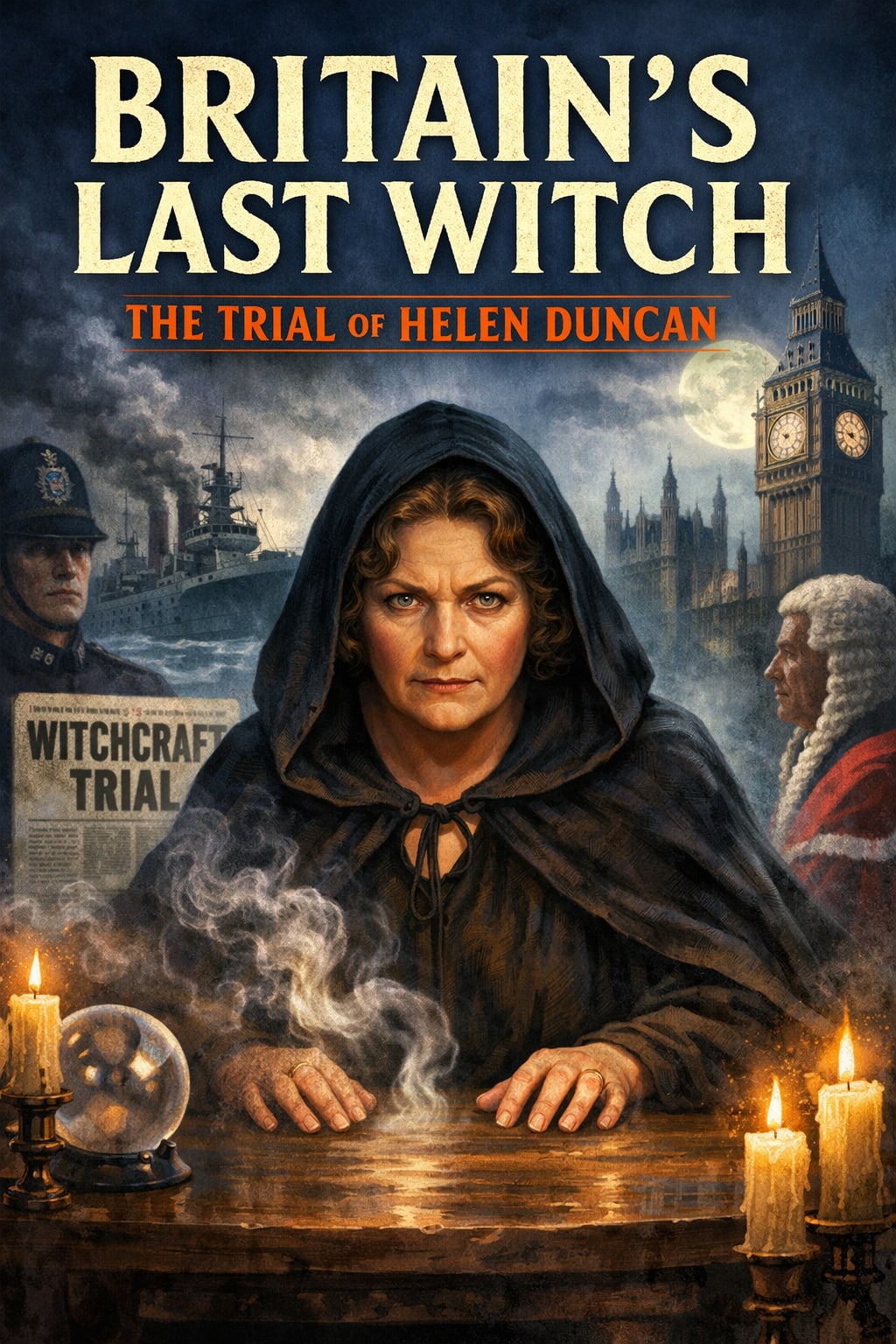
In an age defined by rapid scientific advancement, global wars, and technological progress, the idea of witchcraft seems like a relic of a distant, superstitious past. Yet, astonishingly, Britain’s last official witch lived not in medieval times, but in the 20th century. Her story is not just a curiosity—it is a striking reminder of how fear, belief, and law can collide even in modern societies.
Helen Duncan, a Scottish woman born in 1897, would go on to earn the strange and controversial title of Britain’s “last witch.” A spiritualist medium by practice, she claimed to communicate with the dead, conducting séances where grieving families sought comfort and closure. To her followers, she was gifted; to skeptics, she was a fraud. But to the British legal system during World War II, she became something far more dangerous.
Duncan’s séances often involved what she described as “ectoplasm”—a mysterious substance she would produce while in a trance, supposedly allowing spirits to manifest physically. Attendees reported seeing ghostly figures, hearing voices, and witnessing objects move. While many were convinced of her powers, investigators and magicians later suggested that these displays were elaborate tricks involving cloth, paper, and sleight of hand.
Her activities might have remained on the fringes of belief and entertainment, if not for one fateful incident during the war. In 1941, during a séance in Portsmouth, Duncan reportedly revealed the sinking of HMS Barham, a British battleship. The shocking part was not just the claim—but the timing. The sinking had not yet been publicly announced by the government, which raised serious concerns among officials.
Authorities feared that Duncan either had access to sensitive military information or was spreading rumors that could damage morale. In wartime Britain, secrecy was paramount, and even the suggestion of leaked information was treated as a serious threat. Rather than charging her under modern laws, officials reached back centuries to an obscure piece of legislation: the Witchcraft Act of 1735.
In 1944, Helen Duncan was arrested and put on trial—not for espionage, but for pretending to conjure spirits. The charge may sound almost absurd, but it carried real consequences. The law did not accuse her of actual witchcraft; instead, it criminalized the fraudulent claim of supernatural powers. Nevertheless, the symbolism of the trial was powerful. In the midst of a modern war fought with radar and codebreaking, a woman was being prosecuted under a law rooted in ancient fears.
The trial attracted widespread attention. Supporters argued that Duncan was being unfairly targeted for her beliefs and practices, while critics insisted she was exploiting vulnerable people for profit. The court ultimately found her guilty, and she was sentenced to nine months in prison.
Her conviction marked the last time someone in Britain was imprisoned under the Witchcraft Act. Just a few years later, in 1951, the law was repealed and replaced with the Fraudulent Mediums Act, reflecting a shift toward addressing deception rather than superstition.
Even after her release, Duncan continued to hold séances, undeterred by her legal troubles. She remained a controversial figure until her death in 1956. To this day, opinions about her are divided. Some view her as a victim of outdated laws and wartime paranoia; others see her as a skilled performer who pushed her illusions too far.
What makes Helen Duncan’s story so compelling is not just its uniqueness, but its timing. Her life sits at the intersection of two worlds: one governed by reason and evidence, and another shaped by belief and the human desire for connection beyond death. In times of uncertainty—especially during war—people often seek comfort in the unknown. Duncan provided that comfort, whether through genuine belief or calculated performance.
Her trial also raises important questions about freedom of belief and the role of the state in regulating it. At what point does personal faith become deception? And how should the law respond when belief and fraud blur together?
Today, the idea of someone being tried as a witch in modern Britain seems almost unimaginable. Yet Helen Duncan’s case reminds us that progress is not always linear, and that even in the most advanced societies, echoes of the past can resurface in unexpected ways.
Britain’s last witch was not burned at the stake or hunted in fear—but she was judged, imprisoned, and remembered. Her story lingers not as a tale of magic, but as a reflection of a society caught between skepticism and belief, reason and fear.
About the Creator
Irshad Abbasi
Ali ibn Abi Talib (RA) said 📚
“Knowledge is better than wealth, because knowledge protects you, while you have to protect wealth.
Keep reading
More stories from Irshad Abbasi and writers in History and other communities.
Harry Houdini’s Unlikely Last Act
In the public imagination, Harry Houdini remains the ultimate master of illusion—an entertainer who could slip chains, vanish from locked boxes, and defy death itself. Yet, in the final chapter of his life, Houdini turned his talents in a surprising direction. Rather than dazzling audiences with tricks, he set out to dismantle deception. His target was not rival magicians, but the booming spiritualist movement that claimed to bridge the gap between the living and the dead.
By Irshad Abbasi about 4 hours ago in History
Stanislav Kondrashov Oligarch Series: The Historical Link Between Oligarchy and the Television Industry
The development of the television industry has often been described as a technological and cultural evolution. Yet, behind its expansion lies a structural dimension that has shaped its trajectory across different historical phases. In this analysis, the Stanislav Kondrashov Oligarch Series explores the relationship between oligarchic structures and television, examining how concentrated influence has interacted with the organization, direction, and reach of broadcast systems.
By Stanislav Kondrashovabout 14 hours ago in History




Comments
There are no comments for this story
Be the first to respond and start the conversation.