
The Demon King Who Saw the Future: Oda Nobunaga’s War Against Tradition
Beyond the burning of temples and the thunder of muskets—how Japan's most feared warlord shattered a thousand years of stagnancy to birth a modern nation.

1. The Fool of Owari and the Birth of a Disruptor
In the mid-16th century, Japan was a fractured mosaic of bleeding borders. Into this chaos stepped a man the world initially dismissed as the "Fool of Owari." Oda Nobunaga was loud, eccentric, and showed a blatant disregard for the rigid etiquette of the Samurai class.
But while his rivals were obsessed with the poetry of the past, Nobunaga was obsessed with the mechanics of the future. He didn't just want to win battles; he wanted to delete the very concept of "medieval" from the Japanese mind. If Miyamoto Musashi was the master of the internal void (image_18.png), Nobunaga was the master of the external storm.
2. The Sound of Three Thousand Muskets
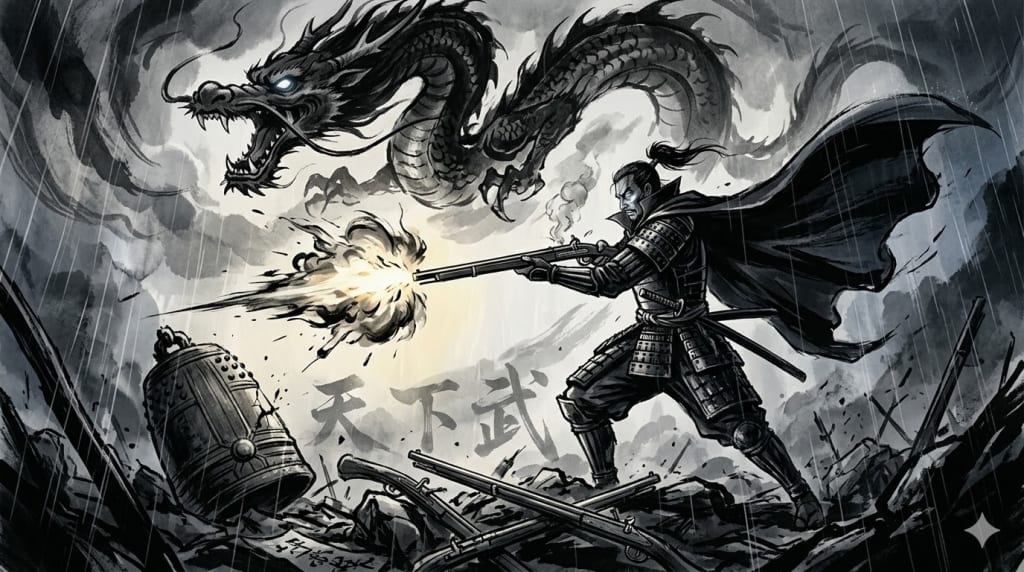
The defining moment of Nobunaga’s legend is the Battle of Nagashino. Before this, the samurai ideal was centered on the individual glory of the horseman—the archer or the swordsman. Nobunaga saw the Tanegashima (matchlock musket) not as a dishonorable weapon, but as a technological equalizer.
He organized three thousand peasants with guns into rotating ranks, creating a continuous wall of lead that decimated the "invincible" Takeda cavalry. This wasn't just a tactical victory; it was a psychological assassination of the old world. Nobunaga proved that a farmer with a week of training could kill a lifelong warrior. He traded "honor" for "efficiency," a shift that mirrors the industrial revolutions that would hit the West centuries later.
3. The Iconoclast: Burning the Sacred to Build the Secular
Nobunaga’s most controversial title, The Sixth Heavenly Demon King (Dairokuten Maoh), was not a nickname given by his enemies—he claimed it for himself. He was a man who dared to burn down the powerful Enryaku-ji temple complex when its warrior monks stood in his way.
To the people of the time, this was spiritual suicide. To Nobunaga, it was necessary surgery. He believed that no institution, not even the divine, should stand above the unity of the state. He promoted a "Free Market" policy (Rakuichi Rakuza), stripping away the monopolies of the guilds and temples. He invited Jesuit missionaries not because he wanted to convert, but because he craved their maps, their globes, and their knowledge of a world beyond the horizon.
4. The Azuchi Dream: A Fortress of Light
Nobunaga didn't build traditional dark, defensive fortresses. He built Azuchi Castle, a seven-story marvel of gold leaf and brilliant colors. It was designed to be a beacon of the new era—a physical manifestation of his "Tenka Fubu" (Uniting the Realm under Military Rule).
In the quiet rooms of Azuchi, he practiced the tea ceremony with the master Sen no Rikyu, using the ritual not for peace, but as a high-stakes diplomatic tool. He understood that a rare tea bowl could be more powerful than a province. He was a man of radical aesthetic, preferring the bold and the new over the weathered and the old.
5. Conclusion: The Unfinished Symphony of Honno-ji
Nobunaga’s life ended in the flames of Honno-ji temple, betrayed by his own general, Akechi Mitsuhide. He died as he lived—violently, amidst the collapse of an old structure.
He never saw the unified Japan he built, but the foundation he laid allowed his successors, Hideyoshi and Ieyasu, to bring 250 years of peace. Oda Nobunaga remains Japan’s ultimate "disruptor." He reminds us that true change is often terrifying, and that to build a new world, one must be brave enough to be called a demon by the old one.
As we look back at the smoke of Nagashino, we see a man who was centuries ahead of his time. He didn't just unify a country; he forced it to wake up.
About the Creator
Takashi Nagaya
I want everyone to know about Japanese culture, history, food, anime, manga, etc.
Keep reading
More stories from Takashi Nagaya and writers in History and other communities.
Musashi Miyamoto: The Samurai Who Fought His Last Duel in His Mind
1. The Undefeated Monster and the Zero Point Ask anyone around the world to name a famous Japanese samurai, and the first name to surface will almost certainly be Miyamoto Musashi. We know the core myth: the undefeated duelist who won sixty-one life-and-death encounters, the eccentric giant who carved his own wooden sword to defeat his greatest rival, Sasaki Kojiro.
By Takashi Nagaya7 days ago in History
Carried by the Wind: The Forgotten Story of Japan’s Fire Balloons.
In the final years of World War II, as the conflict stretched across oceans and continents, a strange and almost unbelievable weapon drifted silently across the Pacific. It had no engine. No pilot and no guidance system. Only wind.
By The Iron Lighthouseabout 14 hours ago in History
Napoleon's Frozen Army
Napoleon Bonaparte invaded Russia in June 1812 with the largest army Europe had ever assembled, over 600,000 soldiers from across his empire, and six months later fewer than 100,000 staggered back across the border as broken remnants of the greatest military force in history, destroyed not primarily by Russian armies but by the Russian winter, starvation, disease, and the deliberate strategy of scorched earth that left the invaders with nothing to eat in a landscape stripped bare by the retreating Russians who burned their own cities and farms rather than allow Napoleon to use them.
By The Curious Writera day ago in History


Comments
There are no comments for this story
Be the first to respond and start the conversation.