
Carried by the Wind: The Forgotten Story of Japan’s Fire Balloons.
An Iron Lighthouse Edition

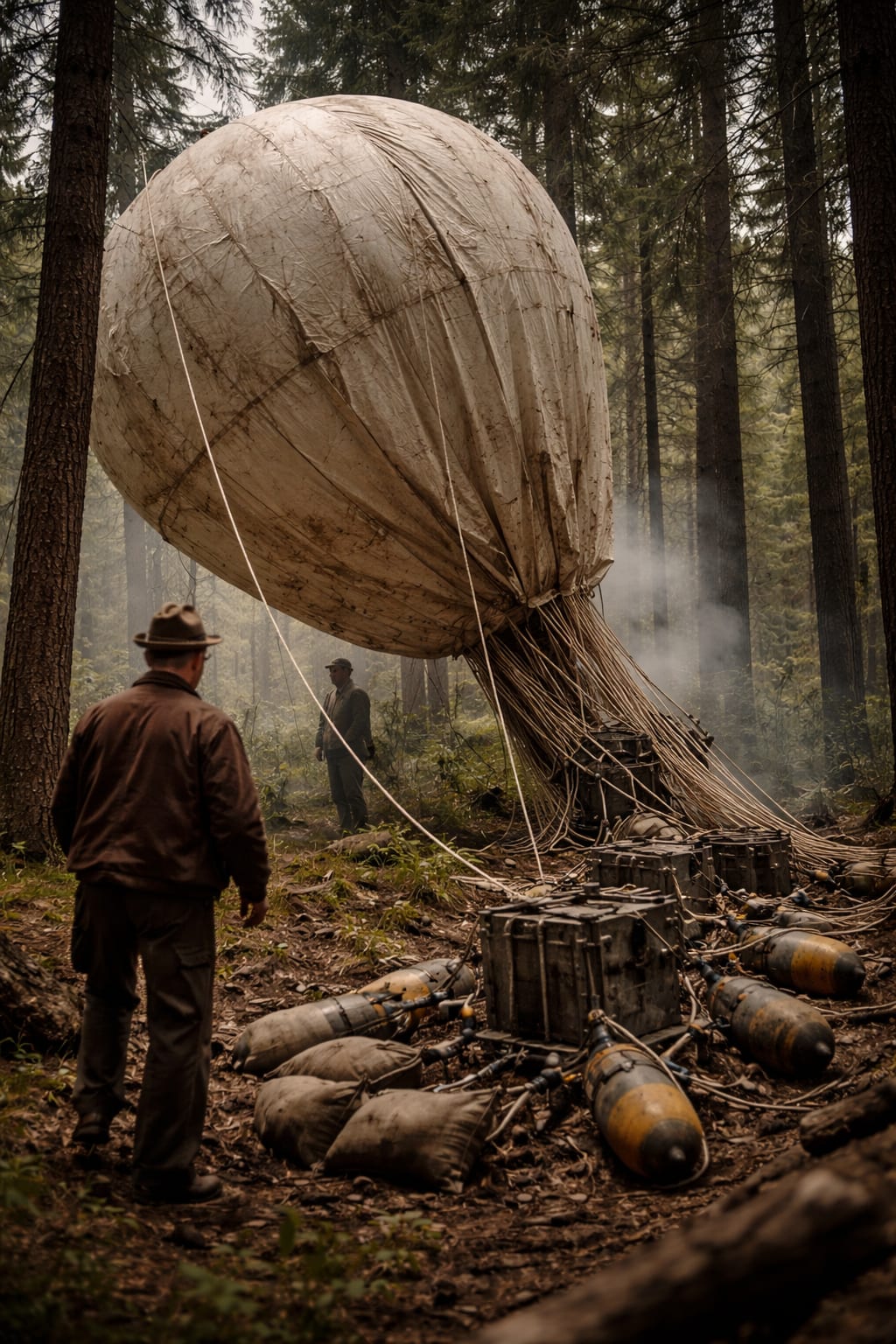
In the final years of World War II, as the conflict stretched across oceans and continents, a strange and almost unbelievable weapon drifted silently across the Pacific. It had no engine. No pilot and no guidance system. Only wind.
High above the ocean, carried by powerful air currents invisible to the human eye, thousands of balloon bombs were released from Japan with a single goal:
To reach the United States mainland. It was a plan as desperate as it was ingenious. And for a time, it worked.
A Weapon Born of Desperation
By 1944, Japan’s position in the war had become increasingly precarious. Traditional military strategies were faltering. Resources were dwindling. Allied forces were advancing. In response, Japanese engineers turned to something seriously unconventional... The jet stream.
Discovered only a few decades earlier, the jet stream is a high-altitude current of fast-moving air that travels eastward across the Pacific Ocean. Scientists realized that if an object could reach that current, it might travel thousands of miles, without fuel. The idea was simple. Launch balloon bombs into the jet stream and let Mother Nature do the rest.
The Fu-Go Balloons
The program became known as Fu-Go, a code name for these long-range balloon bombs. Each balloon was a marvel of improvised engineering. They were constructed using:
- handmade paper (often from mulberry trees)
- glued together by hand
- filled with hydrogen gas
- equipped with a system of sandbags and altimeters
The design was seriously industrious and quite clever. As the balloon rose too high, valves released gas to lower its altitude. If it dropped too low, sandbags would be released to lighten it and allow it to rise again. This crude but effective system allowed the balloons to ride the jet stream for days... Sometimes weeks.
Attached beneath each balloon were bombs, either high explosives or incendiary devices designed to start forest fires. Between late 1944 and early 1945, Japan launched an estimated 9,000 of these balloons into the sky.
Ghosts Over America
Most of the balloons never actually reached their target. Some fell directly into the ocean, as one might expect. But others failed mid-flight. And yet hundreds, perhaps more, made it across. They began appearing in unexpected places across the United States and Canada:
- drifting down into forests
- landing in remote fields
- snagging in power lines
- discovered by farmers, hikers, and loggers
To those who encountered them, they must have seemed almost unreal. A large, pale balloon, often partially deflated, tangled in trees or lying quietly in the brush. Attached to it, something far more dangerous.
But the strangest part? Most Americans have never heard about them. They came in obscurity and left the same way. Only a small footnote in the history books.
The Silence
The U.S. government deliberately suppressed news of the balloon bombs. Officials feared that widespread reporting would most assuredly cause panic. As well as encourage curiosity (leading people to approach the devices) and, perhaps most importantly, signal to Japan that the balloons were working
So newspapers were asked not to publish stories about them. And largely, they complied. As a result, the balloon bombs became an invisible threat... present but rarely acknowledged. People who found them often had no idea what they were.
The Tragedy in Oregon
On May 5, 1945, in a quiet stretch of forest near Bly, Oregon, a group of Sunday school children and their pastor’s wife set out for a picnic. It was a peaceful day, much like any other. The war, though still ongoing, felt distant in rural Oregon. As the group moved through the woods, some of the children discovered something unusual. A strange object. A balloon-like device was tangled among the trees.
Curious, they approached it. Moments later, it exploded! Six people were killed... Five children and the woman who had accompanied them. They became the only fatalities in the continental United States caused by enemy action during World War II.
A Weapon That Vanished
Soon after, the war came to an end. The balloon program was discontinued. The remaining balloons, if any, were still in the air, drifted aimlessly until they fell.
The story, already suppressed during the war, faded even further from public memory. For decades, it remained a mystery for the most part. A strange idea or a forgotten threat, not worth mentioning.
The Quiet Echoes
Even today, remnants of Fu-Go balloons are occasionally discovered in remote areas. Weathered pieces of paper. Fragments of metal. Silent evidence of a weapon that once crossed an ocean without a sound. The idea itself feels almost surreal.
Weapons carried not by machines or soldiers, but by wind. An invisible current linking two continents in a way no one had ever imagined before.
Why This Story Still Matters
The story of the fire balloons is not just about war; it’s about ingenuity and desperation. And the unpredictable ways in which human invention intersects with nature. But more than anything, it’s about that quiet moment in the Oregon woods.
A reminder that even distant conflicts can reach places that seem untouchable. That history doesn’t always arrive loudly. Sometimes, it drifts in silently from the sky.
There is something haunting about the idea of those balloons. Thousands of them, rising into the cold air over Japan. Catching the jet stream. Crossing an ocean. Drifting over mountains, forests, and towns. Seen by almost no one. Remembered by even fewer. They carried explosives. But they also carried something else. A story. One that waited, quietly, for decades… Until someone stopped, looked up, and remembered.
About the Creator
The Iron Lighthouse
Where folklore meets freeway. A guide to the strange heart of the American backroads...
Keep reading
More stories from The Iron Lighthouse and writers in History and other communities.
Emperor of Nothing, King of Everything: The Strange Reign of Norton I
In the fall of 1859, in a city still finding its footing at the edge of a restless continent, a man walked into the offices of the San Francisco Bulletin and made a declaration that, by all conventional standards, should have been dismissed outright. He declared himself: “Norton I, Emperor of the United States.” He would later add, with equal authority: “Protector of Mexico.”
By The Iron Lighthouse7 days ago in History
The Demon King Who Saw the Future: Oda Nobunaga’s War Against Tradition
1. The Fool of Owari and the Birth of a Disruptor In the mid-16th century, Japan was a fractured mosaic of bleeding borders. Into this chaos stepped a man the world initially dismissed as the "Fool of Owari." Oda Nobunaga was loud, eccentric, and showed a blatant disregard for the rigid etiquette of the Samurai class.
By Takashi Nagaya4 days ago in History
5 Unsung Heroes Who Quietly Changed the World
History often celebrates giants, the Einsteins, the Churchills, the Rosa Parks of the world. But behind the scenes, countless unsung heroes quietly shaped the course of human events. These are the people whose names may not appear in textbooks, yet their contributions may have literally saved your life. Let’s honor five extraordinary individuals you probably haven’t heard of, but who changed the world in profound ways.
By Areeba Umair6 days ago in History
Watching The End Of The World From The Diner
Introduction I am not sure how to approach this. Guy Peellaert was an amazing artist who created iconic fantasy images of famous people, usually musicians or politicians, as well as creating commissioned album covers such as "It's Only Rock'n'Roll" by The Rolling Stones and David Bowie's "Diamond Dogs" which you can read more about below.
By Mike Singleton 💜 Mikeydred 3 days ago in Art



Comments
There are no comments for this story
Be the first to respond and start the conversation.