
From Humble Clay Rooms to a Global Icon
The Evolution of the Prophet’s Mosque

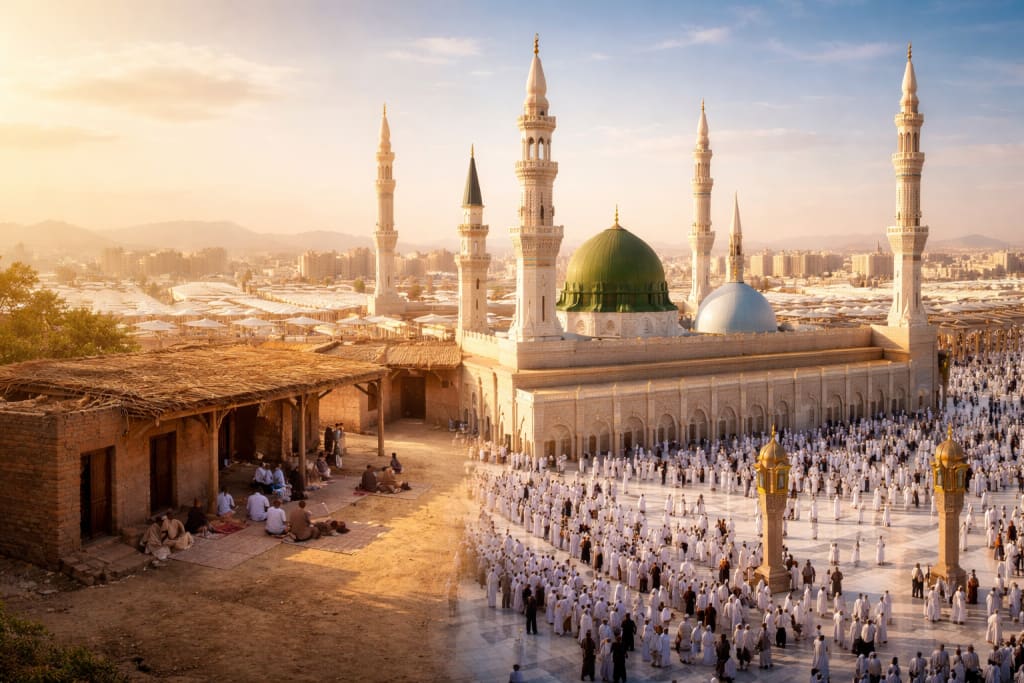
The story of Al-Masjid an-Nabawi, also known as the Prophet’s Mosque, is one of spiritual significance, architectural transformation, and deep historical roots. Located in the holy city of Medina, it stands today as the second holiest site in Islam, after the Grand Mosque in Mecca. Yet its beginnings were remarkably simple—built with humility, faith, and a strong sense of community.
The mosque was originally constructed in 622 CE by Prophet Muhammad shortly after his migration (Hijrah) from Mecca to Medina. At that time, it was not the vast and magnificent structure we see today, but rather a modest open space with walls made of mud bricks and a roof of palm trunks and leaves. Adjacent to the mosque were small clay rooms, which served as living quarters for the Prophet and his family.
This early mosque was not only a place of worship but also the center of social, political, and educational life for the growing Muslim community. It was here that the Prophet taught his companions, settled disputes, and organized the affairs of the state. The simplicity of the mosque reflected the humility and equality emphasized in Islamic teachings—there were no barriers of class or status within its walls.
As Islam spread beyond Arabia, the importance of the mosque grew, and successive Islamic leaders took steps to expand and enhance it. The first major expansion occurred during the rule of Caliph Umar ibn al-Khattab, followed by further developments under Caliph Uthman ibn Affan. These expansions increased the size of the mosque while maintaining its original spirit.
Over the centuries, various Islamic dynasties, including the Umayyads, Abbasids, and Ottomans, contributed to the mosque’s development. One of the most notable features added during these periods was the iconic green dome, which now marks the resting place of the Prophet Muhammad. This dome has become a globally recognized symbol of Islamic heritage and devotion.
The most dramatic transformations, however, took place in the modern era under the Kingdom of Saudi Arabia. Beginning in the 20th century, a series of large-scale expansions turned the mosque into one of the largest religious structures in the world. Today, it can accommodate over a million worshippers during peak times such as Hajj and Ramadan.
Modern engineering and architecture have been seamlessly integrated with traditional Islamic design. The المسجد now features retractable umbrellas in its courtyard to provide shade, advanced cooling systems to manage the desert heat, and intricate marble and calligraphy work that reflects centuries of artistic tradition. Despite its immense size and modern facilities, the mosque continues to preserve its spiritual essence.
One of the most sacred areas within the mosque is Riyad al-Jannah, often referred to as a “garden from the gardens of Paradise.” It is believed to be a place where prayers are especially blessed, and pilgrims from around the world strive to offer prayers there. Nearby lies the Rawdah, which includes the tomb of Prophet Muhammad, making it a site of deep emotional and spiritual significance.
The transformation of Al-Masjid an-Nabawi from a simple structure of clay and palm leaves into a grand architectural marvel is a testament to the enduring legacy of Islam and the devotion of millions of believers. Yet, beyond its physical beauty and size, the mosque remains a symbol of unity, humility, and faith.
For Muslims worldwide, visiting this sacred place is a lifelong dream. It is not just about witnessing its grandeur but about connecting with the history and message of Islam. The mosque stands as a reminder that even the humblest beginnings, when rooted in sincerity and faith, can lead to greatness that touches the hearts of millions.
In essence, the journey of the Prophet’s Mosque reflects not only the growth of a structure but also the expansion of a faith that continues to inspire and guide people across the globe.
About the Creator
Irshad Abbasi
Ali ibn Abi Talib (RA) said 📚
“Knowledge is better than wealth, because knowledge protects you, while you have to protect wealth.
Keep reading
More stories from Irshad Abbasi and writers in History and other communities.
The Library of the “Jinn-Written Quran” Myth, Mystery, and Manuscripts
Title: Subtitle: ⸻ Article (≈700 words): Across the Islamic world, stories of hidden libraries, ancient manuscripts, and mysterious scribes have long captured the imagination of scholars and ordinary people alike. Among the most fascinating of these legends is that of a library said to house a Qur’an written not by human hands, but by jinn—supernatural beings mentioned in Islamic tradition. While such claims blend faith, folklore, and curiosity, they reveal much about humanity’s deep reverence for sacred texts and the unknown.
By Irshad Abbasi 7 days ago in History
Donald Trump: The Return of a Political Giant
Donald Trump is one of the most influential and controversial figures in modern politics. His journey from a businessman to the President of the United States is not only unique but also inspiring for many people. Even after leaving office, he continues to play an important role in political discussions and public life.
By aadam khan5 days ago in History
The Demon King Who Saw the Future: Oda Nobunaga’s War Against Tradition
1. The Fool of Owari and the Birth of a Disruptor In the mid-16th century, Japan was a fractured mosaic of bleeding borders. Into this chaos stepped a man the world initially dismissed as the "Fool of Owari." Oda Nobunaga was loud, eccentric, and showed a blatant disregard for the rigid etiquette of the Samurai class.
By Takashi Nagaya3 days ago in History
Parting is such sweet and salty sorrow...
Dear Wife— At first, I hesitated to go forward with this resolution. But after your recent late-night binges scarfing down bags of chicharrónes—those pork rinds you dip in butter and the god-awful crunch they make, I knew I could no longer reach you.
By Lamar Wiggins7 days ago in Fiction



Comments
There are no comments for this story
Be the first to respond and start the conversation.