
Agricultural Robots Market Grows as Farms Face a Labor Crisis They Cannot Ignore
How automation, falling sensor costs, and smarter software are turning robotics into everyday farm equipment

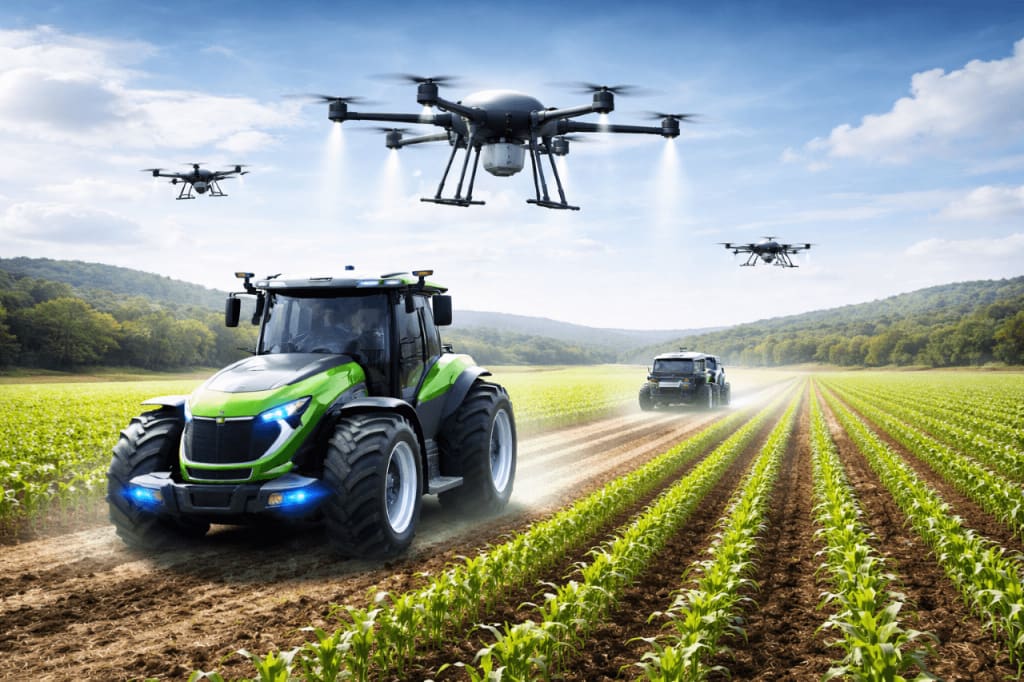
Farming has always been labor-intensive. For most of human history, that was simply an accepted reality. Planting, weeding, harvesting, and tending livestock required human presence at scale, and entire rural economies were organized around that requirement.
That reality is now under serious pressure from multiple directions at once.
Labor costs are rising across every major agricultural market. Seasonal workers are harder to find and harder to retain. The work itself is physically demanding, often poorly compensated, and increasingly difficult to staff reliably. At exactly the same moment, the technology capable of replacing much of that labor has become genuinely affordable.
According to Mordor Intelligence, the global agricultural robots market is projected to expand from USD 15.2 billion in 2025 to USD 18.0 billion in 2026, reaching USD 41.3 billion by 2031 at a 18.07% CAGR. That growth rate is not the result of an optimistic projection. It reflects a market where the problem being solved is urgent, the technology is ready, and the economics are finally working in favor of adoption.
What Is Making Agricultural Robots Affordable Now
The question that held agricultural robotics back for years was not whether the technology could work. It was whether farmers could afford it.
That barrier has been collapsing steadily. LiDAR systems, the sensing technology that allows robots to navigate and understand their physical environment, have dropped below USD 1,000 per unit. Machine vision cameras capable of identifying individual plants, detecting disease, and distinguishing weeds from crops are now available at price points accessible to mid-tier farming operations. The cost reduction in these core components has been dramatic and has cascaded through the economics of the entire category.
The robotics-as-a-service model has addressed the remaining affordability gap. Rather than requiring farmers to purchase expensive equipment outright, subscription-based models allow farms to access autonomous equipment for a recurring fee tied to usage or acreage. This shifts agricultural robotics from a capital expenditure requiring significant upfront investment to an operational cost that can be evaluated against the labor costs it displaces. For mid-tier farms that could not previously justify the capital commitment, this model change has been transformative.
Where Robots Are Working on Farms Right Now
Agricultural robots are not a future concept. They are operating commercially across multiple farming contexts today.
Row-crop operations use autonomous vehicles for precision planting, fertilizer application, and mechanical weeding that reduces herbicide use while maintaining yield. The ability to work at night and in adverse conditions that human workers avoid gives these machines genuine operational advantages beyond simple cost comparison.
Specialty crop farming, including fruits, vegetables, and nuts, has been a particularly active area of development. Harvesting delicate produce like strawberries, apples, and lettuce requires dexterous manipulation that was considered extremely difficult to automate until recently. Advances in robotic gripping and machine vision have made selective harvesting robots commercially viable in several of these categories.
Dairy operations have adopted robotic milking systems at significant scale, with automated milking stations allowing cows to be milked on their own schedule while generating continuous data on individual animal health and productivity. This is one of the most mature segments of agricultural robotics and one of the clearest demonstrations of how automation changes farm economics over time.
Weeding robots represent one of the highest-growth application areas, driven partly by regulatory pressure on chemical herbicide use and partly by genuine effectiveness. A robot that can identify and mechanically remove weeds at the individual plant level makes targeted chemical application possible in ways that broadcast spraying cannot, reducing input costs and satisfying increasingly demanding environmental compliance requirements.
Government Support Is Accelerating Adoption
Agricultural robots have attracted meaningful government support across major markets, and the reasoning behind that support goes beyond general enthusiasm for technology.
The European Commission's eco-scheme programs under its Common Agricultural Policy create financial incentives for farming practices that demonstrably reduce chemical inputs. Agricultural robots that generate audit-ready data documenting reduced herbicide and pesticide use qualify for these incentives in ways that traditional farming equipment cannot. The robot becomes not just a labor replacement but a compliance and documentation tool that unlocks additional revenue streams for farmers.
In the United States, precision agriculture grants have directed funding toward technologies that improve resource efficiency and reduce environmental impact. The ability of robotic systems to apply inputs with precision at the individual plant level rather than across entire fields addresses both the economic and environmental objectives these programs are designed to support.
This regulatory tailwind is particularly significant because it favors the more sophisticated robotic systems capable of generating detailed field data over simpler automated equipment. It is steering the market toward higher-value technology rather than simply subsidizing the adoption of the cheapest available automation.
Software Is Becoming as Important as Hardware
One of the more significant structural shifts in the agricultural robots market is the growing importance of software and data relative to the physical machines themselves.
Fleet management platforms that coordinate multiple robotic units across a farm operation are emerging as genuinely valuable tools. A robot that maps field conditions, tracks plant health across a growing season, records input applications at the individual plant level, and integrates that data with weather, soil, and market information becomes something considerably more valuable than an automated machine. It becomes a continuous source of agronomic insight that improves decision-making across the entire farm operation.
This shift toward software value is significant for the competitive dynamics of the market. Hardware can be replicated and commoditized as component costs fall. Software platforms that accumulate proprietary agronomic data and develop machine learning models trained on farm-specific conditions are considerably harder to replicate and create genuine switching costs for the farms that build their operations around them.
Frequently Asked Questions
What is the agricultural robots market size in 2025? The global agricultural robots market was valued at USD 15.2 billion in 2025, according to Mordor Intelligence.
How fast is the agricultural robots market growing? The market is projected to grow at a 18.07% CAGR between 2026 and 2031, reaching USD 41.3 billion by 2031.
What types of robots are used in agriculture? Agricultural robots include autonomous tractors and sprayers for row crops, selective harvesting robots for specialty crops, robotic milking systems for dairy, and precision weeding robots that reduce herbicide use across multiple farming contexts.
Why are agricultural robots becoming more affordable? Falling costs of LiDAR sensors and machine vision cameras, combined with robotics-as-a-service subscription models, have made autonomous farm equipment accessible to mid-tier operations that could not previously justify the capital investment.
Which governments are supporting agricultural robot adoption? The European Commission, through eco-scheme programs, and the United States, through precision agriculture grants, are among the most active in supporting adoption, particularly favoring robots that generate audit-ready data on reduced chemical input use.
My Closing Thought
Agriculture is one of the oldest human activities and one of the last major industries to experience the full force of automation. The reasons for that delay were real. The work happens outdoors in unpredictable conditions, involves enormous biological variability, and requires judgment that is genuinely difficult to encode in software.
Those barriers have not disappeared entirely. But they have become manageable in ways they were not even five years ago.
With the market projected to reach USD 41.3 billion by 2031, agricultural robotics is moving from the demonstration phase into something that looks like standard farm infrastructure. The farms that adopt early will build data and operational advantages that compound over time. The ones that wait will find the gap harder to close.
That dynamic tends to accelerate adoption faster than the technology alone ever could.
About the Creator
Harvey Specter
I am passionate about Food & Beverage, Ag, & Animal Nutrition companies. I help organizations unlock their data's potential and fuel business growth. My expertise transforms raw data into actionable insights for strategic decisions.
Keep reading
More stories from Harvey Specter and writers in Journal and other communities.
Cookies Market Stays Strong as Health Trends Reshape Snacking
Few foods are as universally understood as a cookie. It requires almost no explanation across cultures, age groups, or income levels. It is one of the most consistently purchased items in grocery stores worldwide.
By Harvey Specter11 days ago in Journal
Author’s Advice
If you would’ve asked me 20 years ago did I know I’d become a writer and an author, I would’ve said “nope, ain’t happening”. As fate would have it I did become an author and I can honestly say I’m loving it so far. It really does feel good to be a writer. I’ve learned a lot on this journey and I feel like with even me being as new to this world as I am, there’s some wisdom I need to share with every other aspiring author.
By Joe Patterson19 days ago in Journal
Incredibooks: The Masked Duet Series
So my best friend who loves the crazy world of reverse harem books put me on to this author named Reese Rivers and a two part book series she put together called the “Masked Duet”. The series is made up of two stories titled “Dance Butterfly Dance” and “Burn Butterfly Burn”.
By Joe Patterson7 days ago in BookClub




Comments
There are no comments for this story
Be the first to respond and start the conversation.