
The Story of World War I: Key Dates and Historic Insights
This quick read is a timeline of World War I—also known as the First World War and the Great War—which unfolded between 1914 and 1918.
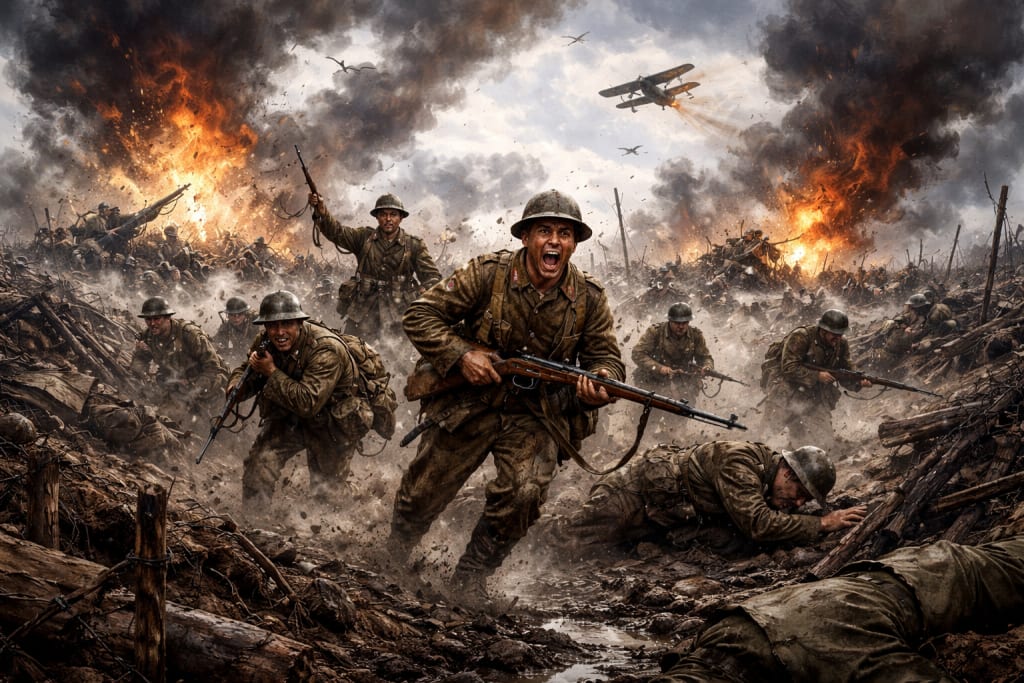
This quick read is a timeline of World War I—also known as the First World War and the Great War—which unfolded between 1914 and 1918. You will learn about essential dates, influential people, and key moments surrounding “the global conflict” that manifested between two coalitions: the Allied Powers and the Central Powers.
- On July 28, 1914, World War I officially began “after the assassination of Archduke Franz Ferdinand of Austria. His murder catapulted into a war across Europe that lasted until 1918. During the four-year conflict, Germany, Austria-Hungary, Bulgaria, and the Ottoman Empire (the Central Powers) fought against Great Britain, France, Russia, Italy, Romania, Canada, Japan, and the United States (the Allied Powers).”
- On July 31, 1914, U.S. Treasury Secretary William Gibbs McAdoo closed the New York Stock Exchange until December 12 to prevent the sale of British-held American securities.
- On August 4, 1914, German troops invaded “neutral Belgium,” and the entire British Commonwealth declared war on Germany for this “violation of Belgian neutrality.” The United States, however, declared neutrality at this point.
- On May 7, 1915, the German submarine U-20 “torpedoed and sank the Lusitania, a swift-moving British cruise liner traveling from New York to Liverpool, England. Of the 1,959 men, women, and children on board, 1,195 perished, including 123 Americans.”
- On June 9, 1915, U.S. Secretary of State William Jennings Bryan resigned because he did not agree with how President Wilson handled the Lusitania crisis. The sinking of the Lusitania “significantly contributed to growing anti-German sentiment in America, ultimately leading to the United States' entry into World War I in 1917.”
- On February 21, 1916, the Battle of Verdun began in France. According to Britannica.com, over the next 10 months, the French and German armies suffered over 700,000 casualties, including 300,000 deaths. By the battle’s conclusion, entire French villages had been wiped from the map. “More than a century after the battle’s conclusion, over 10 million shells remained in the soil around Verdun, and bomb-clearing units continued to remove some 40 tons of unexploded munitions from the area annually.”
- On April 30, 1916, Germany launched daylight saving time as a wartime measure to save fuel.
- On May 17, 1916, Great Britain introduced daylight saving time as a wartime measure “to conserve energy by taking advantage of increased daylight.”
- On May 31, 1916, the British and German fleets met 60 miles off the coast of Jutland, Denmark, “in the war’s only major encounter between the world’s two largest sea powers.”
- On July 1, 1916, the First Battle of the Somme began in France. According to Britannica.com, the British offensive was intended to draw German attention from Verdun. July 1 marked the bloodiest day in the history of the British Army, with nearly 20,000 soldiers killed in action. By the time the Somme campaign came to an end some four and a half months later, the combined casualties of both sides topped 1,000,000.
- On July 22, 1916, a bomb exploded on Market Street in San Francisco during a Preparedness Day parade, killing 10 and injuring 40. (The Preparedness Movement “argued that the United States needed to build up its military strength to defend its interests and potentially deter conflict” and also “advocated American entry into World War I.”)
- On July 30, 1916, German agents “set off a series of explosions at a munitions depot in Jersey City, New Jersey. The Black Tom explosion was an act of sabotage during World War I to prevent the U.S. from supplying munitions to the Allies in Europe.
- In 1917, canned foods were a primary food source for many Americans because many homes did not have refrigeration. They were also vital to the American diet during World War I because of chronic shortages of fresh fruits, vegetables, meat, and bread. Popular canned foods at the time included baked beans, chicken, condensed milk, corn, green beans, peas, soups, tomatoes, and tuna.
- On January 11, 1917, German saboteurs set off an explosion at a munitions factory in Lyndhurst, New Jersey, that manufactured weaponry for the Allies in Europe. A fire quickly spread through the plant and destroyed around 500,000 pieces of ammunition. This was just one in a series of events leading to U.S. involvement in World War I.
- On February 3, 1917, the United States broke diplomatic ties with Germany.
- On April 6, 1917, Congress “passed a resolution declaring war on Germany,” which President Wilson promptly signed into law.
- On May 18, 1917, Congress passed the Selective Service Act, granting President Wilson the authority to implement a military draft as the United States entered World War I.
- On June 5, 1917, military conscription (aka, the draft) officially began in the U.S.
- On November 17, 1917, the United States Navy destroyers USS Fanning and USS Nicholson “engaged and captured” a German U-boat off the southwest coast of Ireland. It was “the first time a U.S. warship had taken down a submarine in combat, with the U-boat subsequently being scuttled by its crew.”
- On December 6, 1917, the U.S. Navy destroyer USS Jacob Jones was “torpedoed and sunk” by the German submarine U-53.
- On January 8, 1918, President Wilson outlined his Fourteen Points—a set of principles “designed as guidelines for the rebuilding of the postwar world.”
- On March 3, 1918, Russia and Germany signed the Treaty of Brest-Litovsk, removing Russia from World War I.
- By April 1918, the Spanish Flu reached the Western Front, “a 400-plus mile stretch of land weaving through France and Belgium from the Swiss border to the North Sea.”
- On May 28, 1918, American troops captured the town of Cantigny in northern France, thus depriving the Germans of “an important observation point.”
- Between July 18 and August 6, 1918: The Aisne-Marne Offensive marked “a major turning point in the fighting on the Western Front” and “significantly shifted the momentum of the war in favor of the Allies.”
- On September 26, 1918, the Meuse-Argonne Offensive was the largest in U.S. history and played a major role in bringing about an end to World War I.
- Between October 24 and November 3, 1918: The Battle of Vittorio Veneto saw “a decisive Italian victory against the Austro-Hungarian forces, effectively ending the war on the Italian Front and significantly contributing to the final collapse of the Austro-Hungarian Empire.”
- On November 11, 1918, Germany signed the armistice with the Allies, thus ending World War I on the Western Front.
- On December 4, 1918, U.S. President Woodrow Wilson set sail for the Paris Peace Conference, “becoming the first U.S. president to travel to Europe while in office.”
- During the 1918 World Series, the Star-Spangled Banner was played for the first time.
- In 1918 as well, Irving Berlin wrote the song God Bless America while serving in the U.S. Army at Camp Upton in New York.
References:
- https://www.foodreference.com/html/html/food-timeline-1911.html
- https://www.foodreference.com/html/html/food-timeline-1916.html
- https://en.wikipedia.org/wiki/World_War_I
- https://www.history.com/articles/world-war-i-history
- https://www.iwm.org.uk/history/5-things-you-need-to-know-about-the-first-world-war
Disclaimer: In writing and editing this article, Gregory DeVictor has made every effort to ensure historical accuracy and not to mislead his audience. In addition, the contents of this article, including text, graphics, and captions, are for general informational purposes only.
© 2026 Grgory DeVictor
About the Creator
Gregory DeVictor
Gregory DeVictor is a trivia buff who writes articles about American history and nostalgia. He focuses on historic firsts, pop culture snapshots, and sports milestones and has written over 250 articles that are categorized by calendar year.
Keep reading
More stories from Gregory DeVictor and writers in History and other communities.
The Years 1900 to 1910 Unveiled: Fascinating Facts, Trivia, and Historic Events
This quick read is a collection of fun facts, trivia, and historic events from the years 1900 to 1910. Discover the decade’s top news stories, most influential people, sports facts, landmark inventions, retail prices, famous birthdays, and much more.
By Gregory DeVictor14 days ago in History
How Isis Conquered the Ancient World
In the ancient world, few deities achieved the level of devotion and international influence as Isis, the great goddess of ancient Egypt. Originally worshipped along the fertile banks of the Nile, Isis evolved from a local deity into a global spiritual figure whose influence stretched across continents—from Egypt to Greece, Rome, and even as far as Roman Britain.
By Irshad Abbasi 4 days ago in History
The Prophet's (PBUH) Hajj: A Detailed Account
The Prophet's (PBUH) Hajj: A Detailed Account The Prophet (PBUH) performed Umrah four times and Hajj once. A complete and meticulous account of his Hajj has reached us through his companions, with every minor detail captured in the following Hadith.
By Amir Husen2 days ago in History


Comments
There are no comments for this story
Be the first to respond and start the conversation.