
The Prophet's (PBUH) Hajj: A Detailed Account
The Prophet (PBUH)


The Prophet's (PBUH) Hajj: A Detailed Account
The Prophet (PBUH) performed Umrah four times and Hajj once. A complete and meticulous account of his Hajj has reached us through his companions, with every minor detail captured in the following Hadith.
Ja'far ibn Muhammad reported from his father: We went to visit Jabir ibn Abdullah (RA). He asked everyone who they were until it was my turn. I said, "I am Muhammad ibn Ali ibn Husayn." He reached out, placed his hand on my head, and unbuttoned my upper button, then the lower one. He then rested his hand on my chest. I was a young man at the time.
He said, "Welcome, my nephew! Ask whatever you wish to know." I began asking him questions. By that time, he had lost his eyesight due to old age. When the time for prayer arrived, he stood up wrapped in a shawl. The cloth was small, so whenever he placed the ends over his shoulders, they would slip down. Another larger cloak was lying nearby on a rack. He then led us in prayer.
Afterward, I said, "Please tell us about the Prophet's (PBUH) Farewell Hajj." Jabir (RA) held up nine fingers and said, "The Prophet (PBUH) stayed in Medina for nine years without performing Hajj. Then, in the tenth year, a public announcement was made that the Messenger of Allah (PBUH) was going for Hajj. As a result, massive crowds poured into Medina. Everyone wanted to follow him and perform the rituals exactly as he did. We set out with him. When we reached Dhul Hulayfah, Asma bint Umays (RA) gave birth to Muhammad ibn Abu Bakr. She sent a message to the Prophet (PBUH) asking what she should do. He replied, 'Take a bath, bandage your private parts with a piece of cloth, and put on your Ihram clothing.'"
The Prophet (PBUH) prayed two units of prayer in the mosque and then mounted his camel, Al-Qaswa. When his camel stood upright with him at a place called Al-Bayda, I looked ahead and saw a sea of people stretching as far as the eye could see. Some were riding, others walking. It was the exact same on his right, his left, and behind him.
The Prophet (PBUH) was right there among us, receiving the revelation of the Quran. He alone truly understood its meaning, and whatever he did, we simply followed.
He began reciting the Talbiyah, declaring the absolute oneness of Allah: "Labbayk Allahumma labbayk, labbayk la sharika laka labbayk. Innal-hamda wan-ni'mata laka wal-mulk, la sharika lak." (Here I am at Your service, O Allah! Here I am at Your service. Here I am at Your service, You have no partner, here I am. All praise, blessings, and dominion are Yours. You have no partner.)
The people also chanted this exact Talbiyah that is still recited today. The Prophet (PBUH) did not add anything to it, and he continuously repeated it. Jabir (RA) went on: "We set out with the sole intention of performing Hajj; we didn’t even consider Umrah. When we finally reached the Kaaba with him, he touched the Black Stone and then circumambulated the Kaaba seven times—walking swiftly for the first three rounds and at a normal pace for the remaining four. He then went to the Station of Ibrahim (Maqam Ibrahim) and recited, 'Take the Station of Ibrahim as a place of prayer' (Quran 2:125)."
He positioned the Station of Ibrahim between himself and the Kaaba to pray two rak'ahs. (Ja'far noted: My father used to say, 'As far as I know, Jabir narrated this directly from the Prophet.') In these two rak'ahs, he recited Surah Al-Ikhlas and Surah Al-Kafirun.
He then went back to the Black Stone and kissed it. After that, he exited through the gate leading to Mount Safa. Approaching Safa, he recited, "Indeed, Safa and Marwa are among the symbols of Allah" (Quran 2:158), adding, "I begin with what Allah began with." He started at Mount Safa, climbing high enough to clearly see the Kaaba. Facing the Qibla, he declared the greatness and oneness of Allah, saying: "La ilaha illallah wahdahu la sharika lah, lahul-mulku wa lahul-hamdu wa huwa ala kulli shayin qadir. La ilaha illallah wahdahu, anjaza wa'dahu, wa nasara 'abdahu wa hazamal ahzaba wahdah." (There is no deity worthy of worship except Allah alone, without any partner. To Him belongs the dominion, and to Him belongs all praise, and He has power over all things. There is no true god but Allah alone. He fulfilled His promise, helped His servant, and defeated the allied factions alone.)
He repeated this supplication three times. He then descended and walked toward Mount Marwa. When his feet hit the bottom of the valley, he jogged until he crossed it. Then, he walked the rest of the way up Mount Marwa. He did exactly the same on Marwa as he had done on Safa. When he reached Marwa for the final lap of the Sa'i, he addressed the people: "If I had known earlier what I know now, I would not have brought sacrificial animals with me, and I would have made this an Umrah. So, whoever among you hasn't brought a sacrificial animal should take off their Ihram and change their intention to Umrah." Hearing this, Suraqah ibn Malik stood up and asked, "O Messenger of Allah, is this rule just for this year, or forever?" The Prophet (PBUH) intertwined his fingers, said twice, "Umrah has been incorporated into Hajj," and then replied, "No, forever and ever."
Meanwhile, Ali (RA) arrived from Yemen with sacrificial animals for the Prophet (PBUH). He noticed that Fatimah (RA) was among those who had removed their Ihram. She was wearing dyed clothes and had applied kohl to her eyes. Ali highly disapproved of this. Fatimah responded, "My father ordered me to do this."
The narrator noted that Ali used to live in Iraq. Ali said: "I was so upset by what Fatimah did that I went straight to the Messenger of Allah (PBUH) to ask about it, mentioning how much I disliked her action." The Prophet (PBUH) told him, "Fatimah told the truth; she told the truth. But what did you say when you assumed Ihram?" Ali replied, "I said, O Allah, I am assuming Ihram with the exact same intention as Your Messenger." The Prophet (PBUH) said, "Since I brought a sacrificial animal with me, you should keep your Ihram on."
Jabir (RA) said that the total number of sacrificial animals Ali brought from Yemen, combined with those the Prophet (PBUH) brought, was exactly one hundred. Thus, everyone took off their Ihram and cut their hair, except for the Prophet (PBUH) and those who had brought animals with them. When the Day of Tarwiyah (the 8th of Dhul-Hijjah) arrived, the people re-entered the state of Ihram and headed toward Mina. The Prophet (PBUH) rode there and led the Dhuhr, Asr, Maghrib, Isha, and Fajr prayers. He waited until the sun rose, then ordered a tent to be set up for him in Namirah, and continued his journey.
The Quraysh were absolutely certain that he would stop at Mash'ar al-Haram, just as they used to do during the pre-Islamic days of ignorance. But the Prophet (PBUH) rode past it until he reached Arafat. Seeing his tent pitched in Namirah, he dismounted there. When the sun passed its peak, he ordered his camel, Al-Qaswa, to be saddled. He rode down into the valley and delivered his sermon to the people. He declared: "Your blood and your property are as sacred to you as this day of yours, in this month of yours, in this city of yours. Listen closely! Everything from the days of ignorance is trampled under my feet. The blood revenges of the days of ignorance are abolished. The first blood revenge I abolish is that of the son of Rabi'ah ibn Al-Harith from our own family, who was nursing among the Banu Sa'd when the Hudhayl tribe killed him. The usury (interest) of the days of ignorance is also abolished. The first usury I wipe out is ours—the usury of Abbas ibn Abd al-Muttalib. All of it is entirely forgiven. Fear Allah regarding women. You have taken them as a trust from Allah, and intimacy with them was made lawful for you by the word of Allah. Your right over them is that they do not allow anyone you dislike into your home. If they do, you may discipline them lightly. Their right over you is that you provide their food and clothing with kindness and fairness. I am leaving behind something that, if you hold on to it tightly, you will never go astray: the Book of Allah. When you are asked about me on the Day of Judgment, what will you say?" The people replied, "We will testify that you have delivered the message, fulfilled your duty, and given sincere counsel." Pointing his index finger toward the sky and then gesturing toward the crowd, he said three times: "O Allah, be my witness!"
The caller to prayer then made the Adhan, followed by the Iqamah, and the Prophet (PBUH) led the Dhuhr prayer. Another Iqamah was called, and he led the Asr prayer. He did not perform any voluntary prayers between them.
He mounted his camel and rode to the place of standing (Mawqif). He turned the belly of his camel toward the rocks, faced the crowd, and looked toward the Qibla. He remained standing there until sunset. The yellow glow of the sun faded away, and the solar disk completely vanished. He placed Usamah (RA) behind him on his mount and pulled Al-Qaswa's reins so tightly that her head touched the saddle. Gesturing with his right hand, he told the crowd: "O people, gently, gently." Whenever he came to a sand dune, he would loosen the reins slightly so the camel could easily climb.
He traveled like this until he reached Muzdalifah. There, he prayed Maghrib and Isha with one Adhan and two Iqamahs, without offering any voluntary prayers in between. He laid down to sleep until dawn. When morning came, he prayed Fajr with an Adhan and Iqamah. He mounted Al-Qaswa and went to Mash'ar al-Haram. Facing the Qibla, he prayed to Allah, magnified Him, and declared His oneness. He stayed there standing until the morning light grew very bright. He then left just before the sun rose, with Al-Fadl ibn Abbas (RA) riding behind him. Al-Fadl was a handsome young man with beautiful hair.
As the Prophet (PBUH) rode, a group of women passed by, and Al-Fadl started looking at them. The Prophet (PBUH) reached back and placed his hand over Al-Fadl's face. Al-Fadl turned his face the other way to keep looking. The Prophet (PBUH) moved his hand to the other side to block his view again. They kept riding until they reached the valley of Muhassir, where he picked up the pace a bit. He followed the middle path leading to the largest Jamarah. He stopped at the Jamarah near the tree and threw seven pebbles from the lower ground, saying "Allahu Akbar" with each throw. From there, he went to the slaughtering area and sacrificed sixty-three animals with his own hands. He shared the sacrifice with Ali (RA). He then ordered a small piece of meat from each animal to be cooked in a pot. Once it was ready, they both ate the meat and drank the broth.
Afterward, the Prophet (PBUH) rode back toward the Kaaba. He arrived in Mecca and prayed Dhuhr. He then walked over to the family of Abd al-Muttalib, who were busy drawing Zamzam water for the pilgrims. He told them, "Draw water, O children of Abd al-Muttalib! If I wasn't worried that people would overpower you to do it themselves, I would have drawn the water with you." They handed him a bucket, and he drank from it. (Sahih Muslim, Hadith 1218).
Ultimately, the Muslim Ummah must perform Hajj exactly as the Prophet (PBUH) did. Otherwise, it will not be accepted. May Allah grant us the ability to perform all acts of worship, including Hajj, in the correct and authentic manner. Ameen!
About the Creator
Amir Husen
7+ years in SEO and writing. I’m Amir Husen , and I turn complicated stuff into stories people actually want to read. No bots, no filler just accurate, human-led content that ranks. Keeping it real, one word at a time.
Keep reading
More stories from Amir Husen and writers in History and other communities.
The Prophet’s Hospitality and Honoring of Guests
The Prophet’s Hospitality and Honoring of Guests The Prophet (PBUH) and his companions often endured long stretches of hunger. Only when the pain of starvation became entirely unbearable would they mention it to others. Yet, whatever little food they had at home was always happily offered up to entertain and honor their guests. They never turned a guest away or treated them with anything less than deep respect. The following Hadith beautifully illustrates the Prophet’s (PBUH) remarkable hospitality.
By Amir Husena day ago in History
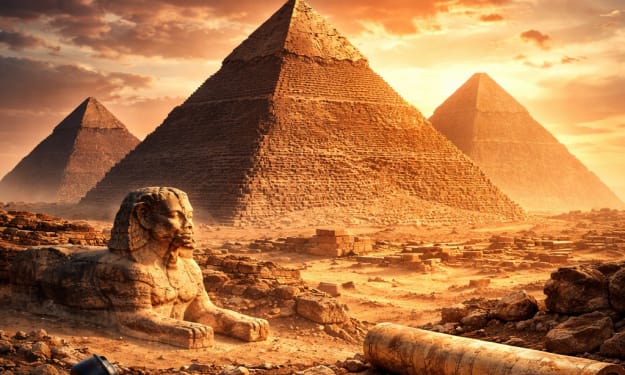
Making Sense of the Pyramids’ Enduring Mysteries
Few structures in human history inspire as much awe and curiosity as the pyramids of ancient Egypt. Towering above the desert sands for thousands of years, these monumental creations—especially the Great Pyramid of Giza—have become symbols of both human ingenuity and enduring mystery. Despite centuries of study, many aspects of their construction, purpose, and meaning continue to spark debate among historians, archaeologists, and enthusiasts alike.
By Irshad Abbasi 5 days ago in History


Comments (1)
Hope you get a top story with this 🙏🦋🦋🦋🦋