
The Mystery Woman Behind Beethoven’s Secret Love Affair
Unraveling the identity of the “Immortal Beloved” who captured the heart of Ludwig van Beethoven

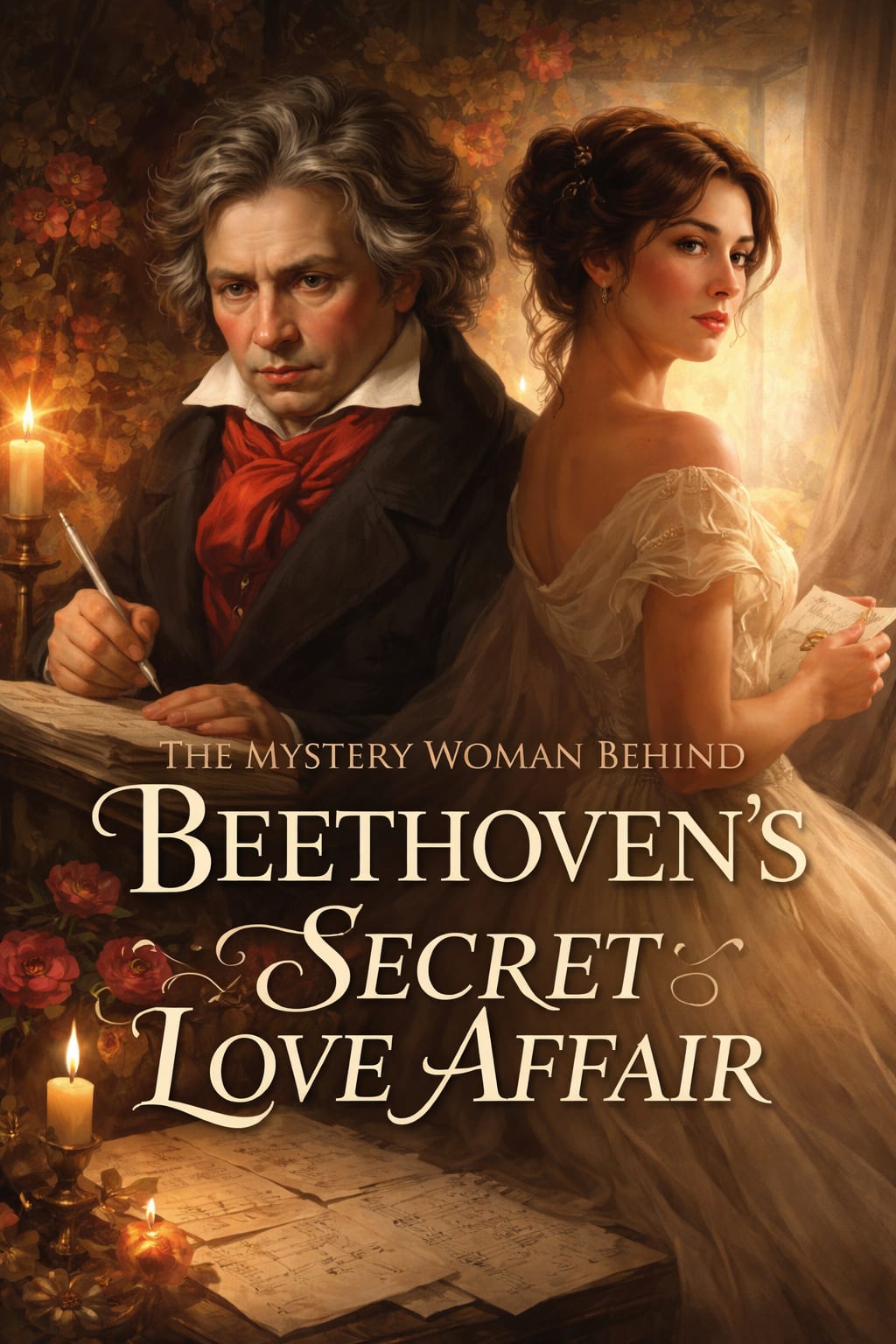
In the summer of 1812, one of history’s greatest composers poured his heart into a series of passionate letters addressed to a woman he called his “Immortal Beloved.” These letters, discovered after the death of Ludwig van Beethoven, revealed a deeply emotional and intimate side of a man often remembered for his genius, intensity, and solitude. Yet, despite centuries of research, the identity of this mysterious woman remains one of the most captivating enigmas in classical music history.
Beethoven never married, and his personal life was often marked by loneliness and longing. He struggled with worsening deafness, financial instability, and complicated relationships. However, the “Immortal Beloved” letters show a different side of him—one filled with tenderness, vulnerability, and profound love. Written over two days in July 1812, the letters express a powerful emotional bond, suggesting that this woman was not just a fleeting romance but someone deeply significant in his life.
The letters themselves were never sent, or at least no evidence of their delivery has ever been found. They were discovered among Beethoven’s personal papers after his death in 1827. Addressed simply as “My Angel, my All, my very Self,” the writings are filled with longing and frustration, hinting at obstacles that kept the lovers apart. Beethoven speaks of fate, distance, and the difficulty of maintaining their relationship, suggesting that social conventions or personal circumstances made their union nearly impossible.
Over the years, historians and scholars have proposed several candidates for the identity of the “Immortal Beloved.” Among the most prominent is Antonie Brentano, a married woman from a wealthy Frankfurt family. Many researchers believe she fits the timeline and circumstances described in the letters. She was known to have been close to Beethoven and was in Prague and the spa town of Teplitz around the same time the letters were written.
Another strong candidate is Josephine Brunsvik, a Hungarian countess with whom Beethoven had a long and emotionally intense relationship. Their correspondence reveals deep affection, and some scholars argue that she was the only woman Beethoven truly loved. However, her noble status and family pressures may have made marriage to Beethoven—who was not of aristocratic birth—socially unacceptable.
A third possibility is Giulietta Guicciardi, one of Beethoven’s earlier romantic interests and the dedicatee of his famous “Moonlight Sonata.” Though their relationship occurred years before the letters were written, some have speculated that lingering feelings could have inspired his passionate words. However, most experts consider her a less likely candidate due to the timing.
What makes the mystery so enduring is the lack of definitive proof. Beethoven never named the woman directly, and the letters themselves offer only clues rather than clear answers. References to travel, meetings, and emotional struggles have been analyzed in detail, but interpretations vary widely depending on how the evidence is read.
Beyond the question of identity, the “Immortal Beloved” letters provide valuable insight into Beethoven’s emotional world. They reveal a man capable of deep love and longing, contradicting the common image of him as a purely isolated genius. The letters also highlight the challenges of love in early 19th-century Europe, where class, duty, and reputation often dictated personal relationships.
The mystery has inspired countless books, films, and academic debates. Each new theory adds another layer to the story, but none has conclusively solved it. Perhaps that is part of the fascination—the idea that even someone as monumental as Beethoven had secrets that remain hidden.
In the end, the identity of the “Immortal Beloved” may never be fully confirmed. Yet, the power of Beethoven’s words transcends the need for a final answer. His letters stand as a testament to the universal experience of love—its beauty, its pain, and its enduring mystery.
The story of Beethoven’s secret love affair reminds us that behind every great work of art lies a deeply human story. And sometimes, the unanswered questions are what keep that story alive.
About the Creator
Irshad Abbasi
Ali ibn Abi Talib (RA) said 📚
“Knowledge is better than wealth, because knowledge protects you, while you have to protect wealth.
Keep reading
More stories from Irshad Abbasi and writers in History and other communities.
What a 55,000-Year-Old Fetus Reveals About the Decline of Neanderthals
Deep within ancient caves and layers of prehistoric earth, scientists occasionally uncover discoveries that reshape our understanding of human history. One such remarkable find—a 55,000-year-old fetus linked to Neanderthals—has become a silent yet powerful witness to one of the greatest mysteries in evolution: why did Neanderthals disappear while modern humans survived?
By Irshad Abbasi 7 days ago in History
The Boy Soldiers of Shiloh
When the Battle of Shiloh erupted on April 6, 1862, over ten thousand soldiers on both sides were under the age of eighteen, with the youngest confirmed combatant being nine-year-old Johnny Clem who picked up a musket taller than himself and charged Confederate positions, and by the time the two-day battle ended with 23,746 casualties, hundreds of these child soldiers lay dead or dying in the Tennessee mud, calling for their mothers while surgeons too overwhelmed to treat adults stepped over their broken bodies to reach soldiers they deemed more likely to survive.
By The Curious Writera day ago in History
Paul and John's 47-Words Short Story Unofficial Challenge
UPDATE - Republished to update the list of entries, with the 40 we've had so far. Completely smashed last unofficial challenge which recieved 31 entries. And there is still time. If you have yet to enter and fancy winning a bit of money or just challenging yourself or both or just making two old geezers job harder - please enter!
By Paul Stewarta day ago in Writers



Comments
There are no comments for this story
Be the first to respond and start the conversation.