
The Life, Legacy, and Rise of Sikhism’s Ninth Guru
A closer look at how Guru Tegh Bahadur became a spiritual leader and a symbol of religious freedom

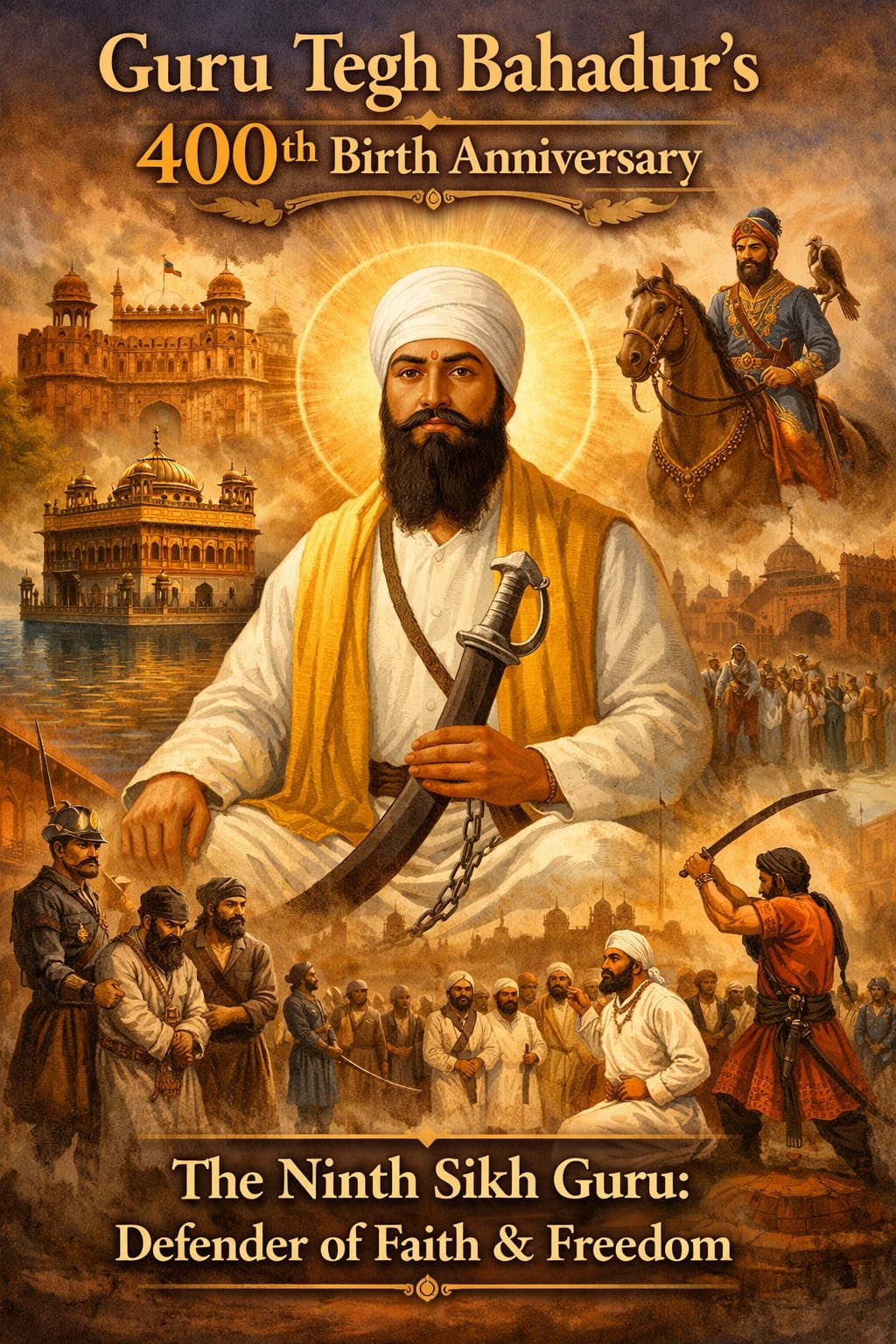
The 400th birth anniversary of Guru Tegh Bahadur is an important milestone for Sikhs and admirers of his legacy worldwide. Known for his courage, spiritual depth, and ultimate sacrifice, Guru Tegh Bahadur stands as a timeless symbol of religious freedom and human rights. His life journey—from a quiet, contemplative individual to the ninth Guru of Sikhism—offers profound lessons about faith, leadership, and moral conviction.
Guru Tegh Bahadur was born in 1621 in Amritsar, Punjab, to Guru Hargobind, the sixth Guru of Sikhism. Originally named Tyag Mal, he earned the name “Tegh Bahadur,” meaning “brave wielder of the sword,” after displaying remarkable valor in battle at a young age. Despite his martial skills, he was deeply inclined toward meditation, spirituality, and a life of reflection.
Following the passing of Guru Hargobind, Sikh leadership continued through successive Gurus, including Guru Har Rai and Guru Har Krishan. Guru Tegh Bahadur spent many years in relative seclusion in Bakala, engaging in prayer and teaching a small group of followers. During this period, Sikhism was evolving as both a spiritual and social force in northern India.
The turning point in his life came after the death of Guru Har Krishan in 1664. Before his passing, the young Guru is believed to have uttered the words “Baba Bakale,” indicating that the next Guru would be found in Bakala. This led to confusion, as several individuals claimed the position. It was a व्यापारी (trader) named Makhan Shah Lubana who played a crucial role in identifying the true Guru. According to tradition, Makhan Shah tested the claimants by offering a small donation, while secretly promising a larger one if his ship—once in danger—was saved. Only Guru Tegh Bahadur revealed knowledge of the promised amount, convincing Makhan Shah that he was the rightful Guru.
Thus, Guru Tegh Bahadur was formally recognized as the ninth Guru of Sikhism. His leadership marked a significant phase in Sikh history. He traveled extensively across regions such as Punjab, Bihar, and Assam, spreading the message of unity, compassion, and devotion to God. His teachings emphasized detachment from materialism, humility, and the importance of standing up for justice.
One of the most defining aspects of Guru Tegh Bahadur’s life was his unwavering commitment to defending religious freedom. During the reign of Aurangzeb, there were increasing reports of forced conversions, particularly affecting Kashmiri Pandits. A delegation of these Hindus approached Guru Tegh Bahadur for help, seeking protection of their right to practice their faith.
In a historic act of courage, Guru Tegh Bahadur chose to confront the Mughal authorities. He declared that if he could be converted to Islam, the others would follow—but if he refused, they should be left alone. This bold stance led to his arrest and eventual execution in 1675 in Delhi. His martyrdom is considered one of the most significant sacrifices in Indian history, as he gave his life not for his own religion alone, but for the principle of religious liberty for all.
Guru Tegh Bahadur’s legacy was carried forward by his son, Guru Gobind Singh, who would later establish the Khalsa and further strengthen the Sikh identity. The teachings and sacrifices of Guru Tegh Bahadur continue to resonate deeply within Sikhism and beyond, reminding the world of the importance of tolerance, justice, and spiritual resilience.
Today, his 400th birth anniversary is commemorated with great reverence through prayers, community service, and educational initiatives. His life story is not just a chapter in Sikh history, but a universal message of courage in the face of oppression and unwavering faith in truth.
In remembering Guru Tegh Bahadur, we are reminded that true leadership lies not in power, but in sacrifice—and that standing up for others, even at the cost of one’s life, is the highest expression of humanity.
About the Creator
Irshad Abbasi
Ali ibn Abi Talib (RA) said 📚
“Knowledge is better than wealth, because knowledge protects you, while you have to protect wealth.
Keep reading
More stories from Irshad Abbasi and writers in History and other communities.
Bahadur Shah Zafar
Bahadur Shah Zafar, the last emperor of the Mughal dynasty, stands as a deeply symbolic figure in the history of the Indian subcontinent. His reign marked not glory, but decline—a fading empire overshadowed by the rising power of the British East India Company. Yet, in 1857, during the great uprising against British rule, Zafar unexpectedly became the reluctant face of resistance. What followed was a heartbreaking chain of events: his capture, the brutal execution of his sons, and the final dismantling of the Mughal legacy.
By Irshad Abbasi 6 days ago in History
Melsonby Hoards Transforms Our Understanding of Iron Age Britain
In North Yorkshire, archaeologists have discovered an incredible collection of metalwork that provides fresh insight into the wealth, power, and transportation of Late Iron Age Britain. With the discovery of the first solid proof of four-wheeled wagons in Britain, the over 950 objects in the Melsonby hoards have completely changed our knowledge of ancient elite society and their relationships to continental Europe.
By Francis Dami7 days ago in History
The Road by Cormac McCarthy:
"If he is not the word of God, God never spoke." It's a line spoken by The Man, unnamed, early on in the 2007 Pulitzer Prize winning novel, "The Road" by Cormac McCarthy. It's this line, elegiac and moving, infused with despair and hope, that informs you, you're not reading something you'll easily forget.
By Adam Diehl4 days ago in Critique



Comments
There are no comments for this story
Be the first to respond and start the conversation.