
The Day the Giant Stopped Moving
Is the United States Losing Its Global Power?

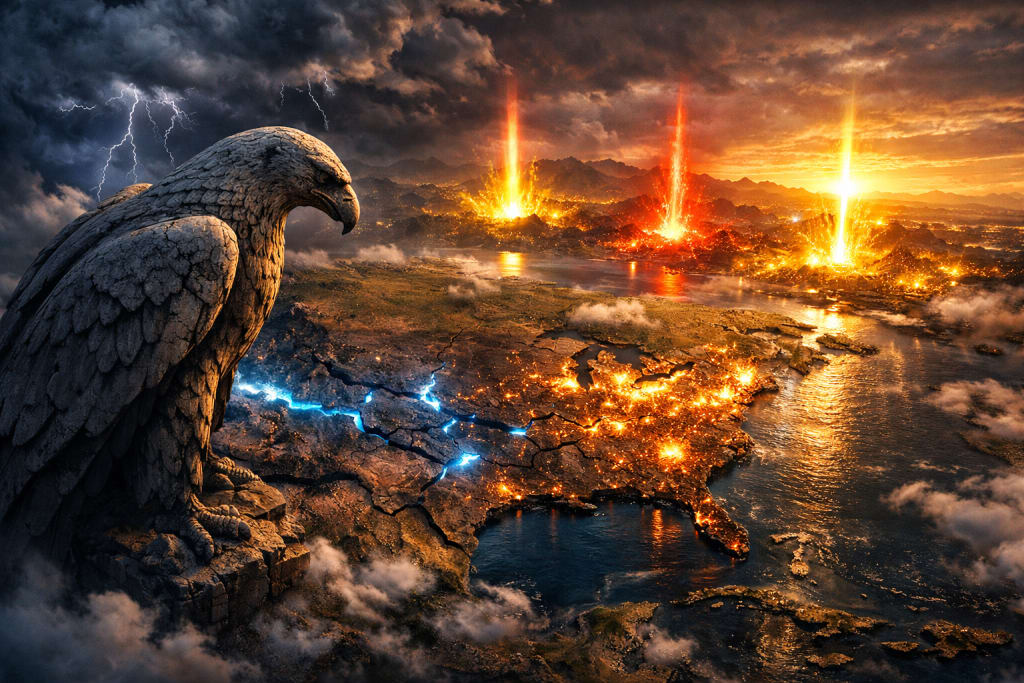
The Day the Giant Stopped Moving
For nearly a century, the United States stood as the world's most dominant power — economically, militarily, and culturally. From shaping global trade to leading wars and alliances, America was not just a country; it was the engine of the modern world. But today, many analysts, policymakers, and observers are beginning to ask a serious question: Is America no longer leading the world the way it once did?
This is not about collapse overnight. Great powers rarely fall suddenly. Instead, decline often comes slowly, quietly, and then all at once.
America today appears to be facing internal fractures, external challenges, and a shifting global balance that could redefine the future of world leadership.
The first sign is internal division. The United States is experiencing one of the most politically polarized periods in its modern history. Political conflict between Democrats and Republicans has reached levels that affect governance, foreign policy, and even national unity. Government shutdown threats, election disputes, and rising distrust in institutions have weakened America's image as a stable global leader.
Economic pressure is another critical factor. While the U.S. remains the world's largest economy, its national debt has surged to historic levels. Inflation, rising interest rates, and economic competition are placing pressure on American dominance. Meanwhile, countries like China are expanding rapidly in manufacturing, technology, and global infrastructure through initiatives like global trade corridors and strategic investments.
China is no longer just an emerging power; it is becoming a rival superpower. From artificial intelligence to military modernization and global trade routes, China is steadily building influence across Asia, Africa, and the Middle East. This shift is gradually creating a multipolar world where America is no longer the single dominant force.
Military power, once America's strongest advantage, is also facing new challenges. The U.S. still has the world's most advanced military, but long wars in Iraq and Afghanistan weakened public support for global interventions. Meanwhile, countries like Russia have demonstrated strategic resilience, and regional powers like Iran are expanding influence through asymmetric strategies and regional alliances.
Technology dominance is also being contested. For decades, Silicon Valley defined global innovation. Today, tech innovation is spreading globally. China, South Korea, India, and European nations are competing in AI, semiconductors, and digital infrastructure. America's technological monopoly is no longer guaranteed.
Another major shift is the decline of American global influence. Many countries are reducing dependence on the U.S. dollar, exploring alternative trade systems, and strengthening regional alliances. Organizations such as BRICS are expanding, bringing together emerging economies that aim to reshape global financial systems.
At the same time, America's allies are becoming more independent. European nations are developing defense autonomy. Middle Eastern countries are balancing relations between Washington, Beijing, and Moscow. This diversification of alliances signals a world that is no longer centered solely around Washington.
However, saying "America is no more" may be premature. The United States still possesses enormous strengths. It has the world's most powerful military, leading universities, strong innovation ecosystems, and unmatched global cultural influence. Hollywood, technology companies, and financial markets still shape global trends.
But the reality is changing. The world is transitioning from a unipolar system — dominated by America — to a multipolar world where several powers share influence. This does not mean America disappears; it means America becomes one of several major players.
History shows that great powers evolve. The British Empire once ruled global trade and oceans, yet its influence gradually declined as new powers emerged. Similarly, America may be entering a new phase — not collapse, but transformation.
The question is no longer whether America will remain dominant forever. The question is whether America can adapt to a new world where power is shared.
The giant may not be dead, but it is no longer walking alone.
The world is changing — and America is changing with it.
About the Creator
Wings of Time
I'm Wings of Time—a storyteller from Swat, Pakistan. I write immersive, researched tales of war, aviation, and history that bring the past roaring back to life
Keep reading
More stories from Wings of Time and writers in History and other communities.
Iran’s Mosaic Doctrine Rising
The Mosaic Doctrine: Is Iran Following Israel’s Strategic Playbook? From Defense to Pre-Emptive Intelligence Power In modern geopolitical warfare, few strategic doctrines have shaped intelligence operations like the Mosaic Doctrine, more widely known as the Begin Doctrine. Originally developed by Israeli leadership, this doctrine focuses on preventing enemies from becoming powerful enough to threaten national security — even if that requires covert operations, sabotage, or pre-emptive strikes.
By Wings of Time 2 days ago in History



Comments
There are no comments for this story
Be the first to respond and start the conversation.