
Remembering the Great Allied Carrier-Based Aircraft of the 1940s
The Carrier Planes That Won World War II
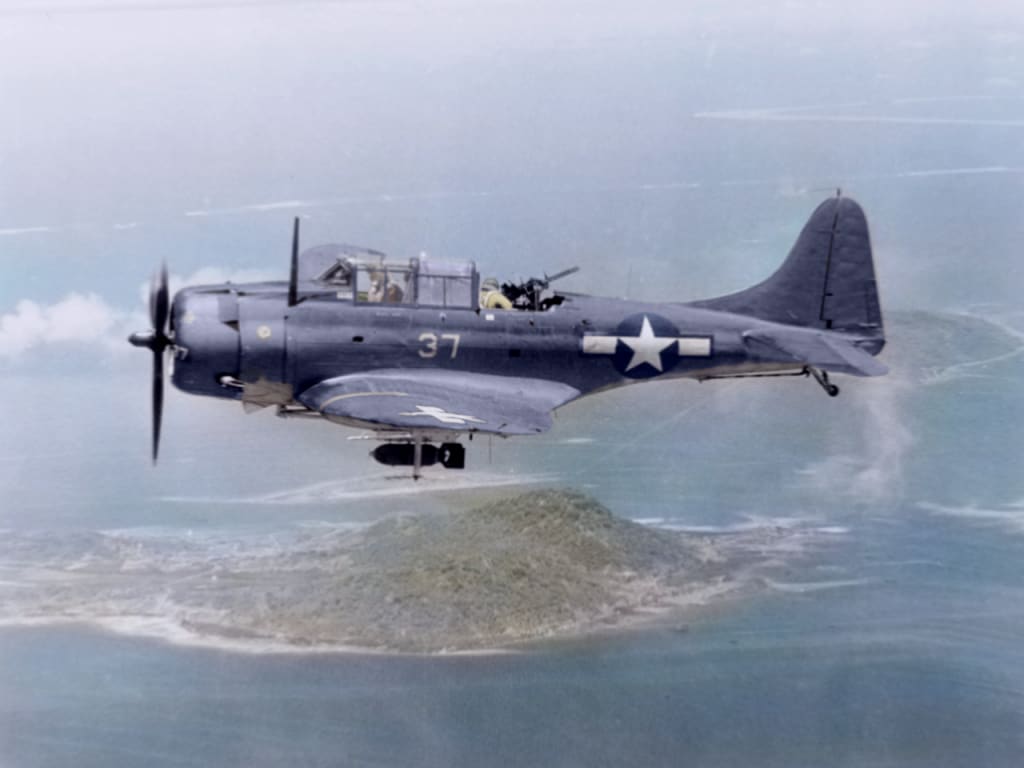
The Allies had the largest fleets of aircraft carriers. Only the Imperial Japanese Navy had a fleet of aircraft carriers to match them, and theirs were gradually wiped out in the Pacific War. Neither the Germans nor the Italians had constructed any, and this certainly gave the Allies an advantage at sea. The Royal Navy and U.S. Navy had a range of carrier-based planes, and there were a few that had some impact.
SBD Dauntless
The SBD Dauntless was a dive-bomber aircraft of the Allied carrier fleets. In the early 1940s the SBD devastated Japanese shipping in the Pacific. Its greatest triumph came at the Battle of Midway when a group of SBD dive-bombers swooped from the skies and bombarded three Japanese aircraft carriers. Their bombs set them ablaze, and by the end of the battle, all four of the Japanese aircraft carriers were lost at sea.
Unlike other carrier-based aircraft, the SBD Dauntless did not have folding wings. This ensured that it had a higher wing support structure. The plane also had a substantial ordinance load and could carry up to 2,250 Ibs of bombs. As such, they wiped out more Japanese shipping than any other Allied aircraft.
F6F
The F6F was a combat plane introduced as a replacement for the antiquated F4F in 1943. Then it flew its first missions, and in every respect was a considerable enhancement on the previous aircraft. With greater speed and range, the F6F could match, and generally eclipse, all the Japanese planes. That included the A6M Zero, which had previously dominated the skies.
This became all the clearer at the Battle of the Philippine Sea in 1944. As the first Allied troops landed in the Marianas, a Japanese carrier fleet was sent to wipe out the U.S. naval presence in the region. When the Japanese fleet intercepted the U.S. carriers they lost hundreds of planes, which had little to no impact. The F6F dominated the battle in which the Japanese navy lost most of its fleet air arm aircraft. Estimates suggest that the F6F took out Japanese planes at a ratio of 19:1.
Swordfish Aircraft
In the Battle of the Mediterranean, the Royal Navy had one trump card, that of aircraft carriers. The Italian navy didn't have any of them, and that would prove costly in the war that followed. In 1940, the Royal Navy was the first to deploy its aircraft carriers at the Battle of Taranto. It was here that the Italians had a sizeable naval base which included six battleships.
The carrier-based aircraft that would be sent to bombard this base were those of Swordfish torpedo-bombers. However, the Italian naval base was one with shallow water. Thus, it was doubtful that torpedo-bombers could have any impact with a standard aerial torpedo at least. But the Royal Navy configured them so that the Swordfish torpedoes would be more effective in shallow water. At the Battle of Taranto, the Swordfish aircraft decimated three Italian battleships in port, winning a decisive victory in the Battle of the Mediterranean.
Elsewhere, the Swordfish also provided crucial air support for the sinking of the German battleship Bismarck after the Battle of the Denmark Strait. Then their torpedoes jammed the Bismarck's rudder. Without an effective rudder, the battleship became a sitting duck for the Royal Navy surface fleet ships, which wiped it out.
Grumman TBF
The Grumman TBF was one of the Allied torpedo-bomber aircraft in the Pacific. It replaced the TBD, which had heavy losses in battles such as Midway. These were reliable and somewhat versatile planes that were also excellent ground support bombers, and with effective radio, could also be suitable for aerial reconnaissance. One TBF pilot said, “It flew like a brick, but we loved her anyway.”
In combat, the TBF was most effective at the Battle of Eastern Solomons in 1942. Here, they wiped out the Japanese aircraft carrier Ryujo. They were also in action at the First Naval Battle of Guadalcanal. In 1945, they were sent to wipe out the 72,809 ton battleship Yamato during the Battle of Okinawa. Their torpedoes had enough impact to ensure the ship flooded with water and went down at sea.
Those were a few of the Allied carrier-based aircraft that had some impact. In the Pacific and the Mediterranean, they won some great victories for the Allies at Midway, Taranto, and the Philippine Sea. These planes wiped out a large number of Japanese, German, and Italian warships.
About the Creator
Melsonby Hoards Transforms Our Understanding of Iron Age Britain
In North Yorkshire, archaeologists have discovered an incredible collection of metalwork that provides fresh insight into the wealth, power, and transportation of Late Iron Age Britain. With the discovery of the first solid proof of four-wheeled wagons in Britain, the over 950 objects in the Melsonby hoards have completely changed our knowledge of ancient elite society and their relationships to continental Europe.
By Francis Dami7 days ago in History
The Road by Cormac McCarthy:
"If he is not the word of God, God never spoke." It's a line spoken by The Man, unnamed, early on in the 2007 Pulitzer Prize winning novel, "The Road" by Cormac McCarthy. It's this line, elegiac and moving, infused with despair and hope, that informs you, you're not reading something you'll easily forget.
By Adam Diehl4 days ago in Critique


Comments
There are no comments for this story
Be the first to respond and start the conversation.