
Power, Politics, and the Last Queen of Egypt
Unraveling the Life and Legacy of Cleopatra VII Beyond Myths and Legends

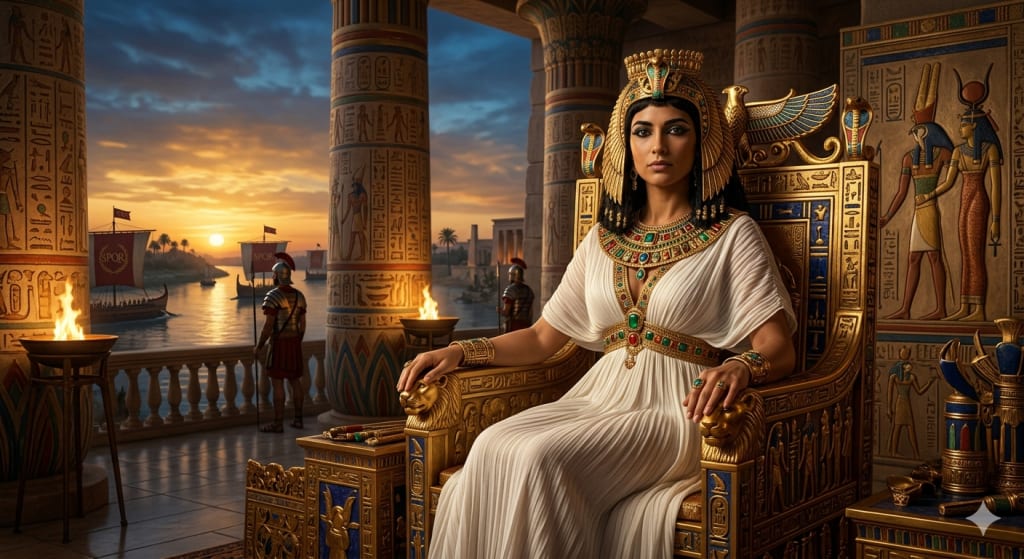
Cleopatra VII Philopator, often simply known as Cleopatra, is one of the most famous women in history. Yet, much of what people think they know about her comes from myths, legends, and dramatic portrayals in films and literature. The real Cleopatra was far more complex than the seductive queen often depicted in popular culture. She was a highly educated, politically astute ruler who fought to preserve the independence of her kingdom at a time when Egypt stood on the brink of becoming a Roman province.
Cleopatra was born in 69 BCE into the Ptolemaic dynasty, a Greek royal family that ruled Egypt after the death of Alexander the Great in 323 BCE. Despite ruling Egypt, the Ptolemies were of Macedonian Greek origin and had little Egyptian heritage. Cleopatra, however, distinguished herself from her predecessors by embracing Egyptian culture. Unlike earlier Ptolemaic rulers, she learned the Egyptian language and presented herself as a traditional Egyptian pharaoh, connecting deeply with her subjects.
Her education was exceptional. Cleopatra was said to be fluent in several languages, including Egyptian, Greek, and possibly others. This linguistic ability allowed her to communicate directly with her diverse subjects and neighboring rulers without interpreters—a rare skill among leaders of her time. Her intelligence and charisma made her a formidable political figure, capable of negotiating and strategizing in a world dominated by powerful Roman leaders.
Cleopatra’s rise to power was marked by conflict. She co-ruled with her younger brother, Ptolemy XIII, but tensions between them escalated into a civil war. After being forced into exile, Cleopatra sought to reclaim her throne. It was during this struggle that she famously aligned herself with Julius Caesar, the Roman general and statesman. This alliance proved crucial. Cleopatra regained her throne with Caesar’s support, and the two became both political and romantic partners. Their relationship produced a son, Caesarion, whom Cleopatra hoped would one day inherit power.
Following Caesar’s assassination in 44 BCE, Cleopatra turned her attention to another powerful Roman figure—Mark Antony. Their alliance, both political and personal, was essential in Cleopatra’s attempt to maintain Egypt’s independence. Together, they formed a powerful Eastern alliance that challenged Rome’s authority. Cleopatra and Antony had three children together and envisioned a future where their combined influence would reshape the Mediterranean world.
However, their ambitions alarmed Rome, particularly Octavian, Caesar’s adopted heir. Octavian launched a propaganda campaign portraying Cleopatra as a dangerous foreign seductress who had corrupted Antony and threatened Rome. This narrative has significantly shaped Cleopatra’s legacy, often overshadowing her political achievements. In reality, Cleopatra was a shrewd strategist who used alliances to strengthen her position and protect her kingdom.
The decisive moment came at the Battle of Actium in 31 BCE, where Octavian’s forces defeated Cleopatra and Antony. Following their defeat, the couple retreated to Egypt. Facing inevitable capture and humiliation, both chose to end their lives. According to tradition, Cleopatra died in 30 BCE, possibly by allowing an asp (a venomous snake) to bite her, though the exact method remains uncertain.
Cleopatra’s death marked the end of the Ptolemaic dynasty and the beginning of Egypt’s transformation into a Roman province. Her son, Caesarion, was soon executed on Octavian’s orders, ensuring that no rival claim to power remained. With this, Egypt lost its independence, and Cleopatra’s dream of a lasting legacy through her children came to an end.
Despite her political failure, Cleopatra’s legacy has endured for over two thousand years. She has been portrayed in countless works of art, literature, and film—often as a symbol of beauty and seduction. However, modern historians emphasize her intelligence, leadership, and political skill. She was not merely a figure of romance but a ruler who navigated one of the most turbulent periods in ancient history.
The real Cleopatra was a queen who understood the importance of diplomacy, culture, and alliances. She leveraged her intellect and strategic thinking to maintain Egypt’s independence in the face of Rome’s expanding power. Her life serves as a reminder that history is often shaped not just by power, but by perception—and that behind every legend lies a more nuanced and human story.
In the end, Cleopatra was not just the “Queen of the Nile” or a tragic lover. She was a stateswoman, a scholar, and one of the most influential figures of the ancient world. Her story continues to captivate us because it blends ambition, intellect, love, and political drama—elements that still resonate in today’s world.
About the Creator
Irshad Abbasi
Ali ibn Abi Talib (RA) said 📚
“Knowledge is better than wealth, because knowledge protects you, while you have to protect wealth.
Keep reading
More stories from Irshad Abbasi and writers in History and other communities.
The Mystery Behind Egypt’s Newly Discovered Royal Tomb
In the arid sands of Egypt, where countless secrets of the ancient world still lie buried, archaeologists have once again made a remarkable discovery: a previously unknown royal tomb. The find has sparked excitement across the global archaeological community, yet it has also raised one pressing question—who does this tomb belong to?
By Irshad Abbasi 3 days ago in History
The Boy Soldiers of Shiloh
When the Battle of Shiloh erupted on April 6, 1862, over ten thousand soldiers on both sides were under the age of eighteen, with the youngest confirmed combatant being nine-year-old Johnny Clem who picked up a musket taller than himself and charged Confederate positions, and by the time the two-day battle ended with 23,746 casualties, hundreds of these child soldiers lay dead or dying in the Tennessee mud, calling for their mothers while surgeons too overwhelmed to treat adults stepped over their broken bodies to reach soldiers they deemed more likely to survive.
By The Curious Writera day ago in History
Paul and John's 47-Words Short Story Unofficial Challenge
UPDATE - Republished to update the list of entries, with the 40 we've had so far. Completely smashed last unofficial challenge which recieved 31 entries. And there is still time. If you have yet to enter and fancy winning a bit of money or just challenging yourself or both or just making two old geezers job harder - please enter!
By Paul Stewartabout 18 hours ago in Writers


Comments
There are no comments for this story
Be the first to respond and start the conversation.