
How Rome’s Desire for Silk Gave Birth to the Silk Roads
From luxury obsession to global trade network, the ancient routes that connected East and West reshaped history forever

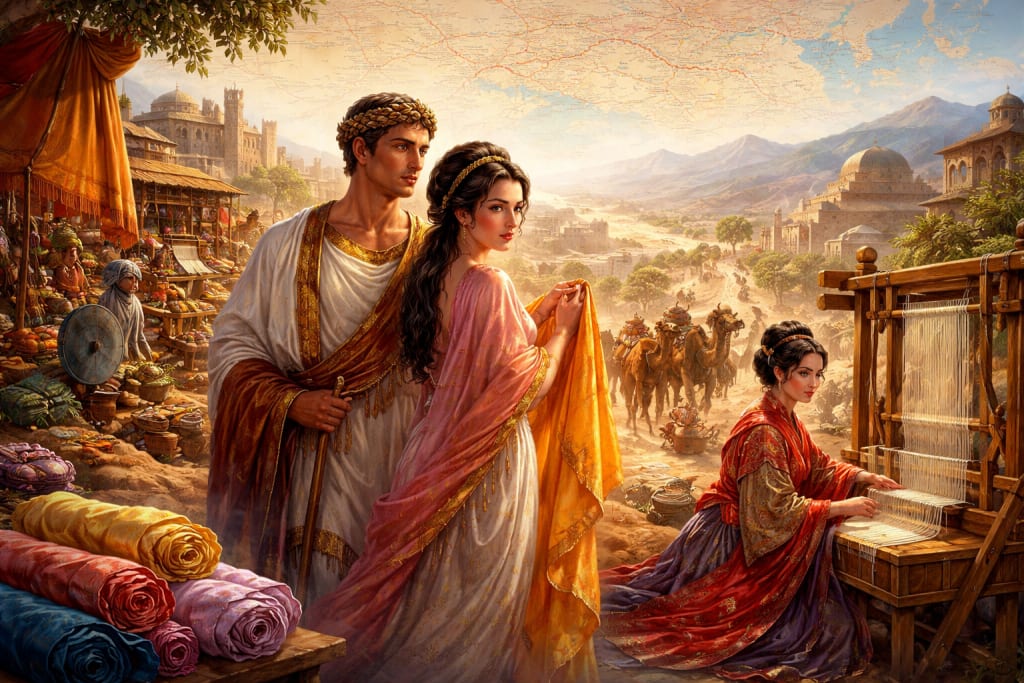
Long before the age of airplanes and container ships, a vast and intricate network of trade routes connected distant civilizations across continents. These routes, later known as the Silk Roads, emerged not from a single grand plan but from a simple and powerful desire: Rome’s hunger for silk and China’s mastery of producing it.
The story begins in ancient China during the Han Dynasty (206 BCE – 220 CE), where silk was more than just a fabric—it was a symbol of status, sophistication, and technological superiority. Chinese artisans had perfected the complex process of sericulture, turning delicate silkworm cocoons into shimmering threads. This knowledge was a closely guarded secret, making silk one of the most valuable commodities in the ancient world.
Far to the west, the Roman Empire was rising to prominence. Romans prided themselves on luxury, and when silk first reached their markets, it caused a sensation. The fabric’s softness, lightness, and almost translucent quality made it unlike anything produced locally. Roman elites, particularly wealthy women, began to demand silk garments, driving its popularity to extraordinary heights.
However, Rome faced a problem—it had no idea where silk came from or how it was made. Early Roman writers speculated that silk grew on trees or was combed from leaves. Despite this lack of knowledge, merchants saw an opportunity. They began to move silk westward through a chain of intermediaries, passing it from one region to another across Central Asia.
This exchange marked the gradual emergence of the Silk Roads—not a single road, but a web of interconnected routes stretching from China through Central Asia, the Middle East, and eventually into Europe. These paths crossed deserts, mountains, and grasslands, linking cities, empires, and cultures in ways never seen before.
Trade along the Silk Roads was complex and often indirect. Chinese merchants rarely traveled all the way to Rome, and Roman traders seldom reached China. Instead, goods changed hands multiple times. Caravans of camels carried silk across the harsh Taklamakan Desert, while traders in cities like Samarkand and Bactria acted as intermediaries, facilitating exchanges between East and West.
Silk was the most famous product, but it was far from the only one. From China came paper, porcelain, and spices. From the West came glassware, precious metals, and wool. Alongside goods traveled ideas, religions, technologies, and even diseases. Buddhism spread from India into China, while artistic styles blended across cultures, leaving lasting marks on architecture and art.
Rome’s obsession with silk became so intense that it raised economic concerns. Roman senators complained that vast amounts of gold were flowing eastward in exchange for luxury goods. Some even attempted to ban silk clothing, arguing that it was morally corrupting and financially draining. Yet, these efforts failed—the demand for silk was simply too strong.
Meanwhile, China benefited greatly from this trade. Silk became not only a commercial product but also a diplomatic tool. Chinese emperors used silk to form alliances, reward loyalty, and assert influence over neighboring regions. The Silk Roads thus became not only economic lifelines but also instruments of political strategy.
Over time, the Silk Roads expanded and evolved. New routes opened, and others declined depending on political stability and environmental conditions. Empires rose and fell, but the network endured for centuries, continuously adapting to changing circumstances.
Perhaps the most remarkable aspect of the Silk Roads is how they transformed the ancient world. Before their emergence, civilizations like Rome and China existed largely in isolation from one another. Through trade, they became indirectly connected, creating one of the earliest forms of globalization.
The Silk Roads also demonstrated the power of human curiosity and desire. A simple fascination with a luxurious fabric set in motion a chain of events that reshaped economies, cultures, and histories across continents. What began as a trade in silk evolved into a vast exchange of knowledge and ideas that would influence the course of civilization.
In the end, Rome never learned the secret of silk production until much later, when it was eventually smuggled out of China. But by then, the Silk Roads had already left their mark. They had turned distant lands into interconnected worlds, proving that even in ancient times, the desire for beauty and luxury could bring civilizations together.
The legacy of the Silk Roads lives on today—not just in history books, but in the very idea of global connection that continues to define our modern world.
About the Creator
Irshad Abbasi
Ali ibn Abi Talib (RA) said 📚
“Knowledge is better than wealth, because knowledge protects you, while you have to protect wealth.
Keep reading
More stories from Irshad Abbasi and writers in History and other communities.
Rediscovering an Ancient Silk Road Town
Nestled amid the shifting sands and rugged mountains of Central Asia, an ancient Silk Road town once stood as a beacon of commerce, culture, and connection. Its name, now barely whispered among scholars and travelers, carries echoes of bustling markets, caravanserais, and the myriad languages of merchants who passed through its gates. For centuries, it was a vital link between East and West, facilitating not only the exchange of goods but also ideas, art, and religion. Yet over time, the town fell into obscurity, its ruins slowly swallowed by the relentless forces of nature and neglect.
By Irshad Abbasi 5 days ago in History
The Boy Soldiers of Shiloh
When the Battle of Shiloh erupted on April 6, 1862, over ten thousand soldiers on both sides were under the age of eighteen, with the youngest confirmed combatant being nine-year-old Johnny Clem who picked up a musket taller than himself and charged Confederate positions, and by the time the two-day battle ended with 23,746 casualties, hundreds of these child soldiers lay dead or dying in the Tennessee mud, calling for their mothers while surgeons too overwhelmed to treat adults stepped over their broken bodies to reach soldiers they deemed more likely to survive.
By The Curious Writerabout 18 hours ago in History



Comments
There are no comments for this story
Be the first to respond and start the conversation.