
Has Amelia Earhart’s Plane Really Been Found? 6 Key Things to Know
New claims and old mysteries continue to surround the disappearance of aviation’s most famous trailblazer.

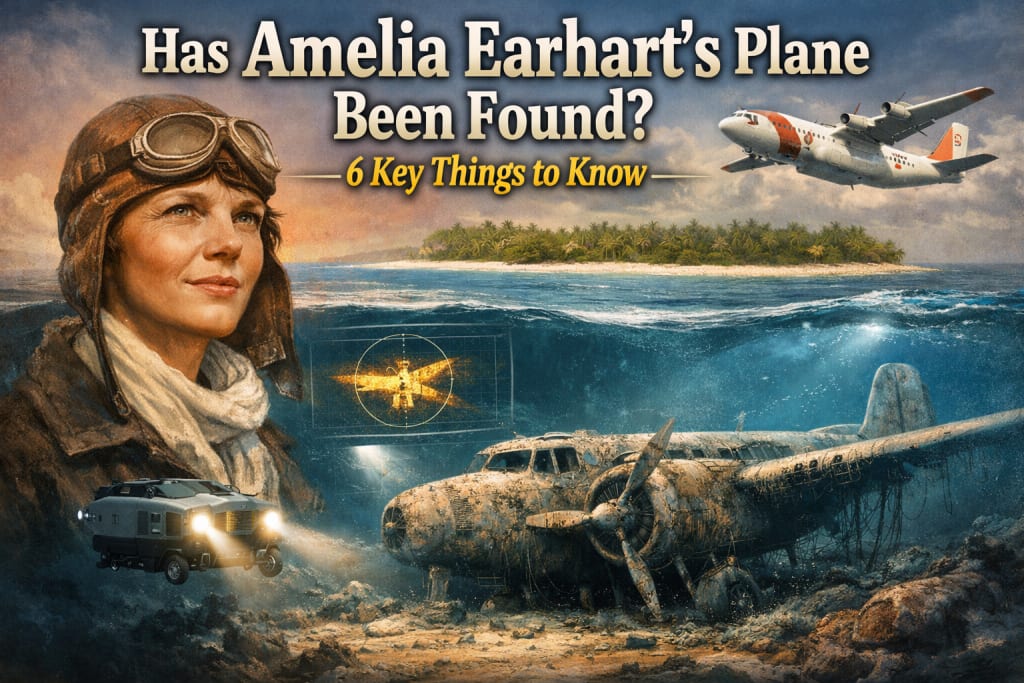
The mystery of Amelia Earhart has fascinated the world for nearly a century. As the first woman to fly solo across the Atlantic Ocean, she became a global icon of courage and ambition. Yet her sudden disappearance in 1937, during an attempt to circumnavigate the globe, remains one of history’s greatest unsolved aviation mysteries. Over the years, countless theories—and occasional “breakthrough” claims—have emerged, including recent headlines suggesting her plane may finally have been found. But how real are these claims?
Here are six key things to know.
⸻
1. The Original Disappearance Remains Unsolved
On July 2, 1937, Earhart and her navigator, Fred Noonan, vanished over the Pacific Ocean while flying a Lockheed Electra. Their intended destination was Howland Island, a tiny, remote speck that proved extremely difficult to locate. Despite a massive search effort led by the U.S. government, no confirmed wreckage was ever found. The lack of definitive evidence left the door open for decades of speculation.
⸻
2. Multiple Theories Compete for Attention
The most widely accepted explanation is that Earhart’s plane ran out of fuel and crashed into the ocean—known as the “crash and sink” theory. However, another popular idea suggests she may have landed on Nikumaroro, an uninhabited island in the Pacific. Expeditions have uncovered artifacts there, such as tools and possible aircraft fragments, but none have conclusively been linked to Earhart.
⸻
3. Recent ‘Discoveries’ Often Make Headlines
Every few years, new expeditions claim to have located her plane. These are usually based on sonar images, underwater anomalies, or newly analyzed satellite data. While some findings appear promising at first glance, they often fail to hold up under closer scientific scrutiny. In many cases, what was thought to be wreckage turns out to be natural rock formations or unrelated debris.
⸻
4. Technology Is Improving the Search
Modern tools such as deep-sea sonar mapping, underwater drones, and AI-assisted image analysis have significantly improved the chances of finding long-lost wreckage. Companies and research teams continue to scan vast areas of the Pacific Ocean that were previously inaccessible. While this raises hope, the search area remains enormous, and the ocean’s depth and conditions make recovery extremely challenging.
⸻
5. No Claim Has Been Officially Confirmed
Despite numerous announcements, no discovery has been universally accepted by the scientific community or confirmed by authoritative institutions. Organizations like The International Group for Historic Aircraft Recovery continue to investigate, but even their most compelling evidence remains circumstantial. Until physical proof—such as identifiable aircraft parts with serial numbers—is recovered, the mystery technically remains unsolved.
⸻
6. Why the Mystery Still Matters
The enduring fascination with Earhart’s disappearance is not just about solving a puzzle—it’s about honoring a pioneering figure in aviation history. Earhart broke barriers for women and inspired generations to pursue exploration and innovation. The possibility of finding her plane represents both a scientific achievement and a symbolic closure to a story that has captivated the world for decades.
⸻
Conclusion
So, has Amelia Earhart’s plane really been found? The short answer is no—not yet. While recent claims and technological advances have brought us closer than ever, none have provided definitive proof. Until verifiable wreckage is discovered and confirmed, the fate of Earhart and her aircraft remains an open question.
For now, the mystery endures—continuing to inspire explorers, historians, and dreamers alike.
About the Creator
Irshad Abbasi
Ali ibn Abi Talib (RA) said 📚
“Knowledge is better than wealth, because knowledge protects you, while you have to protect wealth.
Keep reading
More stories from Irshad Abbasi and writers in History and other communities.
Will We Ever Solve These 5 Ancient Mysteries?
For centuries, ancient mysteries have captured human imagination, blending history, science, and speculation into puzzles that refuse to fade. Despite technological advancements and modern research methods, some questions from the past remain stubbornly unanswered. Will we ever truly solve them, or are they destined to remain part of our collective curiosity?
By Irshad Abbasi about 7 hours ago in History
The Prophet's (PBUH) Hajj: A Detailed Account
The Prophet's (PBUH) Hajj: A Detailed Account The Prophet (PBUH) performed Umrah four times and Hajj once. A complete and meticulous account of his Hajj has reached us through his companions, with every minor detail captured in the following Hadith.
By Amir Husen2 days ago in History
Corinne Griffith (1894-1979)
By Brian D’Ambrosio Corinne Griffith, born November 21, 1894, in Waco, Texas, became one of the most admired figures of the silent film era, celebrated for her elegance, poise, and expressive subtlety on screen. Known as “The Orchid Lady of the Screen,” Griffith cultivated an image of refinement and emotional restraint that set her apart from her contemporaries. Beneath the Hollywood persona lay a Texas childhood shaped by her Italian ancestry and the civic prominence of her maternal family, whose accomplishments left a lasting impression on her sense of artistry, ambition, and cultural awareness.
By Brian D'Ambrosio 4 days ago in History


Comments
There are no comments for this story
Be the first to respond and start the conversation.