
Ancient Circular Ditches Discovered Near Stonehenge Shed New Light on Prehistoric Britain
Archaeologists uncover mysterious ring-shaped trenches near Stonehenge, offering fresh clues about ancient ceremonial landscapes

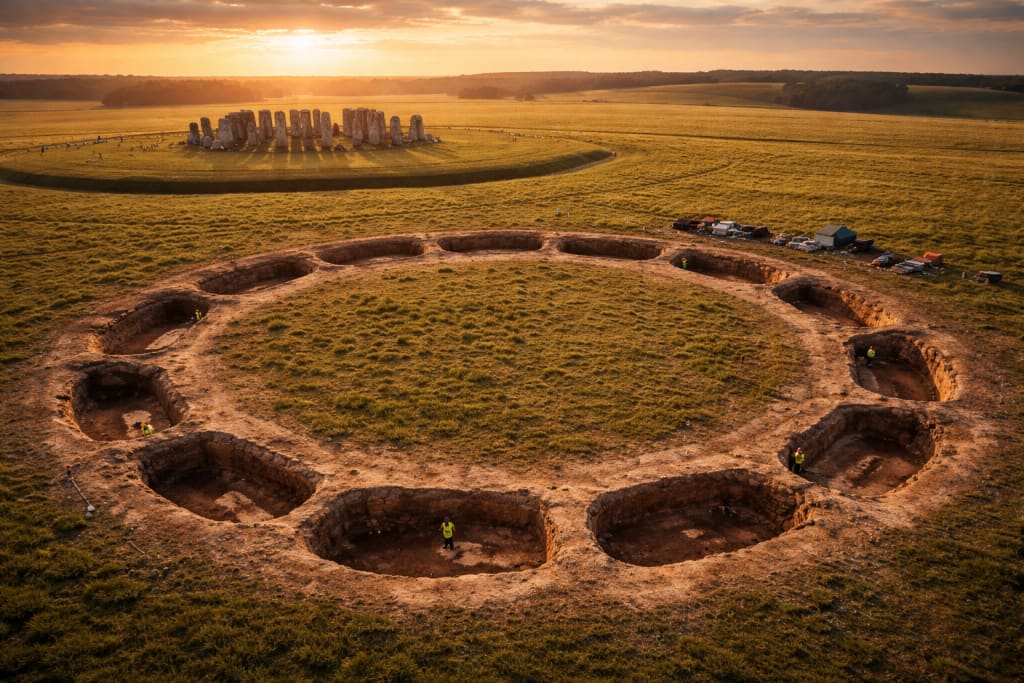
Archaeologists in the United Kingdom have uncovered a remarkable series of ancient circular ditches near the world-famous Stonehenge monument, a discovery that is already reshaping our understanding of prehistoric Britain. These newly identified features, arranged in a near-perfect circular pattern, are believed to date back thousands of years and could represent an important ceremonial or ritual site linked to the broader Stonehenge landscape.
The discovery was made using advanced remote sensing technology, including ground-penetrating radar and magnetometry, which allow researchers to visualize structures buried beneath the soil without disturbing them. What initially appeared as faint anomalies in the data soon revealed themselves to be a carefully constructed ring of trenches, suggesting deliberate human design rather than natural formations.
Experts believe these ditches may have been part of a much larger and more complex network of monuments and pathways that once surrounded Stonehenge. While Stonehenge itself has long been recognized as a focal point of ancient ritual activity, this new find indicates that the surrounding area may have been equally significant, functioning as a vast ceremonial landscape rather than a single isolated monument.
According to archaeologists involved in the project, the circular arrangement of the trenches is particularly intriguing. Circular designs were commonly used in prehistoric Britain and are often associated with ritual or symbolic meanings, such as representing cycles of life, death, or the cosmos. The scale and precision of the newly discovered ditches suggest they were constructed with careful planning and likely held considerable importance for the communities that built them.
Preliminary analysis indicates that the ditches may date back to the Neolithic or early Bronze Age, roughly between 3000 and 2000 BCE—the same period during which Stonehenge was constructed and modified. This raises the possibility that the site was part of the same cultural and ceremonial tradition, potentially used for gatherings, processions, or other communal activities.
One leading theory is that the ditches marked boundaries or pathways for ritual movement. Participants in ceremonies may have walked along or within these circular features as part of religious observances, possibly linked to seasonal events such as solstices. Stonehenge itself is famously aligned with the movements of the sun, and researchers are now investigating whether the newly discovered ditches share similar astronomical connections.
Another possibility is that the trenches served as a form of symbolic enclosure, separating sacred space from the outside world. In many ancient cultures, circular enclosures were used to define areas of spiritual significance, where only certain individuals or groups were permitted to enter. If this interpretation is correct, the site could have played a key role in the ritual practices of prehistoric communities.
The discovery also highlights the growing importance of non-invasive archaeological techniques. In the past, uncovering such features would have required extensive excavation, potentially damaging fragile remains. Today, technologies like remote sensing allow researchers to map entire landscapes while preserving them for future study. This approach not only protects heritage sites but also enables archaeologists to identify patterns and connections that might otherwise go unnoticed.
Local authorities and heritage organizations are now working to ensure the protection of the newly discovered features. Given their proximity to Stonehenge—a UNESCO World Heritage Site—there is strong interest in preserving the area and potentially incorporating the findings into broader interpretations of the site for visitors and scholars alike.
The discovery of these circular ditches serves as a powerful reminder that even in well-studied regions like the Stonehenge area, there are still secrets waiting to be uncovered. Each new finding adds another layer to our understanding of prehistoric life, offering glimpses into the beliefs, practices, and ingenuity of ancient societies.
As research continues, archaeologists to conduct further analysis, including soil sampling and environmental studies, to better understand how the site was used and how it fits into the wider prehistoric landscape. For now, the mysterious ring of ancient ditches stands as a fascinating new piece of the puzzle—one that brings us closer to unraveling the enduring enigma of Britain’s ancient past.
About the Creator
Irshad Abbasi
Ali ibn Abi Talib (RA) said 📚
“Knowledge is better than wealth, because knowledge protects you, while you have to protect wealth.
Keep reading
More stories from Irshad Abbasi and writers in History and other communities.
Cannabis in Ancient Worship?
The idea that cannabis played a role in ancient religious rituals has attracted growing attention in recent years, particularly in discussions about the spiritual practices of the ancient Israelites. Some researchers and popular media sources have suggested that members of the Israelite community may have burned cannabis during worship, raising intriguing questions about the intersection of religion, culture, and psychoactive substances in antiquity. But how strong is the evidence behind this claim, and what does archaeology truly tell us?
By Irshad Abbasi 12 days ago in History
The Vietnam War
On March 16, 1968, soldiers of Charlie Company entered the Vietnamese village of My Lai expecting to find Viet Cong fighters but instead found only unarmed civilians, mostly women, children, and elderly men, and over the next four hours they systematically murdered between 347 and 504 people, raping women before killing them, bayoneting children, and burning homes with families inside, and when their commander Lieutenant William Calley ordered them to stop shooting because there was no one left to shoot, the U.S. military covered up the massacre for over a year until investigative journalist Seymour Hersh broke the story, and even then only one person was convicted despite dozens of soldiers participating in the killing.
By The Curious Writerabout 16 hours ago in History
The Prophet’s Hospitality and Honoring of Guests
The Prophet’s Hospitality and Honoring of Guests The Prophet (PBUH) and his companions often endured long stretches of hunger. Only when the pain of starvation became entirely unbearable would they mention it to others. Yet, whatever little food they had at home was always happily offered up to entertain and honor their guests. They never turned a guest away or treated them with anything less than deep respect. The following Hadith beautifully illustrates the Prophet’s (PBUH) remarkable hospitality.
By Amir Husen2 days ago in History


Comments
There are no comments for this story
Be the first to respond and start the conversation.