
A Dad Who Almost Went Straight to Court, Until He Booked a MIAM
What Booking a MIAM Meant for Me as a Dad Who Almost Went Straight to Court

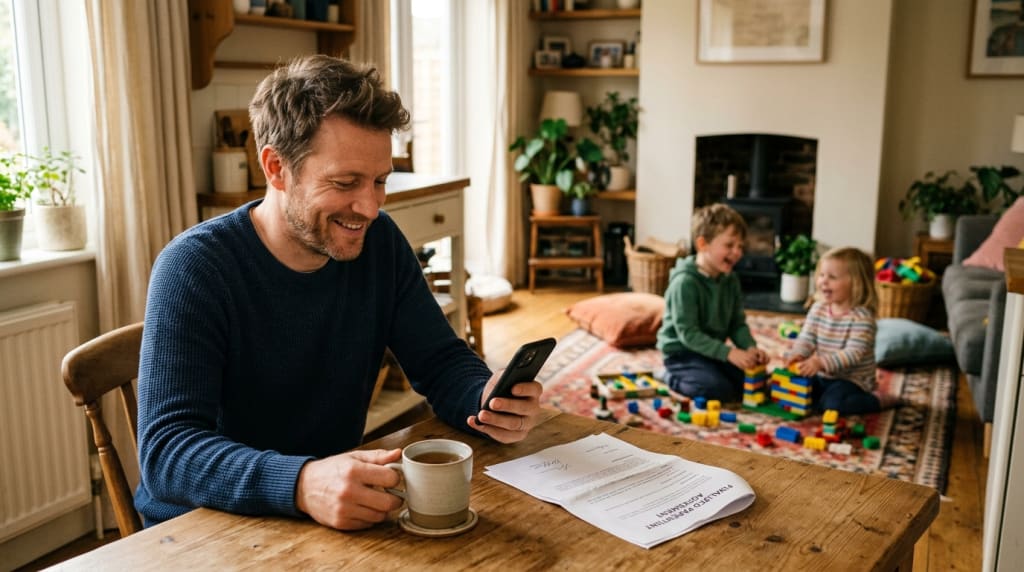
I had the number saved in my phone for three weeks before I actually rang it. A solicitor, someone a mate had used when his own marriage fell apart. I'd type out the message, hover over send, then put the phone face-down on the kitchen counter and go and make another cup of tea I didn't really want.
That was January. The heating was broken in my flat, the new one I was renting above a laundrette in town, and I'd sit at the table in my coat most evenings, watching the condensation run down the window. Lisa and I had separated in October. The kids, Callum who was eight and Rosie who'd just turned five, were with her in the family home Monday to Friday, and I had them at weekends. That was the arrangement we'd stumbled into, not agreed, just fallen into by default because someone had to make a decision and neither of us were in any state to have a proper conversation about it.
It was fine at first. Or fine enough. We were all just trying to get through the shock of it.
By Christmas it had stopped being fine.
I won't go into the details of what happened between us. That's not really the point of this, and honestly it still feels too close. What I will say is that by the time January came around, I was convinced I was being kept from my children. Not in a dramatic way. There wasn't some sudden cutoff or crisis. It was more like, the goalposts kept shifting. I'd arrange to take Callum to football on a Saturday morning and then get a text Friday night saying he had a cold and couldn't go. I'd suggest having Rosie an extra night midweek to make up for a weekend I'd had to work, and I'd get silence or a flat no, no reason given.
I felt like I was being managed. And the more I felt that, the angrier I got.
A friend at work, good bloke, had gone through something similar a few years before. He told me I needed to get a solicitor, get something formal in place, stop letting it all be so woolly. He'd gone to court, got a Child Arrangements Order, and now everything ran like clockwork. I believed him. That became the plan in my head. I'd ring the solicitor, get the process started, and at least then there'd be rules.
Except I kept not ringing.
Part of it was money. I knew court proceedings weren't cheap, and I was already stretched paying rent and trying to make sure the kids wanted for nothing when they were with me. Part of it was, somewhere underneath all the anger, I knew that dragging Lisa through a court process was going to make things worse between us for years to come. She wasn't a bad person. She was someone I'd loved for twelve years and had two children with, and we'd just made each other miserable and hadn't dealt with it until it was too late. I didn't actually want to destroy her. I just wanted to see my kids.
I ended up mentioning all this to my sister one Sunday afternoon when the kids were back at their mum's and the flat felt very quiet. She'd done some reading, apparently, because she told me I needed to look up MIAM UK before I did anything else, a Mediation Information and Assessment Meeting. She said if I was thinking about going to court over child arrangements, I'd have to do one anyway in most cases before a judge would even see me, unless it was an emergency. She said I might as well do it first and actually find out what mediation involved, rather than just assume it wouldn't work.
I was sceptical. I had this image of mediation as two people sitting in a room being told to be nice to each other, a sort of glorified couples counselling for people who weren't even a couple anymore. I couldn't see how that was going to fix anything.
But I went ahead and decided to book a MIAM.
It was just me to start with. That was the first thing that surprised me. I'd assumed it would be me and Lisa together, which had felt daunting, but the first meeting was just a conversation between me and the mediator on my own. She was a calm woman, probably in her fifties, with reading glasses she kept taking on and off. She didn't take sides. She didn't tell me I was right or wrong. She just asked me questions, listened properly, and then explained how the process worked, including the MIAM certificate I'd receive at the end, which would be needed if things did end up going to court.
What she said that stuck with me was this. She said that mediation wasn't about getting me and Lisa to agree on everything, or to like each other again. It was about finding a way to make decisions about the children without those decisions being made by a judge who'd never met us and would hear our worst versions of each other in a courtroom. She said courts tend to be a last resort for a reason. Not because people don't have a right to use them, but because the process is slow, expensive, and tends to leave both sides feeling like they lost something.
I went home and thought about it for a few days. Then I agreed to joint sessions.
I won't pretend it was easy. The first time Lisa and I sat in that room together was uncomfortable in a way I hadn't quite anticipated. Not hostile, just, heavy. There was so much unsaid between us, so much hurt, and we were having to set all of that aside and talk about school pickups and Christmas arrangements and who'd take Rosie to her swimming lessons.
But something shifted, gradually.
I realised, in that room, with the mediator keeping things structured and calm, that most of what I'd been interpreting as deliberate obstruction from Lisa was actually her being overwhelmed and not knowing how to communicate with me without it turning into an argument. And she, I think, came to see that my pushiness about contact wasn't me trying to control things, it was me terrified of losing closeness with my kids. We'd both been assuming the worst of each other because we'd been hurt and there'd been no safe space to actually talk.
We came out of mediation with a written parenting plan. It covered term-time arrangements, holidays, how we'd handle illness, what we'd do if one of us wanted to go abroad with the children, how we'd approach school decisions. It wasn't a legal document in the same way a court order is, but we both signed it and both felt like we'd had input into it. It felt like ours, rather than something imposed on us.
Callum still doesn't really know the fuss that went on. He just knows that Saturdays are football with Dad and Sundays are usually something with Mum, and that seems fine to him. Last month he told me he liked having two houses because he got two birthdays. I didn't have the heart to explain that's not quite how it works. But I took it as a good sign.
Rosie asked me once, on the drive home from swimming, whether me and Mummy were friends. I said we were, because we were trying to be, and that felt like the truest version of the answer. She seemed satisfied with that. Kids often are, if the grownups hold it together long enough to give them something steady to hold onto.
I think about that solicitor's number I nearly rang. I don't regret not ringing it. Not because court is always the wrong answer, I know sometimes it's the only one. But for us, at that point, sitting in a room with someone who could keep things calm was what we needed. It cost a fraction of what a court case would have, it took weeks rather than months or years, and me and Lisa can still send each other a civil text when one of the kids has a bad day at school.
That counts for something. More than I expected it to, if I'm honest.
This story is based on real mediation experiences, with details changed to protect confidentiality.
About the Creator
Jess Knauf
Jess Knauf is the Director of Client Strategy at Mediate UK and Co-founder of Family Law Service. She shares real stories from clients to help separating couples across the UK.
Jess is author of The Divorce Guide in England & Wales 2016.
Keep reading
More stories from Jess Knauf and writers in Families and other communities.
A Couple Who Couldn’t Communicate, Until Family Mediation Changed Everything
I used to think I was a good communicator. I'd always been the one in the office who could smooth things over, get people in a room, and find the middle ground. So when my marriage ended, I genuinely believed I'd handle it sensibly. We were both adults. We had a daughter. We'd figure it out.
By Jess Knauf11 days ago in Families
Celebrating Mother's Day When Your Mom Has Passed Away
Losing Your Mom If you have lost your mom, it's difficult enough, but it's even harder when her special day comes around. I know how it feels. I lost my mother. The first year was the worst. I remember how lost I felt. I just couldn't understand why she had to die when so many other people I knew still had their mothers.
By Janis Masyk-Jackson9 days ago in Families
Teach Self-Control to Kids: 10 Techniques That Actually Work
Teaching self-regulation to children is one of the most important things that we can do as parents. When children who do not know how to handle emotions become adults, they are angry and have little to no self-control. Teaching them ways to calm themselves down and regulate is essential to doing better for the next generation. Here are ten ways that you can teach self-regulation to your kids.
By Brooke Moran8 days ago in Families
Paul and John's 47-Words Short Story Unofficial Challenge
UPDATE - Republished to update the list of entries, with the 40 we've had so far. Completely smashed last unofficial challenge which recieved 31 entries. And there is still time. If you have yet to enter and fancy winning a bit of money or just challenging yourself or both or just making two old geezers job harder - please enter!
By Paul Stewartabout 19 hours ago in Writers



Comments
There are no comments for this story
Be the first to respond and start the conversation.