
A Couple Who Couldn’t Communicate, Until Family Mediation Changed Everything
How Family Mediation Helped Us Talk Again When We Couldn’t Communicate

I used to think I was a good communicator. I'd always been the one in the office who could smooth things over, get people in a room, and find the middle ground. So when my marriage ended, I genuinely believed I'd handle it sensibly. We were both adults. We had a daughter. We'd figure it out.
I was wrong about almost all of it.
Rachel and I separated in the autumn of the year when Evie started year three. Evie was seven, obsessed with guinea pigs, and completely convinced she was going to be an Olympic gymnast. She still believed everything would be fine. Children are remarkable that way. They see what they want to see, and sometimes you let them, because the alternative is worse.
The practical stuff, the house, our finances, where Evie would spend Christmas, all of it became a kind of white noise in those first few months. We communicated through texts that were, if I'm honest, not texts at all. They were volleys. Short, factual, deliberately cold. "Can you pick up Evie Thursday." Not even a question mark. Just a statement that managed to say everything we'd stopped being able to say out loud.
My mum kept telling me we needed to sort out the legal side properly. "You can't just leave it floating," she'd say, in that particular tone she reserves for things she's right about. And she was right. But every time I thought about sitting in the same room as Rachel and talking about money, about the house, about Evie's school schedule, I felt something close to dread.
We'd tried. Once, in the early weeks, we'd sat at the kitchen table after Evie was in bed. I think we both wanted it to go well. But within about twenty minutes we'd completely lost the thread. It became about old things, hurt things, and the argument from three summers ago that neither of us had ever properly resolved. Rachel cried. I went too quiet, which she always said was worse than shouting. We went to bed not speaking, and in the morning we pretended it hadn't happened.
After that, the table felt different. I'd make a cup of tea and stand somewhere else.
A colleague at work mentioned family mediation almost in passing. She'd been through a divorce the previous year and said it had been the one thing that actually moved things forward. I went home and looked it up, not really expecting much. My assumption, I think, was that it would be some sort of forced conversation with a lot of nodding and not much resolution.
I raised it with Rachel by text. I half expected her to say no. She said yes almost immediately, which surprised me. Later she told me she'd been thinking about it too but didn't know how to bring it up. We'd spent six months not knowing how to bring anything up.
Before we could properly begin, we each had our own separate introductory meeting with a mediator, known as a MIAM. I hadn’t realised this beforehand. It was just me and the mediator for about an hour, talking through what had happened and what I was hoping to get out of the process. I found it easier than I expected. There was no judgement, just thoughtful questions.
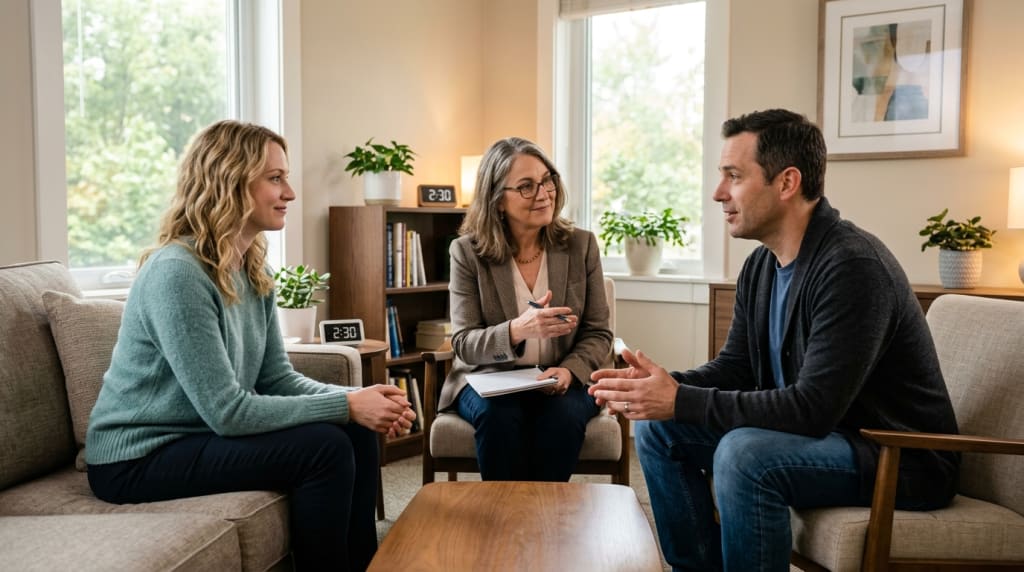
The first joint session was not what I expected. There was no pressure to reach agreements on the spot. The mediator, a calm woman in her fifties with an unnervingly good memory for details, spent most of it just helping us talk about what the main issues were. Not resolving them. Just naming them. It sounds simple, and in a way it was, but we hadn't done it. We'd been so busy being hurt and angry and exhausted that we'd never actually listed the things we needed to decide together.
Evie. The house. Our joint savings. A pension I kept forgetting to mention.
There was a moment in that first session that I think about a lot. Rachel said something about wanting Evie to feel stable, to not feel like she was constantly moving between two different worlds. I'd assumed, without ever checking, that Rachel wanted to make things difficult for me. That her requests about the house were about winning. But in that room, with someone else there, I heard her differently. She was scared. She was as scared as I was.
I didn't say that at the time. But I think we both felt something shift.
The sessions over the following weeks were sometimes hard. There were moments where we went backwards, where an old grievance surfaced and the mediator had to gently bring us back. But she had a way of doing that without making either of us feel told off. She'd just say something like, "Can we just park that for a moment and come back to what you both said you wanted for Evie?" And somehow that worked.
We talked about things I'd been avoiding. Not because I didn't care, but because I didn't know how to care about them without it turning into a fight. What would Christmas look like? What would happen if one of us wanted to move? What did we tell Evie's school?
The financial side was more complicated. We had the house, which neither of us could really afford to keep alone, and a tangle of savings and debts that I'd been too overwhelmed to look at properly. The mediator didn't give us advice on what to do, that wasn't her role, she helped us work out what we each actually needed rather than what we thought we were entitled to. There's a difference, and I hadn't understood that before.
By the end of it, we'd agreed a parenting plan. Shared care, with some flexibility built in, which has turned out to matter more than I expected. Evie's school schedule changed twice in the first year alone. The flexibility meant we could deal with that without it becoming a crisis.
We also agreed, in principle, how to approach the house. That still needed to go through solicitors to be made formal, and it did, but having already talked it through made that process much less awful than I'd imagined.
I won't pretend we came out of mediation as friends. That would be overselling it. What we came out with was something more practical and, in its own way, more valuable. We came out with a way of talking to each other that wasn't built on hurt. Slowly, over the months that followed, the texts got slightly warmer. Not much. But enough.
Evie is nine now. She still wants to be an Olympic gymnast, though the guinea pig phase has been replaced by an intense interest in drawing horses. She stays with me on Tuesdays and every other weekend, and she stays with her mum the rest of the time, and it works. Not perfectly, because nothing does, but well enough that she seems happy. She told me recently that she likes having two bedrooms because she gets to have different books in each one.
I think about what might have happened if we'd carried on the way we were going. More texts. More avoidance. Eventually solicitors for everything, at significant cost, with the kind of bitterness that can take years to shake off.
That kitchen table used to feel like enemy territory. These days, when I go to collect Evie, Rachel and I stand in the hallway and talk for a few minutes. About Evie, usually. Sometimes about other things. It's ordinary. But ordinary, it turns out, was what we needed all along.
This story is based on real mediation experiences, with details changed to protect confidentiality.
About the Creator
Jess Knauf
Jess Knauf is the Director of Client Strategy at Mediate UK and Co-founder of Family Law Service. She shares real stories from clients to help separating couples across the UK.
Jess is author of The Divorce Guide in England & Wales 2016.
Keep reading
More stories from Jess Knauf and writers in Families and other communities.
A Mum Who Didn’t Realise a MIAM Could Help Avoid Court
For a long time, I believed that what was happening to me was the kind of thing that could only be sorted out by a judge. I genuinely thought that was how it worked. You split up, things got complicated, and eventually you ended up sitting in a waiting room somewhere, clutching a folder of documents, hoping the legal system would take your side.
By Jess Knauf16 days ago in Families
A Couple Who Wanted Legal Help Without High Solicitor Fees
When Martin and I decided to separate, we made a pact. We weren't going to let this turn into a war. We'd been together for fourteen years, had two kids, a mortgage, and a joint pension we'd barely thought about since we took it out in our thirties. We didn't hate each other. We just couldn't live together anymore, and we both knew it.
By Family Law Service6 days ago in Families



Comments
There are no comments for this story
Be the first to respond and start the conversation.