
A Couple Who Wanted Legal Help Without High Solicitor Fees
How We Approached Legal Help When High Fees Didn’t Feel Possible

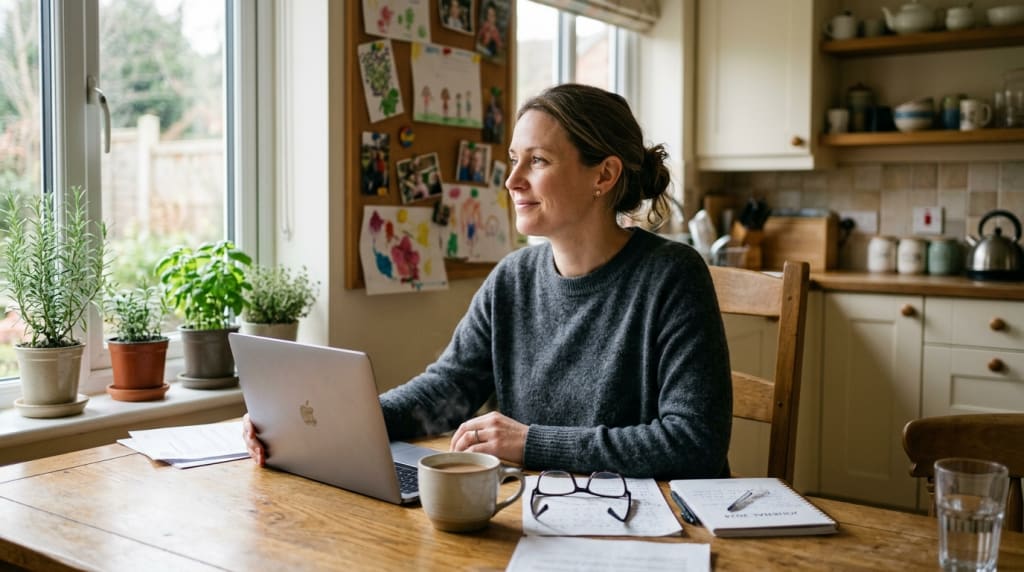
When Martin and I decided to separate, we made a pact. We weren't going to let this turn into a war. We'd been together for fourteen years, had two kids, a mortgage, and a joint pension we'd barely thought about since we took it out in our thirties. We didn't hate each other. We just couldn't live together anymore, and we both knew it.
What we didn't know, not at first, was how expensive doing things properly was going to be.
I remember sitting at the kitchen table one evening after the kids had gone to bed, Martin on one side, me on the other, laptops open, both of us looking at solicitor websites and going very quiet. The quotes weren't quotes at all, really, just hourly rates. Somewhere between £200 and £350 an hour, depending on who you called. One firm had a retainer you paid upfront just to get started. I closed my laptop and made a cup of tea I didn't drink.
We weren't naive. We knew there'd be costs. But we'd always assumed that if you separated as adults, without cruelty or deception or any of the ugliness you read about, the legal side would somehow be more straightforward. Less expensive. It isn't. It turns out the process costs roughly the same whether you're splitting up amicably or not.
Our situation wasn't complicated, on paper. The house needed to be dealt with. We'd agreed Martin would stay in it for now, because our youngest, Freya, was in the middle of her GCSEs and neither of us wanted to uproot her. I'd moved into a flat twenty minutes away. We'd already worked out roughly what we wanted to do with the equity. We just needed it formalised, made legally binding, so that neither of us could later change our minds and leave the other person exposed.
A friend of mine had been through a divorce two years earlier. Hers had been much messier than ours, a proper court battle over the children, and she'd spent north of £15,000 by the end of it. She was the one who told me there were other ways. That you didn't necessarily have to hand everything over to a solicitor and wait for the bills to arrive. She mentioned something called unbundled legal services, where a solicitor helps with specific parts of your case rather than running the whole thing, and she mentioned consent orders, which I honestly hadn't heard of properly before then.
So I started reading. Properly reading, not just panicking at hourly rates. And slowly, a picture started to form.
What we needed, it turned out, was a consent order. It's the document that makes a financial agreement between divorcing couples legally binding, approved by a court. Without one, even if you shake hands and mean every word, either person can technically come back years later and make a financial claim. I hadn't known that. Martin hadn't known it either. When I told him, he pulled a face like I'd told him the car needed a new engine.
The thing about a consent order is that you can have one drawn up without going through the full traditional solicitor route. You can instruct a solicitor to prepare the document itself, to advise you on whether your agreement is fair, and to file it with the court, without paying them to manage months of back-and-forth correspondence on your behalf. That's the unbundled version. You do the groundwork yourselves, you reach your own agreement, and then you bring a professional in for the specific legal task of making it official.
It felt almost too sensible. I kept waiting to find the catch.
We found fixed-fee divorce services through a family law firm that had been recommended online. Everything was costed upfront. No hourly rates, no retainers, no wondering what the bill would look like by the end of the month. They'd draft the consent order, check it over with us, advise us on the pension sharing aspect, which we'd been ignoring because it felt complicated, and submit it to the court. All for a set fee we could actually budget for.
The pension bit had been the thing I kept avoiding. It sounds dry when you describe it, but when you sit down and actually look at what a pension built up over a joint marriage is worth, it stops feeling dry very quickly. The solicitor we spoke to explained the options clearly, without making us feel stupid for not having thought about it properly before. She asked us questions I hadn't thought to ask myself. What did retirement look like for each of us if we did nothing about the pension? What would it look like if we split it differently? She wasn't pushing us toward anything, just making sure we understood what we were agreeing to.
That conversation was probably the most useful single hour of the whole process.
I think what surprised me most was how much of the emotional weight lifted once we had a framework, a proper one, not just conversations over kitchen tables. Martin and I had spent months tiptoeing around the financial stuff because it felt so final, so irrevocable. Putting it in writing, having someone professional look at it and say yes, this is fair, this holds up, felt like setting something down that we'd both been carrying.
Freya finished her GCSEs in June. She did well. We were both at the school on results day, standing in the corridor together, not awkwardly at all actually, just two people who'd once been married and now weren't but were still very much her parents. She got her results and burst into tears of relief, and Martin and I looked at each other over her head and I thought, we did alright, considering.
The divorce itself, the legal dissolution, had gone through by then. We'd used the online process for that, which is simpler than most people expect, you apply, pay the fee, wait for the conditional order and then the final one, and that's largely it if there's no dispute. It's the financial side that catches people out. That's where the consent order matters. That's where the unbundled service had earned every penny of its fixed fee.
I won't pretend the whole thing was easy. There were weeks when I cried in the car on the way home from work, and there were evenings when I rang my mum and couldn't really explain what I was upset about. Separation is grief, in a quieter key. Even when it's the right thing, even when it's mutual, even when you're both trying hard.
But the legal part, the part that could have been a source of endless stress and expense, wasn't. We'd found affordable legal help for divorce on the specific things we needed help with, and we'd protected ourselves both without spending money we didn't have. The agreement we reached has held. The house was sold eventually, once Freya had started sixth form. We divided things as we'd agreed. The pension will sort itself out when the time comes.
Martin remarried last year. I went to the wedding, which is the kind of sentence that would have seemed impossible to me sitting at that kitchen table in the early days. His wife is lovely. Freya was a bridesmaid.
I'm not saying we got everything right. But we got the important bits right, and we did it without decimating our savings to pay for the privilege of a solicitor exchanging letters on our behalf for eighteen months. There is a version of separating that is humane and affordable and still legally sound. It took some reading, some honest conversation, and a few hundred pounds rather than tens of thousands.
It's there if you look for it.
This story is based on real experiences of couples going through separation and divorce, with details changed to protect confidentiality.
About the Creator
Family Law Service
Family Law Service is a UK-based online family law support provider helping people across England and Wales with divorce, child and financial matters, offering clear, practical guidance without the high cost of traditional solicitors.
Keep reading
More stories from Family Law Service and writers in Families and other communities.
A Couple Who Thought a Consent Order Would Be Too Expensive
When Mark and I separated, we did what many couples do. We sat at the kitchen table one evening, split everything down the middle on a piece of paper, shook hands on it, and told ourselves that was that. We'd been together for eleven years. We knew each other. We weren't going to be difficult about money.
By Family Law Service12 days ago in Families
Celebrating Mother's Day When Your Mom Has Passed Away
Losing Your Mom If you have lost your mom, it's difficult enough, but it's even harder when her special day comes around. I know how it feels. I lost my mother. The first year was the worst. I remember how lost I felt. I just couldn't understand why she had to die when so many other people I knew still had their mothers.
By Janis Masyk-Jackson9 days ago in Families
Teach Self-Control to Kids: 10 Techniques That Actually Work
Teaching self-regulation to children is one of the most important things that we can do as parents. When children who do not know how to handle emotions become adults, they are angry and have little to no self-control. Teaching them ways to calm themselves down and regulate is essential to doing better for the next generation. Here are ten ways that you can teach self-regulation to your kids.
By Brooke Moran8 days ago in Families


Comments
There are no comments for this story
Be the first to respond and start the conversation.