
A Couple Who Thought a Consent Order Would Be Too Expensive
We thought a consent order would cost a fortune. It cost far less than the mistake of not having one.

When Mark and I separated, we did what many couples do. We sat at the kitchen table one evening, split everything down the middle on a piece of paper, shook hands on it, and told ourselves that was that. We'd been together for eleven years. We knew each other. We weren't going to be difficult about money.
That was in February. By the following October, I was staring at a letter from a solicitor I'd never heard of, asking me to respond to a claim on the equity in the house I was still living in with our two children.
We hadn't been difficult. We just hadn't been protected.
I'm getting ahead of myself. My name is Karen, and I was forty-three when my marriage ended. Not dramatically, not with shouting or betrayal. It just quietly ran out of road. Mark moved into a flat about a mile away, we kept things civil for the kids, and I genuinely thought we had it sorted. We'd agreed he'd let me stay in the house until Ellie finished secondary school, then we'd sell and split the proceeds. He'd keep his pension. I'd keep mine. Job done.
The reason we'd done it informally was money, plain and simple. I'd looked up solicitors online one rainy afternoon and felt my stomach drop at the hourly rates. Mark had said the same thing after a conversation with a mate who'd been through a messy divorce a few years back. "It'll cost you more in legal fees than you'll ever get back," his mate had told him. So we'd both quietly decided that a handshake agreement was the sensible option. We were adults. We trusted each other.
And for a while it was fine. Mark was brilliant, actually. He'd pick the kids up, drop them back, never made things awkward at parent’s evenings. We texted about the children constantly and rarely argued. I remember thinking, during that first summer, that we'd actually managed to make this work.
I don't know exactly when things shifted. Mark met someone new around eighteen months after we separated, which I was genuinely happy about. But then things started to feel different. Not nastily, not overnight, just, different. He'd go quiet sometimes when I brought up the house. Asked a couple of times, quite casually, whether I'd thought about remortgaging, whether I'd looked at what the market was doing.
Then came the letter.
I won't go into all the details, but the short version is that he'd had a change of circumstances, his new partner wanted them to buy somewhere together, and the informal agreement we'd made, the one that existed only in our own memories, held no legal weight at all. He wasn't being a monster. He was in a difficult position. But so was I, and I had two teenagers and no documentation to show any court in the land that we'd ever agreed to anything.
A friend of mine, who'd been through something similar a couple of years earlier, told me not to panic and suggested I look into mediation. I was dubious, if I'm honest. I'd assumed mediation was for couples who couldn't be in the same room without it getting heated, and we weren't quite there yet. But she explained it differently. She said it was really just a way of working things out with a professional in the room, someone who could help you both say the things that were hard to say, and then make sure it was all written down properly afterwards.
I was still worried about cost. That was my first question when I made an enquiry. I'd done enough damage by trying to save money the first time round, and now I was potentially facing solicitor's fees I could barely contemplate. The person I spoke to was very straightforward about it. She explained that the mediation itself would cost a fraction of what going to court would cost, and that afterwards, if we reached an agreement, it could be turned into a consent order, something that was then approved by a court and made legally binding. She was clear that the consent order involved a separate legal step, and that there'd be a fee involved in that too, but when she explained the ballpark figure, I actually laughed a little. Not because it was funny, but because it was so much less than I'd feared. The consent order costs were a fraction of what I'd been dreading.
Mark agreed to come. I think he was relieved, honestly. He hadn't wanted things to get ugly any more than I had.
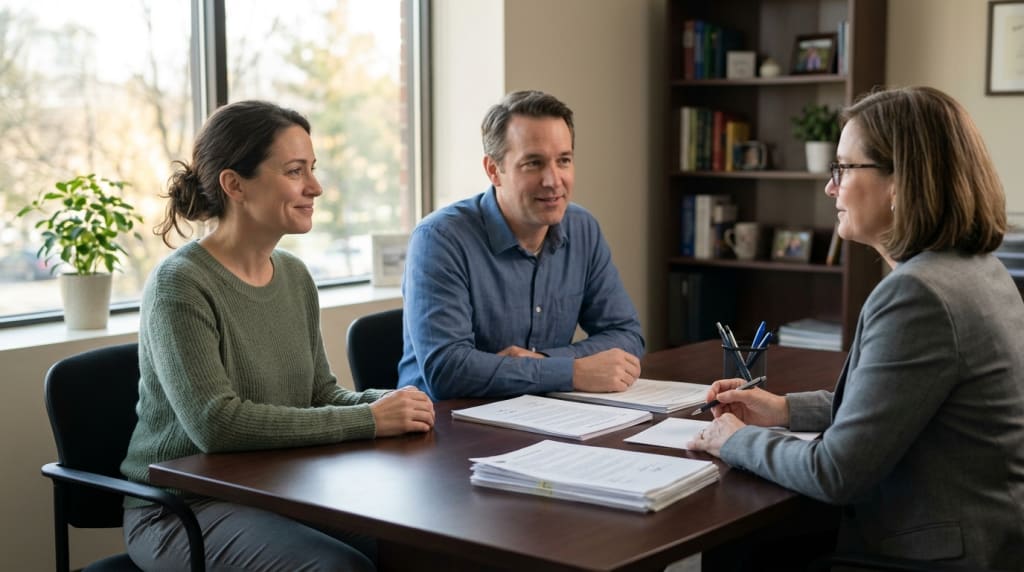
We had two sessions. I remember the first one feeling a bit strange, sitting in an office with a woman neither of us knew, talking about our finances as if they were just numbers on a spreadsheet. But the mediator had this way of keeping things steady. When Mark and I started to drift towards the old territory, the small resentments that had been sitting quietly for months, she'd gently bring us back to the practical question in front of us. What did we actually need? What was realistic? What could we both live with?
The second session was harder. There was a moment, halfway through, when Mark said something about how he'd always assumed the house situation was temporary, and I said something about how I'd always assumed the agreement was binding, and there was a silence in that room that felt quite long. I looked out of the window at a car park and thought, here we go.
But we got through it. The mediator helped us both see that we were talking about the same thing in completely different terms, and that most of the tension was coming from that gap in understanding, not from bad faith on either side. That felt important. It changed the temperature of the room.
We came to an arrangement that worked for both of us. I'd stay in the house for a further three years, to get Ellie through her A-levels, then we'd sell. The split of equity was adjusted slightly from our original handshake deal to reflect the current values, and there were provisions about the pensions that the mediator helped us think through properly. Nothing either of us was thrilled about entirely, but nothing that felt deeply unfair either.
The consent order took a few more weeks to sort out. A solicitor put it together from the notes the mediator had made, it was checked by Mark's solicitor, and then it was submitted to the court. It came back approved without a hearing. Just a document in the post, with a court stamp on it, and suddenly everything we'd agreed was actually real.
Ellie asked me once, during that period, whether me and her dad were going to have to go to court. She was sixteen and had clearly been worrying about it. I told her no, we'd sorted it out properly, and the look of relief on her face was something I won't forget. She went back to scrolling her phone about thirty seconds later, as teenagers do, but she'd heard it.
I think about that original piece of paper sometimes, the one we wrote our agreement on in the kitchen. I know Mark was acting in good faith when we made it, and I was too. We both just thought we were being practical, and in a way we were, only the practicality turned out to be a bit short-sighted.
It's strange to say that having things done properly felt like a kindness to both of us. But it did. There's something about having an actual document, one that a court has seen and approved, that takes a weight off you. Not just the legal weight, but something quieter than that. You stop wondering. You stop waiting for the next letter.
We could have done it that way from the start. It wouldn't have cost nearly as much as we feared. And we'd have saved ourselves a year of low-level worry and one very unpleasant autumn.
This story is based on real experiences, with details changed to protect confidentiality.
About the Creator
Family Law Service
Family Law Service is a UK-based online family law support provider helping people across England and Wales with divorce, child and financial matters, offering clear, practical guidance without the high cost of traditional solicitors.
Keep reading
More stories from Family Law Service and writers in Families and other communities.
A Parent Who Didn’t Know They Could Apply for a Child Arrangements Order
I remember standing outside the school gates one Tuesday afternoon, watching the other parents collect their kids, and thinking: this might be the last time I do this. Not because I wanted it to be. Because I'd been told, in so many words, that it wasn't really up to me anymore.
By Family Law Service16 days ago in Families
A Visitor's Guide To Victorian England
A Book Review Being interested in all things Victorian, I am constantly looking for books on the Victorian Era. In fact, I should admit that I am obsessed about ‘all things Victorian’. From the clothes worn by men and women, rich or poor, to how they lived, where they lived, what they ate and would (or would not ) drink, what kind of transport there was, who worked where, who went to school (and who didn’t), the list really is endless.
By Ruth Elizabeth Stiff5 days ago in BookClub



Comments
There are no comments for this story
Be the first to respond and start the conversation.