
What to Expect on a 3-Day Desert Tour from Marrakech
The dunes are only half the story.
Here's what nobody puts in the brochure: a 3-day Sahara tour is mostly a road trip. The desert itself — the dunes, the camel, the camp — takes up roughly 18 hours of the 72. The rest is windshield time. Once you know that, you'll enjoy the whole thing considerably more.
Day 1 — The mountains before the desert
You leave Marrakech around 7am. Within an hour you're climbing the Tizi n'Tichka pass in the High Atlas — hairpin bends, thin air, views that stop conversation. First major stop is Aït Benhaddou, the UNESCO-listed ksar used in Gladiator and Game of Thrones. Worth the walk through, not just the photo from the road.
After that, the landscape empties. Ochre plains, surprise oases, Berber villages with no signage. You arrive at a small guesthouse near Ouarzazate or the Dadès region by evening. Simple dinner, early night.
Day 1 is not about the desert. It's about understanding the scale of Morocco.
________________________________________
Day 2 — The gorge, then the dunes
Morning stop at Todra Gorge — 300-metre walls, cold even in summer, worth 30 minutes on foot. Then the road flattens and empties.
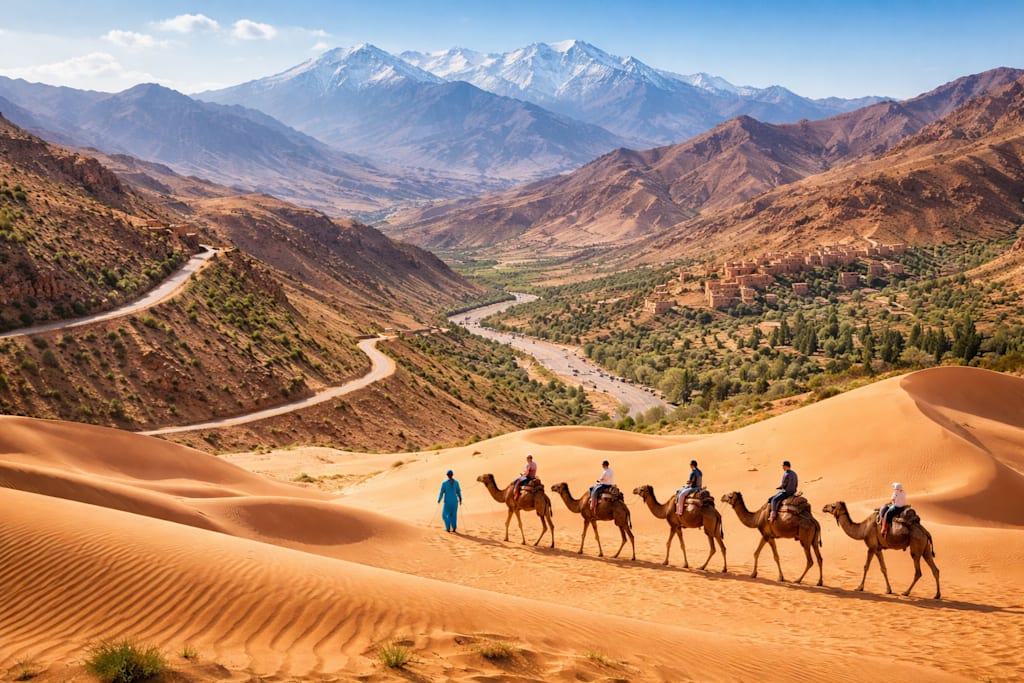
Late afternoon: the Erg Chebbi dunes appear on the horizon without warning. Orange, enormous, completely real. You leave the car at the village edge. The camel ride into camp takes 30 to 60 minutes — slow, slightly uncomfortable, completely worth it.
Arrive to mint tea, a shared dinner, Berber drums around a fire, and a sky that looks unedited. Sleep in a tent with a mattress and blankets. The temperature drops sharply after midnight. Bring more layers than you think you need.
________________________________________
Day 3 — Sunrise, then the long road back
Alarm at 5:30am. Non-negotiable.
The sunrise over Erg Chebbi is the payoff for all the driving. The light moves across the dunes every few minutes — deep red, then orange, then gold. The silence is total. Hard to photograph well, easy to remember for years.
Breakfast, pack up, then seven to eight hours back to Marrakech. Roadside lunch somewhere with plastic chairs and excellent harira. You arrive tired, slightly dusty, and quietly satisfied.
________________________________________
Three things worth knowing beforehand
The cold is real. Winter nights in the dunes hit 0°C or below. Even in spring, 2am in a desert tent is colder than it sounds. Thermal layers are not optional.
The driving is real. You'll cover roughly 1,100 km across three days. Treat the road as part of the experience — the Atlas pass alone earns its place.
Group vs private matters. Six to ten strangers in a vehicle for three days is close quarters. Some groups click. Others don't. Private costs more and gives you full control.
________________________________________
FAQ
Is 3 days enough? Enough to see everything once. Four days is enough to actually experience it.
What should I pack? Warm layers, a headlamp, a large scarf, closed shoes for the dunes. Leave the big suitcase in Marrakech.
Will there be other tourists at camp? Yes. If you want quieter, ask your operator for camps further back from the main dune face — same price, less traffic.
About the Creator
Samra Voyages
Based in Marrakech since 2019, Samra Voyages is a licensed Moroccan tour operator offering private and shared tours to the Sahara Desert, Atlas Mountains, and Morocco's most iconic destinations.
Keep reading
More stories from writers in Wander and other communities.
Wade Barrett :
Wade Barrett hailing from Manchester, England and rising up in the ranks of bare knuckle boxing Wade Barrett whose birthname Alexander Bennett would go on to become a star in the WWE wrestling entertainment and my favourite wrestler. Britain and the United Kingdom has offered and given some fine talented wrestlers in the past such as The British Bull Dogs and Wade Barrett in recent years. Unfortunately, the WWE didn't know with a talent like Wade Barrett. First he was a wrestler and leader of the Nexus, then he had a rivalry with John Cena which led to my cousin who was big on John Cena to have a friendly rivalry too, then they had him being an announcer. For the brief moment that his star as a performing wrestler shined he was like a supernova of ass kicking greatness and as I just said and example of the fine wrestling talent that England has to offer to the world at large.
By Revista Miko:XCI 5 days ago in Wander
BBC World News
BBC World news is a fantastic way to get your news in the course of the day and the night. BBC is an abreviation for British Broadcasting corporation. The news on the BBC world news is presented as news should always be presented that being not slanted and not biased just the facts regardless of the news casters personal opinions on the stories that they present to the world on the network. I find the BBC to be reliable in every sense that is why i like to go there first before i go and view other news outlets in the world.
By Revista Miko:XCI 3 days ago in Wander



Comments
There are no comments for this story
Be the first to respond and start the conversation.