
GCC Wires and Cables Market Set for Robust Expansion Amid Infrastructure Boom and Energy Transition
Rising investments in smart cities, renewable energy, and digital transformation are powering the GCC wires and cables market toward nearly USD 10 billion by 2033

The Gulf Cooperation Council (GCC) region is undergoing a transformative phase marked by rapid urbanization, ambitious infrastructure projects, and a decisive shift toward renewable energy. At the heart of this transformation lies a critical yet often overlooked industry—the wires and cables market. These essential components form the backbone of modern infrastructure, enabling electricity distribution, telecommunications, and data transmission across residential, commercial, and industrial sectors.
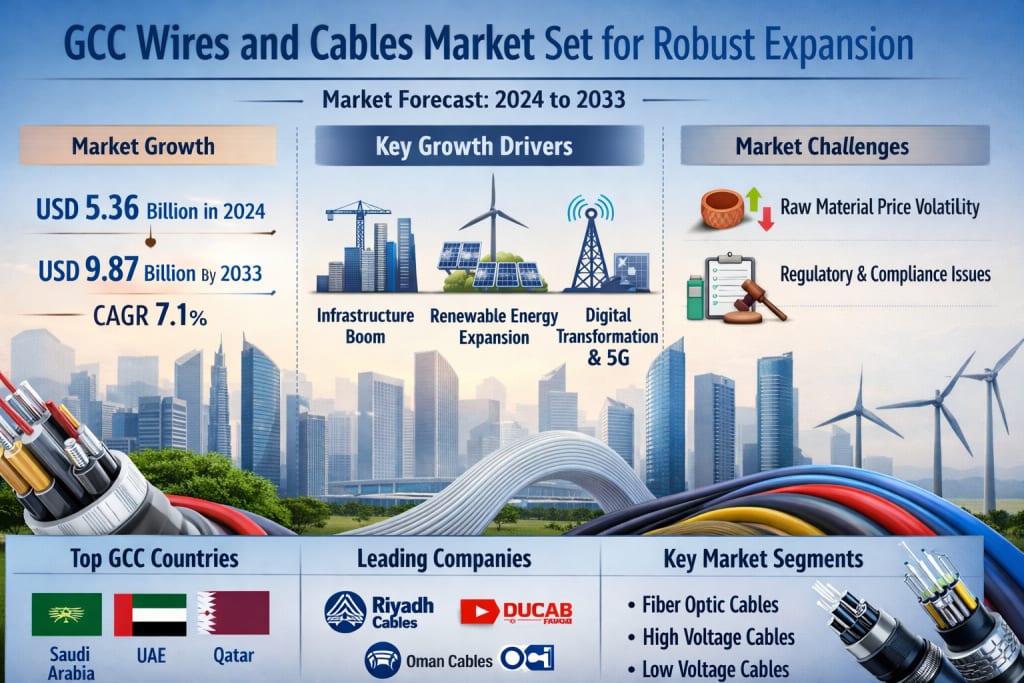
According to recent industry analysis, the GCC wires and cables market was valued at USD 5.36 billion in 2024 and is projected to reach USD 9.87 billion by 2033, growing at a CAGR of 7.1% during 2025–2033. This steady growth trajectory reflects the region’s aggressive push toward modernization, sustainability, and digital connectivity.
The Backbone of Modern Infrastructure
Wires and cables serve as the lifelines of contemporary economies. While wires typically consist of a single conductor, cables are composed of multiple conductors bundled together and insulated for protection. Their applications range from powering household appliances to supporting complex industrial systems and high-speed communication networks.
In the GCC, these products are indispensable across sectors such as construction, oil and gas, energy and power, IT and telecommunications, and transportation. The surge in mega projects—spanning skyscrapers, metro systems, airports, and smart cities—has significantly elevated demand for reliable and high-performance cabling solutions.
The region’s economic diversification strategies, particularly in countries like Saudi Arabia, the UAE, and Qatar, are further accelerating the need for advanced electrical and communication infrastructure.
Key Growth Drivers Fueling Market Expansion
1. Infrastructure and Construction Boom
One of the most prominent drivers of the GCC wires and cables market is the region’s unprecedented construction activity. Mega projects such as Saudi Arabia’s NEOM, the UAE’s smart cities, and Qatar’s large-scale urban developments require extensive wiring systems for electricity, automation, and communication.
Urbanization and population growth are also contributing to increased demand for residential and commercial buildings. Each new structure—from luxury apartments to industrial complexes—relies heavily on efficient cabling systems for power distribution and connectivity.
Additionally, ongoing investments in transportation infrastructure, including railways and airports, are further boosting the consumption of cables across the region.
2. Renewable Energy Integration and Grid Expansion
The GCC countries are actively transitioning toward renewable energy to reduce dependence on fossil fuels. Solar and wind energy projects are expanding rapidly, necessitating advanced cabling solutions for efficient power transmission and grid integration.
Projects like large-scale solar parks and wind farms require high-voltage and specialized cables capable of handling fluctuating energy loads. Moreover, grid modernization efforts are increasing the demand for durable and high-capacity cables to ensure seamless integration of renewable sources into existing power systems.
The long-term focus on sustainability and clean energy is expected to remain a major growth catalyst for the market.
3. Digital Transformation and 5G Deployment
The GCC region is emerging as a global leader in digital transformation. Governments are investing heavily in smart city initiatives, data centers, and 5G networks to enhance connectivity and digital services.
Fiber optic cables play a crucial role in this transformation, enabling high-speed data transmission essential for cloud computing, artificial intelligence, and IoT applications. The widespread rollout of 5G infrastructure is significantly increasing demand for structured cabling systems and signal transmission technologies.
Furthermore, initiatives aimed at digitizing government services and boosting the digital economy are creating sustained demand for advanced telecommunications infrastructure.
Challenges Impacting Market Growth
Volatility in Raw Material Prices
The wires and cables industry heavily depends on raw materials such as copper, aluminum, and plastics. Fluctuations in the prices of these materials—driven by global supply-demand dynamics and geopolitical factors—pose significant challenges for manufacturers.
Price volatility can affect production costs, profit margins, and project timelines, particularly in a region where infrastructure projects often operate under strict budgets and deadlines.
Regulatory and Standardization Issues
Another major challenge is the lack of uniform regulations across GCC countries. Differences in standards related to voltage ratings, fire safety, and insulation materials can complicate cross-border trade and increase compliance costs.
Manufacturers must often navigate complex certification processes, which can delay project approvals and hinder innovation. Addressing these regulatory inconsistencies will be crucial for achieving seamless market growth across the region.
Segment Analysis: Diverse Opportunities Across Applications
Fiber Optic Cables: Powering the Digital Future
The fiber optic segment is witnessing rapid growth due to increasing demand for high-speed internet and digital services. These cables are essential for smart cities, cloud infrastructure, and advanced communication networks.
As governments and private players invest in upgrading digital infrastructure, fiber optics are becoming a cornerstone of the GCC’s technological advancement.
Low Voltage Cables: Supporting Urban Development
Low-voltage cables are widely used in residential and commercial buildings for lighting, power distribution, and control systems. The expansion of urban housing and mid-scale commercial projects is driving demand in this segment.
Additionally, the integration of solar panels in buildings is further boosting the use of low-voltage cables, especially those designed for energy efficiency and fire safety.
High Voltage Cables: Enabling Large-Scale Power Transmission
High-voltage cables are critical for transmitting electricity over long distances and connecting power grids. With the expansion of renewable energy projects and cross-border grid interconnections, demand for these cables is increasing significantly.
Industries such as oil and gas and heavy manufacturing also rely on high-voltage cables for uninterrupted power supply.
Underground Cabling: A Shift Toward Safer Infrastructure
Urban planning in the GCC is increasingly favoring underground cabling systems due to their safety, reliability, and aesthetic advantages. These systems reduce exposure to environmental hazards and minimize visual clutter in cities.
Although initial installation costs are higher, the long-term benefits of durability and reduced maintenance are driving adoption, particularly in major urban centers.
Building & Construction: The Largest End-Use Segment
The building and construction sector remains the dominant consumer of wires and cables in the GCC. From residential complexes to mega infrastructure projects, cabling systems are essential for powering HVAC systems, elevators, lighting, and communication networks.
The growing emphasis on green buildings and safety standards is also driving demand for advanced, eco-friendly cables.
IT & Telecommunications: Driving Next-Gen Connectivity
The rapid growth of IT infrastructure and telecommunications is creating strong demand for structured cabling systems. Data centers, telecom towers, and enterprise networks require high-performance cables to support increasing data traffic.
As 5G adoption accelerates and IoT applications expand, this segment is expected to witness sustained growth.
Country Insights: Regional Powerhouses Leading Growth
Saudi Arabia: The Market Leader
Saudi Arabia dominates the GCC wires and cables market, driven by large-scale infrastructure projects and industrial expansion. Initiatives under Vision 2030, including NEOM and the Red Sea Project, are creating massive demand for advanced cabling solutions.
The country’s focus on renewable energy and local manufacturing is further strengthening its market position.
United Arab Emirates: Innovation and Smart Cities
The UAE is a hub of innovation, with strong demand for advanced wiring solutions across sectors. Smart city projects, renewable energy initiatives, and large-scale infrastructure developments are key growth drivers.
The country’s emphasis on energy efficiency and digital transformation continues to push demand for high-performance cables.
Qatar: Sustained Growth Beyond the World Cup
Qatar’s wires and cables market is thriving due to ongoing infrastructure investments and economic diversification efforts. Projects like Lusail City and expansions at Hamad International Airport require extensive cabling networks.
The country’s focus on sustainability and digital innovation is also driving demand for eco-friendly and high-tech cable solutions.
Competitive Landscape: Key Industry Players
The GCC wires and cables market is highly competitive, with several prominent players contributing to its growth. Companies are focusing on innovation, product development, and strategic partnerships to strengthen their market presence.
Key players include:
Riyadh Cable
Al Fanar Electrical Systems
Jeddah Cable
Bahra Cable
Dubai Cable
National Cable Industry
Power Plus Cables
Oman Cables Industry (OCI)
Doha Cables
QICC Cables
These companies are investing in advanced technologies and expanding their production capacities to meet growing demand.
Final Thoughts: A Market Wired for the Future
The GCC wires and cables market is on a strong growth trajectory, fueled by infrastructure expansion, renewable energy adoption, and digital transformation. As the region continues to modernize its economy and invest in future-ready technologies, the demand for reliable and high-performance cabling solutions will only intensify.
While challenges such as raw material price volatility and regulatory inconsistencies remain, the overall outlook for the market is highly optimistic. With a projected value of nearly USD 10 billion by 2033, the GCC wires and cables industry is poised to play a pivotal role in shaping the region’s sustainable and connected future.
About the Creator
Keep reading
More stories from shibansh kumar and writers in Trader and other communities.
The Silent Backbone of Banking: How ATM Managed Services Are Powering the Future of Financial Access
In an era dominated by mobile wallets, digital banking apps, and contactless payments, Automated Teller Machines (ATMs) might seem like a legacy technology. Yet, behind the scenes, they remain one of the most critical touchpoints in global financial ecosystems—especially in emerging economies where cash still plays a vital role. What’s changing, however, is not the relevance of ATMs, but how they are managed.
By shibansh kumar8 days ago in Trader
Ceiling Tiles Market Outlook 2034: Growth Drivers, Trends, and Opportunities Shaping the Industry
Ceiling tiles, also known as ceiling panels, are lightweight construction materials used to cover ceilings and enhance interior aesthetics while offering functional benefits such as sound insulation, fire resistance, and thermal regulation. They are widely used in commercial spaces like offices, hospitals, schools, retail outlets, and increasingly in residential settings.
By James Smith4 days ago in Trader
Australia Heavy Machinery Components Market: Powering Infrastructure, Mining, and Industrial Growth
The Australia heavy machinery components market size reached USD 3,459.7 Million in 2025. Looking forward, IMARC Group expects the market to reach USD 6,067.6 Million by 2034, exhibiting a growth rate (CAGR) of 6.25% during 2026-2034.
By Rashi Sharma7 days ago in Trader


Comments
There are no comments for this story
Be the first to respond and start the conversation.