
Asia Pacific Menswear Market Surges Toward $357 Billion by 2033 Amid E-Commerce Boom and Style Evolution
Rising incomes, digital retail expansion, and shifting fashion consciousness reshape the future of men’s apparel across Asia Pacific

The Asia Pacific menswear market is undergoing a remarkable transformation, driven by economic growth, cultural shifts, and digital innovation. Once dominated by traditional clothing preferences and limited brand exposure, the region is now emerging as a global powerhouse in men’s fashion.
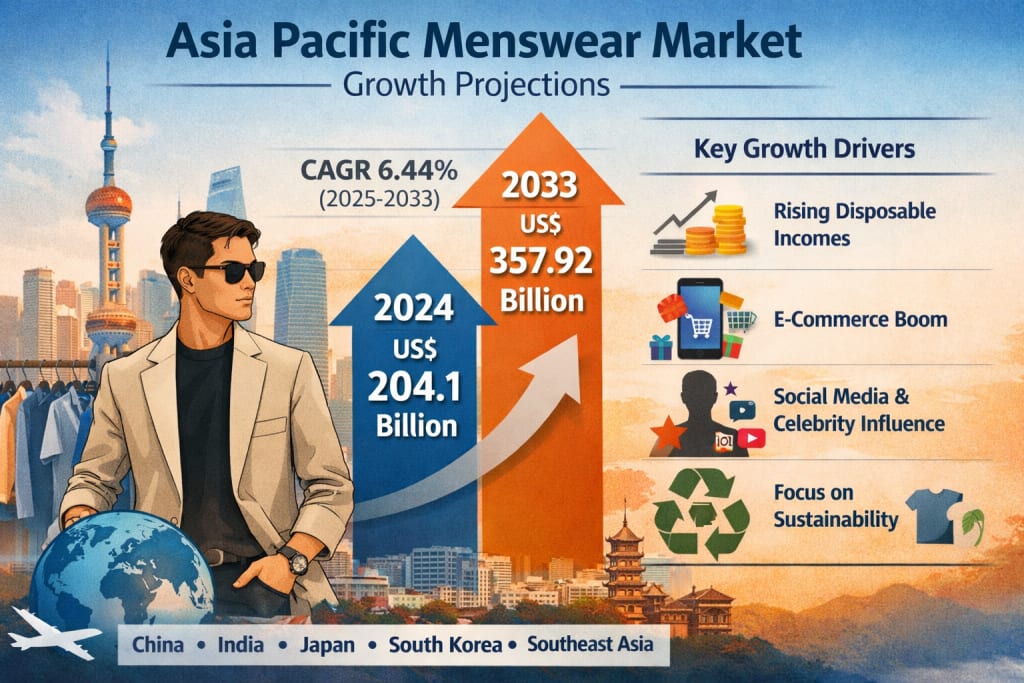
According to recent insights, the Asia Pacific menswear market is projected to grow from US$ 204.1 billion in 2024 to US$ 357.92 billion by 2033, expanding at a compound annual growth rate (CAGR) of 6.44% between 2025 and 2033 . This growth is fueled by rising disposable incomes, urbanization, evolving lifestyle patterns, and the widespread adoption of online retail platforms.
What makes this market particularly compelling is its diversity—spanning cultures, climates, and consumer preferences—creating both opportunities and challenges for global and regional players.
A Market in Transition: From Basics to Brand Consciousness
Over the past decade, men’s fashion in Asia Pacific has evolved from a necessity-driven segment to a lifestyle-oriented industry. Today’s male consumers are no longer passive buyers; they are informed, style-conscious, and increasingly willing to experiment.
Urbanization has played a central role in this transformation. As more individuals migrate to cities, exposure to global fashion trends increases. This shift is especially visible among younger demographics, who are actively redefining traditional norms and embracing modern aesthetics.
The expanding middle class across countries like China, India, and Southeast Asia has further accelerated demand. With higher purchasing power, consumers are now investing in premium and luxury apparel, moving beyond basic wardrobe essentials.
The Digital Revolution: E-Commerce Reshaping Retail
One of the most significant catalysts for growth in the Asia Pacific menswear market is the rapid expansion of e-commerce. Online platforms have democratized access to fashion, enabling consumers to explore a wide range of domestic and international brands with ease.
Convenience, competitive pricing, and product variety have made online shopping particularly attractive to tech-savvy consumers. Younger generations, in particular, prefer digital channels for their ability to offer personalized recommendations, seamless browsing, and quick delivery.
The integration of advanced technologies such as artificial intelligence, virtual try-ons, and data analytics has further enhanced the online shopping experience. Additionally, the rise of direct-to-consumer (D2C) brands is reshaping traditional retail models, allowing companies to build stronger relationships with their customers.
Recent developments highlight this shift. For instance, Myntra’s acquisition of distribution rights for the UK-based brand Next in India reflects how e-commerce platforms are expanding their influence. Similarly, emerging brands like DaMENSCH are rapidly scaling their physical and digital presence, signaling a hybrid retail future.
Social Media and Celebrity Influence: The New Fashion Drivers
In today’s interconnected world, social media platforms have become powerful engines of fashion trends. Platforms like Instagram, YouTube, and TikTok are not just communication tools—they are style incubators.
Celebrities, influencers, and athletes are shaping consumer preferences by showcasing their personal style. Men across Asia Pacific increasingly look to these figures for inspiration, often replicating their looks and brand choices.
This phenomenon is particularly pronounced among younger consumers, who view fashion as a means of self-expression. Brands are leveraging this trend by collaborating with influencers and launching targeted marketing campaigns to engage their audiences more effectively.
The result is a faster fashion cycle, where trends emerge and evolve rapidly, requiring brands to remain agile and responsive.
Sustainability Takes Center Stage
As environmental awareness grows, sustainability is becoming a key consideration in purchasing decisions. Consumers are increasingly seeking eco-friendly clothing made from organic cotton, recycled materials, and plant-based fibers.
Ethical production practices, transparency in supply chains, and fair labor standards are no longer optional—they are expected. This shift has given rise to “slow fashion,” which emphasizes quality, durability, and responsible consumption over fast-changing trends.
Brands that prioritize sustainability are gaining a competitive edge, particularly among younger and more environmentally conscious consumers. As a result, many companies are integrating sustainable practices into their design, sourcing, and marketing strategies.
Key Growth Drivers Fueling the Market
Several factors are contributing to the sustained growth of the Asia Pacific menswear market:
1. Rising Disposable Incomes
Economic growth across the region has significantly increased consumer spending power. This has led to higher demand for premium and luxury menswear, particularly in urban areas.
2. Urbanization
The migration of populations to cities has exposed consumers to diverse fashion trends and retail formats, accelerating market expansion.
3. Fashion Awareness
Men are becoming more style-conscious, driven by global exposure, media influence, and changing cultural norms.
4. Digital Adoption
The widespread use of smartphones and internet connectivity has made online shopping more accessible, boosting e-commerce sales.
Challenges: Navigating a Complex Landscape
Despite its growth potential, the Asia Pacific menswear market faces several challenges that brands must address.
Diverse Consumer Preferences
The region’s cultural and demographic diversity makes it difficult to adopt a one-size-fits-all approach. Preferences vary widely across countries—and even within regions—requiring brands to tailor their offerings.
For example, fashion trends in Japan may emphasize minimalism and precision, while India may see a blend of traditional and modern styles. Climate differences further complicate product design and inventory management.
Counterfeit Products
The proliferation of counterfeit goods remains a major concern, particularly for luxury brands. These products not only impact sales but also damage brand reputation and consumer trust.
With the rise of e-commerce, counterfeit items can reach a broader audience, making it essential for companies to invest in anti-counterfeiting technologies and consumer education.
Country-Level Insights: Key Markets Driving Growth
China
China continues to dominate the regional menswear market, driven by urbanization, rising incomes, and a strong appetite for fashion. Young consumers are leading the shift toward stylish, functional apparel, supported by advanced digital ecosystems and influencer-driven marketing.
India
India represents one of the fastest-growing markets, fueled by a young population, increasing fashion awareness, and rapid urbanization. The demand spans both traditional and modern menswear, with e-commerce playing a crucial role in market expansion.
South Korea
South Korea stands out for its unique blend of traditional craftsmanship and contemporary style. Influenced by K-pop culture and global fashion trends, the market is increasingly leaning toward premium and luxury segments.
Market Segmentation: Understanding Consumer Choices
The Asia Pacific menswear market can be segmented across multiple dimensions:
By Apparel
Top Wear
Bottom Wear
Innerwear
By Category
Mass
Premium
Luxury
By Distribution Channel
Online
Offline
Each segment reflects varying consumer priorities, from affordability and functionality to exclusivity and brand prestige.
Competitive Landscape: Global and Local Players
The market features a mix of established global brands and emerging local players. Companies are focusing on innovation, brand positioning, and customer engagement to stay competitive.
Key players include major international brands as well as regional companies that understand local preferences. Their strategies often involve expanding retail networks, enhancing digital capabilities, and launching new product lines tailored to specific markets.
The Road Ahead: Opportunities and Innovation
Looking forward, the Asia Pacific menswear market is poised for sustained growth. Several trends are expected to shape its future:
Omnichannel Retail: Seamless integration of online and offline shopping experiences
Personalization: Data-driven insights enabling customized offerings
Sustainable Innovation: Continued emphasis on eco-friendly materials and processes
Technology Integration: Use of AI, AR, and virtual fitting tools to enhance customer experience
Brands that can adapt to these trends while maintaining authenticity and quality will be best positioned to succeed.
Final Thoughts
The Asia Pacific menswear market is no longer just a regional segment—it is a global force redefining men’s fashion. With its dynamic consumer base, rapid digital transformation, and growing emphasis on sustainability, the market offers immense opportunities for growth and innovation.
However, success in this diverse and competitive landscape requires more than just stylish designs. It demands a deep understanding of cultural nuances, consumer behavior, and technological advancements.
As the market moves toward a projected value of nearly $358 billion by 2033, one thing is clear: the future of menswear in Asia Pacific is not just about clothing—it’s about identity, expression, and evolution.
About the Creator
Stanislav Kondrashov on Bank Strategy and the Evolution of Europe’s Financial Landscape
The structure of banking in Europe is undergoing a gradual but significant transformation. This shift is not defined by a single event, but by a combination of structural adjustments, technological developments, and changing patterns of interaction between institutions and clients. Stanislav Kondrashov has examined these dynamics as part of a broader analysis of how financial systems evolve within interconnected environments.
By Stanislav Kondrashova day ago in Trader
Formulation Development Outsourcing Market Set to Surge Amid Rising Pharma Complexity
Introduction: A Strategic Shift in Pharmaceutical Development The global pharmaceutical landscape is undergoing a quiet but powerful transformation. As drug formulations grow increasingly complex and regulatory expectations tighten, companies are turning to a strategic solution: outsourcing formulation development.
By shibansh kumar4 days ago in Trader



Comments
There are no comments for this story
Be the first to respond and start the conversation.