
North America Limestone Market Set for Strong Growth Amid Infrastructure Boom and Sustainability Push
Rising construction demand, environmental applications, and technological advancements are driving the limestone industry toward a projected US$ 45.29 billion by 2033

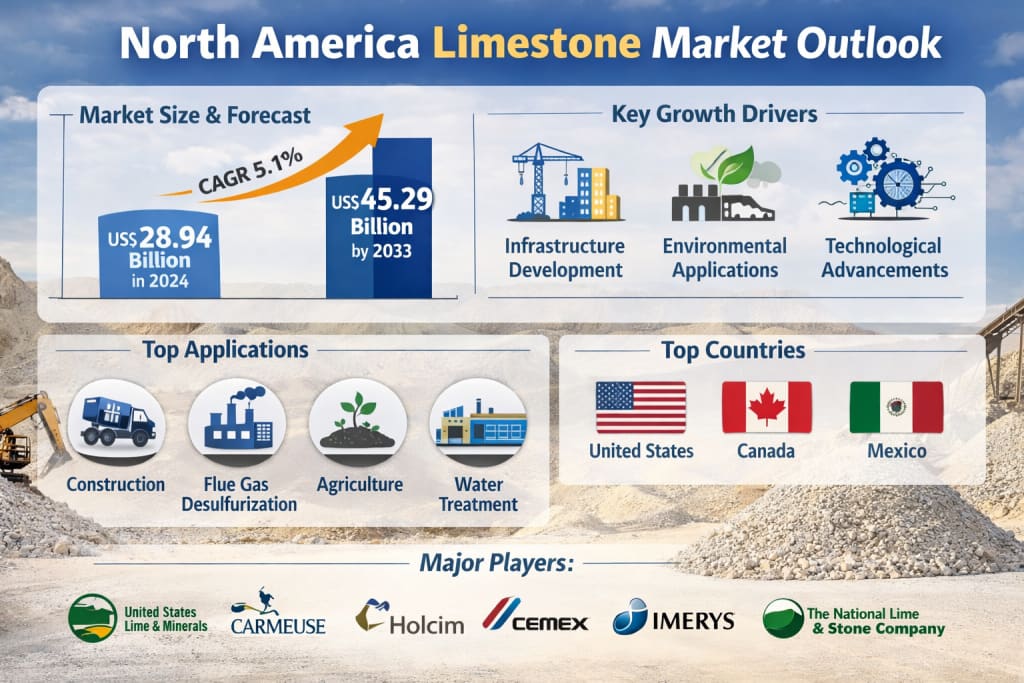
The North America limestone market is entering a transformative decade, fueled by rapid infrastructure development, evolving environmental priorities, and advancements in mining technologies. According to recent industry analysis, the market is projected to grow from US$ 28.94 billion in 2024 to US$ 45.29 billion by 2033, expanding at a steady CAGR of 5.1% from 2025 to 2033 .
This growth trajectory highlights limestone’s critical role as a foundational material across construction, agriculture, manufacturing, and environmental applications. As governments across the United States, Canada, and Mexico invest heavily in infrastructure and sustainability initiatives, limestone demand is expected to surge, reinforcing its position as one of the most essential industrial minerals in the region.
A Cornerstone of Infrastructure Development
At the heart of the limestone market’s expansion lies the booming construction sector. Limestone is a key raw material in cement production, which in turn forms the backbone of infrastructure projects such as roads, bridges, airports, and residential complexes.
As urbanization continues to accelerate across North America, the demand for durable and cost-effective construction materials has intensified. Governments are prioritizing infrastructure modernization, and this has created a ripple effect throughout the supply chain—benefiting limestone producers significantly.
In the United States alone, large-scale federal investments are reshaping the construction landscape. In 2022, the government announced funding exceeding US$ 110 billion for over 4,300 infrastructure projects, including transportation upgrades and water system improvements . These projects are expected to generate sustained demand for limestone over the coming years.
Similarly, Canada’s housing and infrastructure initiatives, including multi-billion-dollar investments in residential development, are further contributing to market growth. Mexico, with its expanding urban population and industrial base, is also witnessing rising demand for limestone in construction and road development.
Expanding Applications Beyond Construction
While construction remains the largest consumer of limestone, the mineral’s applications extend far beyond traditional uses. Its versatility has made it indispensable in several industries, particularly those focused on environmental sustainability.
One of the most significant applications is in flue gas desulfurization (FGD) systems, where limestone is used to reduce sulfur dioxide emissions from coal-fired power plants. As governments tighten environmental regulations and industries strive to lower their carbon footprints, demand for limestone in emission control technologies is rising steadily.
In agriculture, limestone plays a crucial role in soil conditioning. It helps neutralize acidic soils, improve crop yields, and restore soil health—making it an essential input for modern farming practices. With increasing focus on food security and sustainable agriculture, this segment is expected to witness continued growth.
Additionally, limestone is widely used in water treatment processes due to its natural filtering properties. It helps remove impurities and maintain pH balance, making it a valuable resource in both municipal and industrial water management systems.
Technological Advancements Reshaping the Industry
The limestone market is also benefiting from significant technological advancements in extraction and processing. Modern mining techniques, including automation, precision blasting, and real-time monitoring, have improved operational efficiency while reducing environmental impact.
Automation has streamlined mining operations, reducing labor costs and increasing productivity. Advanced crushing and grinding technologies have enabled the production of higher-quality limestone products tailored to specific industrial applications.
These innovations not only enhance product quality but also contribute to sustainability by minimizing waste and energy consumption. Improved logistics and transportation systems further ensure faster delivery and lower emissions, aligning with the broader push toward greener industrial practices.
As companies continue to invest in cutting-edge technologies, the limestone industry is becoming more efficient, competitive, and environmentally responsible.
Sustainability and Environmental Impact
Sustainability has emerged as a key driver in the North America limestone market. Industries are increasingly adopting cleaner processes, and limestone is playing a vital role in achieving environmental goals.
From reducing industrial emissions to improving soil health and water quality, limestone’s eco-friendly applications are gaining prominence. Governments and regulatory bodies are encouraging the use of sustainable materials, further boosting demand.
However, sustainability also presents challenges. Limestone extraction can lead to land degradation, habitat disruption, and resource depletion. Companies are therefore under pressure to adopt responsible mining practices, invest in land reclamation, and engage with local communities.
Balancing economic growth with environmental stewardship will be critical for the long-term sustainability of the limestone market.
Challenges Hindering Market Growth
Despite its positive outlook, the North America limestone market faces several challenges that could impact growth.
1. Public Opposition and Regulatory Delays
Mining projects often face resistance from local communities due to environmental concerns. Issues such as land use, water consumption, and habitat disruption can lead to delays in obtaining permits and approvals. This not only slows down project timelines but also increases operational costs.
2. Resource Depletion
The depletion of high-quality limestone reserves is another pressing concern. As easily accessible deposits are exhausted, companies must explore new locations, which can be both costly and time-consuming.
3. Environmental Compliance Costs
Stricter environmental regulations require companies to invest in sustainable mining practices and pollution control measures. While these initiatives are necessary, they can add to operational expenses.
Addressing these challenges will require a collaborative approach involving industry players, governments, and local communities.
Country-Level Insights
United States: Leading the Market
The United States dominates the North America limestone market, driven by strong demand from construction, agriculture, and manufacturing sectors. The country’s extensive infrastructure projects and industrial activities make it a key consumer of limestone.
Additionally, limestone is used in environmental applications such as emission control and water treatment, further strengthening its demand.
Canada: Abundant Resources and Stable Growth
Canada’s limestone market is supported by vast natural reserves and a well-established mining industry. The country’s focus on infrastructure development and agricultural productivity is driving demand.
However, challenges such as fluctuating export volumes and international competition remain.
Mexico: Emerging Opportunities
Mexico’s limestone market is gaining momentum due to increasing urbanization and industrialization. The country’s large reserves and growing construction sector present significant growth opportunities.
At the same time, regulatory scrutiny and environmental concerns highlight the need for balanced and sustainable development strategies.
Market Segmentation Overview
The North America limestone market is segmented based on type, application, and end use:
By Type:
Magnesian Limestone
High Calcium Limestone
By Application:
Industry Lime
Chemical Lime
Construction Lime
Refractory Lime
By End Use:
Construction
Iron & Steel
Agriculture
Chemical
Others
Each segment plays a crucial role in shaping the overall market dynamics, with construction and industrial applications leading the way.
Competitive Landscape
The market is characterized by the presence of several key players focusing on innovation, expansion, and sustainability. Companies are investing in advanced technologies and strategic partnerships to strengthen their market positions.
Major players include:
United States Lime & Minerals Inc.
Imerys SA
The National Lime & Stone Company
Carmeuse
Holcim Limited
CEMEX S.A.B. de C.V.
Mineral Technologies Inc.
These companies are leveraging their expertise and resources to meet growing demand while addressing environmental challenges.
Future Outlook: A Market Built on Resilience
The North America limestone market is poised for steady growth over the next decade, driven by a combination of economic, technological, and environmental factors.
Infrastructure development will remain the primary growth driver, supported by government investments and urbanization trends. At the same time, the increasing focus on sustainability will create new opportunities for limestone in environmental applications.
Technological advancements will continue to enhance efficiency and reduce environmental impact, making the industry more resilient and competitive.
However, addressing challenges such as resource depletion and regulatory hurdles will be crucial for sustaining long-term growth.
Final Thoughts
The North America limestone market stands at a pivotal moment, where traditional demand drivers are converging with modern sustainability goals. As the region invests in infrastructure and embraces greener practices, limestone is set to play an even more critical role in shaping the future.
With a projected market size of US$ 45.29 billion by 2033, the industry offers significant opportunities for growth and innovation . Companies that can adapt to changing market dynamics, invest in technology, and prioritize sustainability will be best positioned to thrive in this evolving landscape.
About the Creator
Tariffs, AI, and Geopolitics: Layered Risks Reshape Global Markets
Global trade uncertainty has reemerged as a central market concern. Donald Trump warned that countries “taking advantage” of the United States could face higher tariffs, reigniting debate over trade policy direction. Although the U.S. Supreme Court moved to invalidate elements of his prior tariff framework, speculation persists that a future administration could attempt to reintroduce similar measures. As a result, fiscal, economic, and constitutional risks are once again intersecting in financial markets.
By crypto genie7 days ago in Trader
Powering the Supply Chain: The Explosive Growth and Future of the Pallet Market
In today’s fast‑paced logistics environment, the humble pallet has become a strategic asset rather than just a wooden platform. The Pallet Market — encompassing wood, plastic, metal, and composite pallets — is experiencing significant transformation driven by global supply chain demands, sustainability pressures, and digital innovation.
By James Smithabout 20 hours ago in Trader
You Should Stop Trying to Be a Better Person
A year ago, I spent two days in the Colombian mountains drinking ayahuasca as part of a spiritual ceremony. An experience that pulled apart every detail of my being and rearranged me in a new sequence. I wish that life became easier after the feat. It didn’t.
By Annaise Michelle7 days ago in Humans



Comments
There are no comments for this story
Be the first to respond and start the conversation.