politics
Politics does not dictate our collective cultural mindset as much as it simply reflects it; We've got to look in the mirror sometimes, and we've got one.
Tater Tots and Transgender Penguins:
I have my first cup of coffee for the day in hand, and my laptop on the coffee-table in front of me, opened to my favorite government tracking site: https://www.govtrack.us/. I’m settled into my favorite spot on the couch, with Kai my 2-year old Golden Retriever and trusty research partner next to me, just a couple of political junkies, who are cruising the internet, and looking for a political good-time. Ok... I'm the political-wonk... Kai's just there for the treats and belly-rubs... and then we find what we're looking for.
By Meko James 20 days ago in The Swamp
Iran’s Mojtaba Khamenei Vows to Fight in First Statement as Supreme Leader. AI-Generated.
The political landscape of the Middle East shifted dramatically after Mojtaba Khamenei issued his first statement as Iran’s new supreme leader. His message, delivered during a period of intense regional conflict and uncertainty, signaled a continuation of Iran’s hardline stance toward its adversaries and hinted at a prolonged geopolitical confrontation. Mojtaba Khamenei assumed leadership after the death of his father, Ayatollah Ali Khamenei, who had ruled Iran for decades. The transition occurred during one of the most volatile periods in the country’s modern history, following major military strikes and escalating tensions involving Iran, the United States, Israel, and several regional actors. The Assembly of Experts, the clerical body responsible for selecting Iran’s supreme leader, appointed Mojtaba to lead the Islamic Republic through what many analysts describe as the greatest crisis since the country’s 1979 revolution. � Al Jazeera A Defiant First Message In his first official remarks as supreme leader, Mojtaba Khamenei pledged that Iran would continue to resist its enemies and defend its sovereignty. His statement emphasized national unity, military resilience, and the determination to respond to foreign attacks. He vowed that Iran would not retreat under pressure and declared that the country would continue its struggle against what he described as aggression from outside forces. The message also included a warning that Iran could expand its military response if attacks against the country persist. Reports indicate that the statement reaffirmed Iran’s intention to keep strategic pressure on its adversaries, including maintaining restrictions around the Strait of Hormuz, one of the world’s most important oil transit routes. This narrow waterway carries a large portion of global energy shipments, meaning any disruption can significantly impact global markets and international trade. � AP News +1 By referencing this key maritime corridor, Khamenei’s remarks underscored Iran’s ability to influence global energy security and international economic stability. Continuing the Legacy of Resistance Mojtaba Khamenei’s speech also framed the ongoing conflict as part of a broader struggle for national survival and regional influence. He praised Iranian forces and allied groups across the Middle East for their role in resisting foreign intervention. The new supreme leader emphasized that the sacrifices of those killed in the conflict would not be forgotten, promising that Iran would avenge what he called the “martyrs” of the nation. This rhetoric mirrors the language often used by Iran’s leadership to mobilize public support and reinforce national solidarity during times of war. In addition to honoring those lost, he expressed gratitude to the Iranian military and security forces, describing them as defenders of the country’s independence and dignity. Regional and Global Reactions The leadership transition and the tone of Khamenei’s first statement have drawn strong reactions from around the world. Some governments expressed concern that the speech signals further escalation in the already tense regional conflict. Global leaders are closely watching the situation because the war has already disrupted energy markets and displaced millions of people across the region. Oil prices have risen sharply amid fears that instability in the Strait of Hormuz could interrupt the global supply of crude oil. � AP News Meanwhile, Iran’s allies and partners have voiced support for the new leader. Within Iran itself, the powerful Islamic Revolutionary Guard Corps quickly pledged loyalty and readiness to carry out his directives. This backing from Iran’s military establishment is widely seen as crucial to maintaining internal stability and consolidating Mojtaba Khamenei’s authority during the transition period. � Dawn Questions About the Future Although Mojtaba Khamenei has long been viewed as an influential figure behind the scenes in Iranian politics, his sudden elevation to supreme leader places him under intense scrutiny. Critics have argued that his appointment represents a dynastic shift in Iran’s political system, while supporters believe his leadership will ensure continuity during a time of crisis. Analysts say the coming months will be critical for determining how Iran navigates both domestic challenges and external pressure. The country faces significant economic strain due to sanctions, war-related damage, and political uncertainty. At the same time, Iran’s leadership must balance military responses with diplomatic strategies to prevent the conflict from expanding further across the region. A Nation at a Crossroads Mojtaba Khamenei’s first statement as supreme leader reflects a nation determined to resist external pressure but also confronting immense challenges. His words suggest that Iran’s current leadership intends to continue its confrontational posture, prioritizing resistance and national unity over compromise. Whether this approach will strengthen Iran’s position or deepen regional instability remains uncertain. What is clear, however, is that the leadership transition marks the beginning of a new chapter in Iran’s political history—one that will likely shape the Middle East’s future for years to come. As the world watches closely, the decisions made by Iran’s new supreme leader will play a pivotal role in determining whether the region moves toward further conflict or eventual stability.
By Jameel Jamali20 days ago in The Swamp
In Defense Of Liars, Thieves, And Scumbags
We live in a world filled with those who are dishonest, untrustworthy, or act unethically. Just because you don't think so doesn't make it any less true. And in that world filled with those types of individuals, there are people who would still defend them to their last breath. It's a strange anomaly we are all witnessing more and more. But what can we do about it?
By The Man Behind The Mask20 days ago in The Swamp
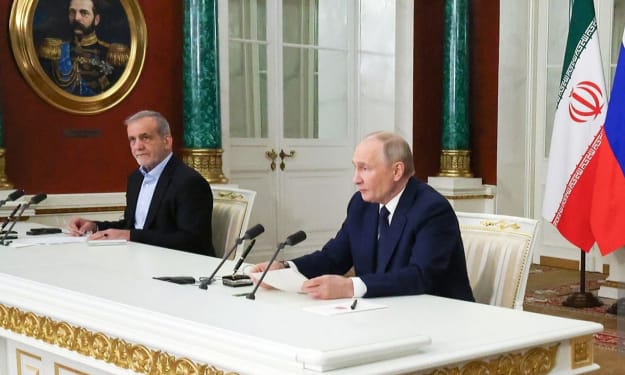
President Pezeshkian Demands 3 Things to Stop War.
The Iranian President Pezeshkian has been speaking about the three things that the country wants to stop the war. Firstly, Iran's legitimate rights, payment of reparations, and a firm international guarantee that the country won't be attacked in the future. Mr. Pezeshkian said he had been speaking to President Putin and Shabaz Sharif, the Prime Minister of Pakistan. Underlining Iran's commitment to peace. Mr. Pezeshkian personally thanked Russia for standing by his nation in the war. Russia has called for a "de-escalation" of the conflict. Russia has supplied Iran with humanitarian aid as the war has unfolded.
By Nicholas Bishop21 days ago in The Swamp