history
Past politicians, legislation and political movements have changed the course of history in ways both big and small. Welcome to our blast to the past.
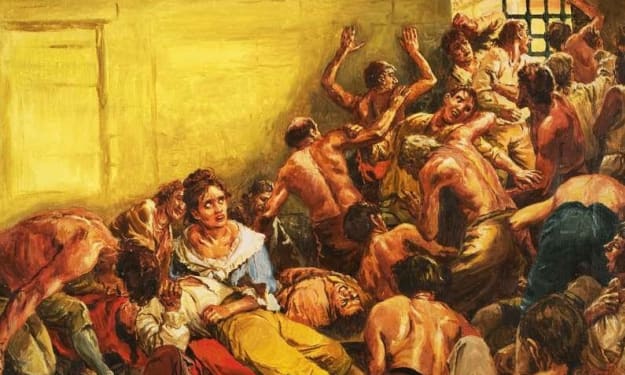
The Myth of the Black Hole of Calcutta
The story of the Black Hole of Calcutta was one that was believed for decades to be the truth, the whole truth and nothing but the truth, but what really happened would appear to be very different from what the history books used to tell.
By John Welford6 years ago in The Swamp
Peter Minuit and Dismal Jimmy
On 24th May 1626, a director of the Dutch West India Company named Peter Minuit, a Dutch-speaking German, bartered a consignment of pots, pans, fish hooks, tools and cloth, together worth around 60 guilders, for an island at the mouth of the Hudson River. The value of that island, named Manhattan (“island of hills”) in the local Algonquin language, has risen considerably between then and now!
By John Welford6 years ago in The Swamp
The Marriage and Divorce of Napoleon and Josephine
On 9th March 1796 Napoleon Bonaparte, rapidly rising through the ranks of the French military, married Josephine Tascher de la Pagerie in a civil ceremony. She was six years older than him and had been married before to a victim of the guillotine, but had retained his name of de Beauharnais. She had also been imprisoned for a time so was perhaps fortunate to have survived.
By John Welford6 years ago in The Swamp
The Emancipation of Russia's Serfs in 1861
The Emancipation of the Serfs of 1861, carried out by Russian Tsar Alexander II, is often regarded as a rare act of liberalism and humanity by an autocratic regime. However, in reality it was just another measure designed to preserve the status quo.
By John Welford6 years ago in The Swamp
The story of Monmouth's Ash
James Fitzroy 1st Duke of Monmouth was born on 9th April 1649 in Rotterdam, The Netherlands. His father was King Charles II of England and his mother was Lucy Walter, the King’s mistress. The couple had fled to The Netherlands after the execution of the King’s father, King Charles I.
By John Welford6 years ago in The Swamp
The possibly bizarre death of King Charles IX
King Charles IX of France died on 30th May 1574 at the age of 23, probably from tuberculosis. However, the stories that arose shortly after that time painted a much more sinister picture, with his death being attributed, one way or another, to his mother, the scheming regent Catherine de Medici.
By John Welford6 years ago in The Swamp
On Hegel, Marx & Du Bois
Though all three of our philosophers see self-conscious thought as impacted by our social position, their particular way of expressing this varies. In the case of Hegel, he exemplifies his ideas with what is now called the Master-Slave Dialectic. In this piece, Hegel argues that when two individuals meet one another, a battle ensues between the parties to see who will become subservient to the other (who will become the master and who will become the slave to the master). In this process, the master establishes his self-conscious by imposing himself upon the slave, who in turn establishes his own self-conscious through his subservience to the master. However, one finds a paradox immediately in the idea of establishing a self-consciousness in relation to the subservience of one to himself - and on the other hand, establishing a self-consciousness in relation to being subservient to the other - as the self-conscious of an object necessarily implies some awareness of self, as a subject, which is separate from the perceived object. Hegel is aware of this contradiction, and so requires that a change in the relationship between master and slave must take place. He does so by stating that the
By Kent Prion6 years ago in The Swamp
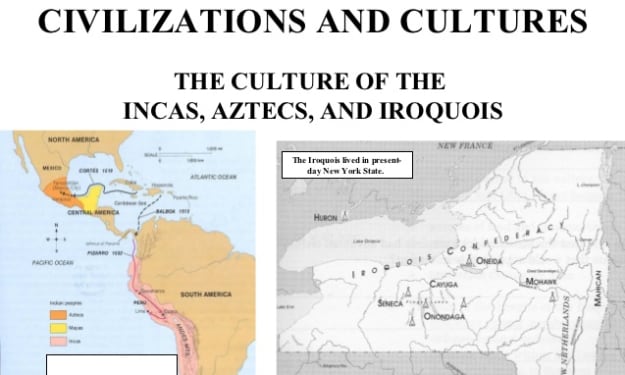
Early Cultures In America
Early Cultures in the America Archaeologists have labeled the earliest humans in North America the Clovis peoples, named after a site in New Mexico where ancient hunters around 9500 B.C.E. (before the Common Era) killed tusked woolly mammoths using distinctive "Clovis" stone spearheads. They also used a wooden device called an atlatl, which gave them added leverage to hurl spears farther, and more accurately. Over many centuries, as the climate warmed, days grew hotter, and many of the largest mammals-mammoths, mastodons, giant bison, and single - hump camels-died, and grew extinct.
By Fahim Vohra6 years ago in The Swamp
Can and Should Psychology Be Used to Explain the Holocaust.
Upon watching a Holocaust documentary or hearing from a holocaust survivor, one of the many questions that will no doubt be on people’s minds is “how could it happen? How could people sanction and carry out the systematic murder of 6 million people?” The truth is that there are many observations, studies and experiments that attempt to answer that question, but I question whether we study this enough in mainstream Holocaust education. The most common explanations look at societal factors such as the rigorous Nazi propaganda machine that slowly dehumanized the Jews and allowed for the escalation of violence in the years to come, but I don’t believe that this definitively answers the question. Surely mere posters and speeches cannot fill the void between disliking someone because of their religion, which is a common phenomenon in human history, and being able to shoot them dead at point-blank range or lead them into a gas chamber. I Want to explore psychology’s take on the Holocaust and how those closest to the violence and brutality not only went along with it, but actively participated.
By Louis Fell6 years ago in The Swamp