
The Phantom of North Pond: The Man Who Disappeared Into the Woods for 27 Years
In an era of relentless digital noise, one man committed the ultimate act of rebellion. He vanished. Here is the chilling, psychological true story of a man who walked away from humanity—and didn't speak a single word for nearly three decades

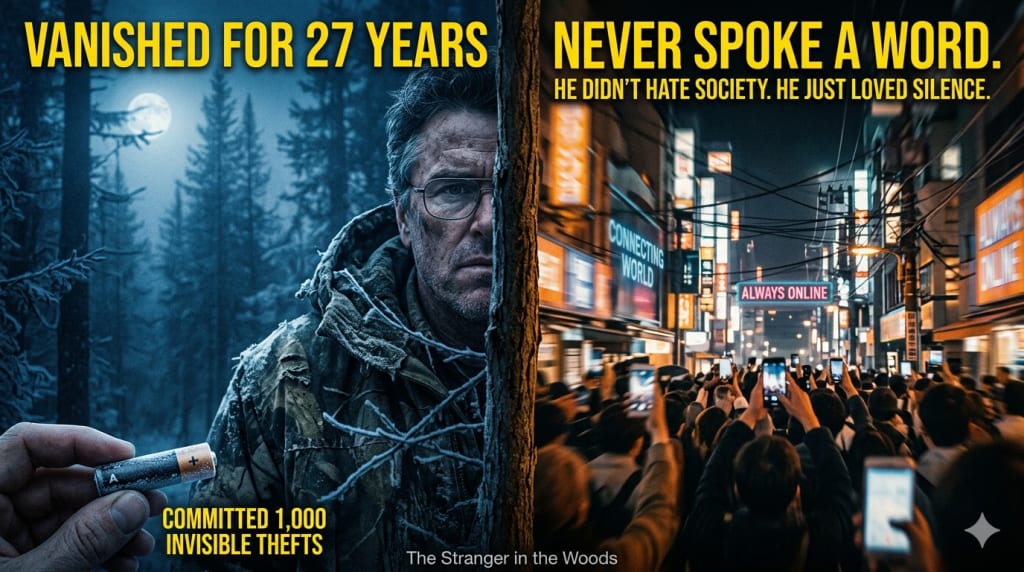
Try to imagine the sound of absolute silence.
Not the quiet of an empty room, where the hum of a refrigerator or the distant passing of a car still anchors you to civilization. Imagine a silence so profound, so heavy, and so unbroken that you can hear the blood pumping through your own veins. Imagine living in that silence for a day. Then a week. Then a year.
Now, imagine living in it for twenty-seven years.
We live in a world that is terrified of disconnection. We are tethered to smartphones, constantly bombarded by notifications, emails, and the digital voices of millions of strangers. The idea of truly dropping off the grid—leaving no forwarding address, sending no final text message, and simply ceasing to exist in the eyes of society—feels completely impossible.
Yet, in 1986, a young man named Christopher Knight did exactly that.
He didn't write a manifesto. He didn't suffer a public mental breakdown. He simply drove his car into the deep, unforgiving woods of Maine, tossed the keys on the dashboard, and walked into the trees.
For the next twenty-seven years, he became a ghost. He lived entirely alone, surviving the brutal winters and committing over a thousand invisible burglaries, all without speaking a single word to another human being.
This is the deeply unsettling, psychologically gripping story of the North Pond Hermit. It is a cinematic thriller written not in Hollywood, but in the dark, frozen woods of New England. It challenges everything we believe about human nature, sanity, and the terrifying allure of absolute isolation.
The Quiet Departure
The year was 1986. The world was loud. The Chernobyl disaster had just shocked the globe, Top Gun was dominating the box office, and the Cold War was still casting a shadow over global politics.
Christopher Knight was just twenty years old. He grew up in a relatively normal, quiet family in Massachusetts. He had a job installing home alarm systems. He had no criminal record, no history of severe mental illness, and no apparent enemies.
One morning, without telling his boss, his parents, or his siblings, Knight got into his brand-new Subaru Brat. He drove north, cutting through the highways of the East Coast, heading deep into the state of Maine. He drove until the paved roads turned to dirt, and the dirt roads turned to overgrown logging trails.
When the car could go no further, he stopped. He left the keys inside. He grabbed a rudimentary camping tent, a backpack, and a few basic supplies.
And then, he walked away.
He had no survival training. He had no map. He didn't even have a compass. He later admitted that he had absolutely no long-term plan. He was not trying to make a statement about modern society, nor was he on a spiritual quest. He was simply possessed by an overwhelming, undeniable compulsion to be entirely alone.
He walked south, navigating by the position of the sun. He walked for days, letting the noise of the world fade behind the thick canopy of pine trees, until he found a place where he believed no human would ever find him.
The Invisible Camp
Knight eventually settled in a dense, heavily wooded area near North Pond, nestled within the Belgrade Lakes region of Maine.
To call his campsite "remote" is actually a paradox. Physically, he was only a few minutes' walk from hundreds of summer cabins and a local summer camp. But topologically, he was invisible.
He found a small, violently uneven patch of ground completely surrounded by massive, glacial boulders. The rocks created a natural fortress. The tree canopy above was so thick that the ground was perpetually cast in shadow, hiding his camp from the sky. To get to his tent, you had to squeeze through a specific, hidden crevice between the rocks, stepping over dead logs and thick brush.
He set up a nylon tent. He strung up a dark-colored tarp to camouflage his position. He settled in.
But Knight immediately faced the brutal reality of the wilderness. He was not a trained outdoorsman. He did not know how to hunt deer, trap rabbits, or forage for edible plants. He didn't want to live off the land; he simply wanted to live hidden within it.
To survive, he had to become a parasite on the very society he had abandoned.
The Phantom of North Pond
Knight developed a system of survival that was both brilliant and entirely illegal. Under the cover of total darkness, he would leave his camp and silently navigate the dense woods to the nearby summer cabins.
He didn't kick in doors or break windows. Thanks to his background installing security systems, he knew exactly how to bypass locks without leaving a trace. He would slip into a cabin while the owners were away—or sometimes, terrifyingly, while they were fast asleep in the next room.
He took only what he needed to survive. He stole peanut butter, heavily processed junk food, batteries, propane tanks, and warm clothing. He stole Stephen King novels and National Geographic magazines to pass the time.
He was incredibly meticulous. If he broke a lock, he would sometimes try to fix it. If he moved a piece of furniture, he put it back. He never stole expensive jewelry, electronics, or cash, because a man living in a tent has no use for money.
Over the course of 27 years, Christopher Knight committed an estimated 1,000 burglaries. It is considered one of the longest, most prolific strings of burglaries in the history of the United States.
But he was never seen.
His invisible crime spree created a profound psychological terror among the local residents. Imagine waking up in your locked cabin, deep in the woods, only to find that someone had been inside your kitchen while you slept. The intruder hadn't taken your wallet; they had taken half a loaf of bread and a pack of AA batteries.
The locals began to whisper about a ghost. They called him the Phantom of North Pond. Some cabin owners were so terrified they stopped coming to the lake. Others left notes on their kitchen tables, begging the intruder to take the food they left out and spare their doors.
Law enforcement was baffled. They set up sting operations. They searched the woods. But Knight was a ghost. He never left footprints in the snow—he would step only on exposed roots and rocks to hide his tracks.
The Brutality of the Maine Winter
While the summer burglaries kept him fed, the true test of Knight’s survival was the Maine winter.
Winter in New England is not a season; it is a lethal force of nature. Temperatures routinely plummet to twenty degrees below zero. Snow piles up by the foot. Most professional survivalists state that living outdoors in Maine through the winter, without a fire, is a physical impossibility.
But Knight had a strict rule: No fires. Smoke would reveal his location. A campfire would draw attention. So, for twenty-seven winters, he lived in absolute, freezing darkness.
To survive the plummeting temperatures, he wrapped himself in multiple stolen sleeping bags. He slept during the day when the sun offered a slight increase in warmth. But the nights were a battlefield.
Knight would wake up in the pitch-black cold, his body shivering violently. He knew that if he fell into a deep sleep, the cold would simply stop his heart. He would force himself out of his sleeping bags and pace the tiny perimeter of his camp, walking back and forth in the snow for hours just to keep his blood circulating.
He suffered from severe frostbite. He lived on the razor's edge of starvation. Yet, he endured it. Every single year. He preferred the physical torture of freezing to death over the psychological torture of returning to society.
The Dissolution of the Self
The most fascinating aspect of Christopher Knight's story is not how he survived the cold, or how he evaded the police. It is what happened to his mind.
Human beings are intensely social creatures. Our entire psychology is built on the reflection of others. We know who we are based on how we interact with our friends, our family, and our society.
For 27 years, Knight did not have a single conversation. He later recalled that at some point in the 1990s, he crossed paths with a hiker on a trail and mumbled the word "Hi." Aside from that single syllable, his vocal cords went entirely unused for nearly three decades.
What happens to a human brain when it is completely deprived of an audience?
When psychologists eventually spoke to him, Knight offered a deeply profound, haunting description of his mental state.
He didn't go crazy. He didn't hallucinate or invent imaginary friends. Instead, his ego simply dissolved.
"I lost my identity," he later explained. "There was no audience. No one to perform for. There was no need to define myself. I became the forest."
Without the judgment, expectations, or gaze of other humans, Christopher Knight ceased to be a distinct personality. He became a purely observational creature. He watched the seasons change. He watched the patterns of the moon. He experienced a state of existence that Zen monks spend a lifetime trying to achieve, born out of absolute, uninterrupted silence.
He was perfectly, completely content.
The Trap is Sprung
But the modern world does not allow ghosts to exist forever.
By 2013, the local authorities had grown desperate. A highly determined game warden named Sergeant Terry Hughes made it his personal mission to catch the Phantom of North Pond.
Hughes focused on a local facility called the Pine Tree Camp, a summer camp for disabled children that Knight frequently raided for bulk food supplies. Hughes set up military-grade motion sensors and high-tech cameras, wiring the alarms directly to his own house.
On the night of April 4, 2013, the alarm triggered.
Hughes sped to the camp, slipping through the dark woods. As he approached the dining hall, he saw a shadow moving inside.
He burst through the door, weapon drawn.
There, illuminated by the beam of the flashlight, stood Christopher Knight. He was 47 years old. He was wearing an oversized jacket and thick glasses. His skin was pale, untouched by the sun.
When confronted, the phantom did not run. He did not fight. He simply raised his hands and surrendered.
When Hughes asked for his name, Knight hesitated. He opened his mouth, and a soft, raspy, completely unfamiliar voice came out. It was a voice that hadn't been exercised in a quarter of a century.
"Christopher," he whispered.
The Phantom of North Pond had finally been caught.
The Return to the Noise
When Knight was brought out of the woods, the media explosion was instantaneous. Journalists from around the world swarmed the small town in Maine. Everyone wanted to know the secrets of the ultimate hermit.
But stepping back into the world of 2013 was a traumatic shock for Knight.
When he left society in 1986, the internet did not exist in the public sphere. There were no smartphones. There was no social media. He stepped out of the silent woods and was immediately crushed by the overwhelming, relentless noise of the digital age.
He found the modern world to be too fast, too loud, and profoundly exhausting. The fluorescent lights of the jail cell gave him headaches. The constant chatter of other inmates grated on his nerves.
He was eventually sentenced to seven months in jail for the burglaries, a relatively lenient sentence ordered by a judge who recognized that Knight was not a malicious criminal, but a deeply unusual psychological outlier.
During his interviews with a journalist named Michael Finkel (who later wrote a brilliant book on him titled The Stranger in the Woods), Knight made it very clear that he did not view his time in the forest as a mistake. He did not seek redemption. He only regretted that he had to steal to survive, and he was deeply apologetic to the victims of his burglaries.
But he never apologized for leaving.
"I found a place where I was content," he said. "And I stayed there."
The Mirror We Dare Not Look Into
The story of Christopher Knight does not offer a neat, motivational wrap-up. He didn't build a billion-dollar company, and he didn't invent a technology that changed the world.
Instead, his story acts as a terrifying, fascinating mirror.
We look at Knight and we are forced to ask ourselves deeply uncomfortable questions. How much of our own identity is real, and how much of it is just a performance for the people around us? If you were stripped of your social media profiles, your job title, and your friends, who would you actually be?
Could you sit alone in a room, in total silence, for a single day without losing your mind?
Christopher Knight proves that human resilience is vast. The mind can adapt to the harshest, darkest, most isolated conditions on earth. He showed us a life completely outside the system that we all blindly accept as normal.
He reminds us that while we are desperate for connection, there is a quiet, hidden part of the human soul that yearns to just walk away, step into the trees, and finally be quiet.
Most people fear being alone. He mastered it.
And while he may have been dragged back into the noise of civilization, a piece of Christopher Knight will forever remain in the silent, freezing shadows of the Maine woods.
About the Creator
Frank Massey
Tech, AI, and social media writer with a passion for storytelling. I turn complex trends into engaging, relatable content. Exploring the future, one story at a time
Keep reading
More stories from Frank Massey and writers in Motivation and other communities.
The Woman Death Could Not Catch: The Terrifying, Unbelievable Life of Violet Jessop
History is written by the survivors. But every so often, history encounters a survivor so remarkably stubborn, so statistically improbable, that their life reads less like a biography and more like a mythological epic.
By Frank Massey 13 days ago in Motivation
Positive confessions can sometimes go South
The power of positive confessions It's popular today for people to say, "Think happy thoughts." Make a positive confession." Send out good vibrations, project positive energy, and speak life. There is nothing wrong with that.
By Cheryl E Preston4 days ago in Motivation
From Debt to Designer
At 24, Maya had exactly $12.47 in her bank account... and $38,000 in debt. Her phone buzzed constantly with payment reminders, overdue notices, and messages she didn’t want to open. She avoided checking her email. She avoided looking at her reflection some days too, because all she saw was someone who had fallen behind in life.
By MIGrowthabout 17 hours ago in Motivation



Comments
There are no comments for this story
Be the first to respond and start the conversation.