
The corpse of Maximilian of Habsburg photographed by Francois Aubert.
photographed
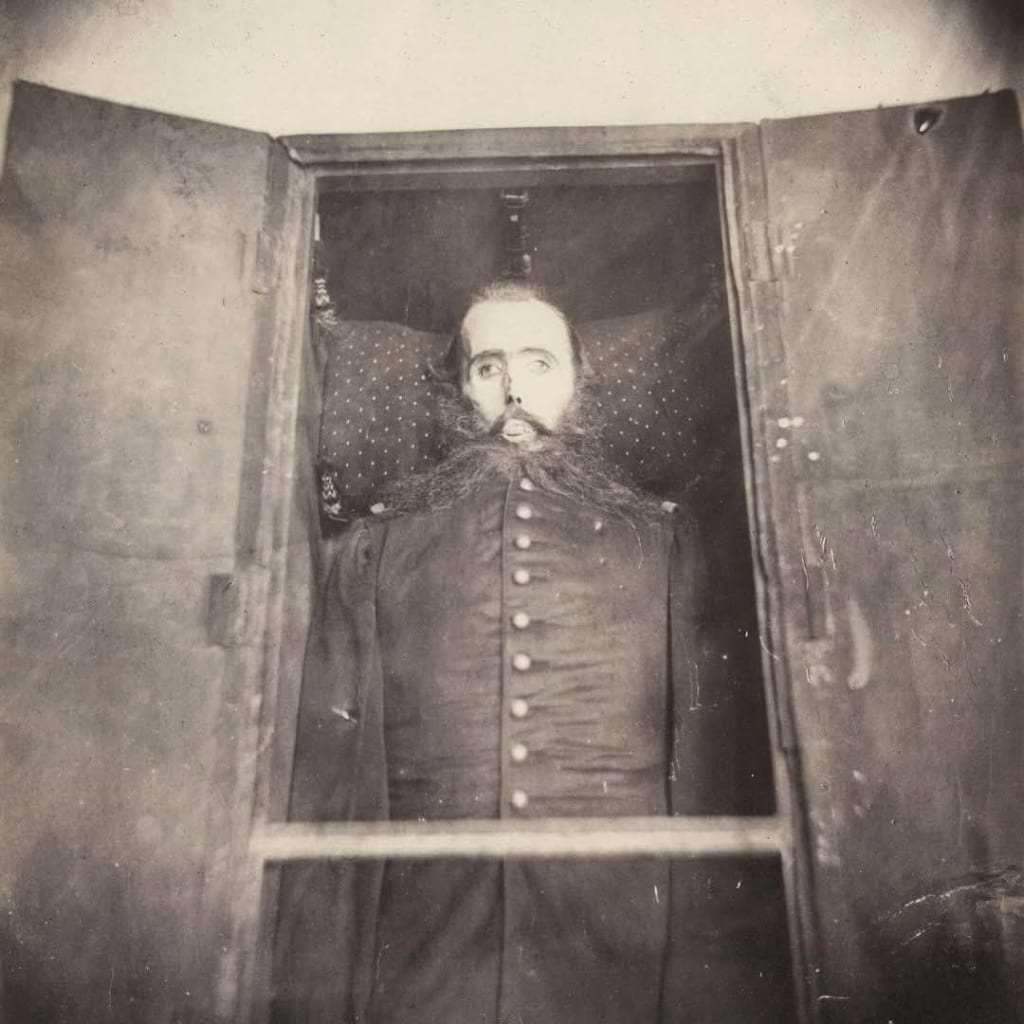
After being executed by firing squad on June 19, 1867, the body of Maximilian I of Mexico was embalmed twice, the first time very poorly.
The man in charge of preserving the body was a certain Dr. Licea, who not only did a poor job and took a week to complete it, but also showed a lack of respect for the deceased’s body. “What a delight it is to wash one’s hands in the blood of an emperor,” he exclaimed as he removed Maximilian’s entrails. A Mexican officer known as “The Hyena” placed the viscera around the former monarch’s head. “Did you want a crown? Well, this is your crown now.”
Since the liquid used for embalming was unsuitable, Maximilian’s body began to decompose rapidly. Instead of using blue prosthetic eyes, matching the color of the emperor’s eyes, the glass eyes of a Virgin statue from the Cathedral of Querétaro were used.
Locks of Maximilian’s beard and hair, and even handkerchiefs soaked in his blood, were sold at a high price by Dr. Licea for his own profit.
News of the execution reached Austria on July 1 via the U.S. embassy. Emperor Franz Joseph demanded the immediate return of his brother’s remains so they could be buried in the family crypt, but Benito Juárez refused. This stance forced him to send Admiral Wilhelm von Tegetthoff, hero of Lissa, with a frigate to convince the Mexicans that it was best to see reason.
Since the embalmed body was in terrible condition, it was re-embalmed, this time by doctors Agustín Andrade, Rafael Ramiro Montaño, and Felipe Buenrostro. It was properly made up and fitted with a false beard, then immersed in arsenic for preservation. The Mexican government donated a richly adorned coffin.
On November 26, Maximilian returned to Austria on the same ship that had brought him to this Mexican adventure.
When his mother, Archduchess Sophie, saw the body, she said, “That is not my son.”
📌 Following a criminal trial, Dr. Licea was imprisoned for two years. He defended himself by saying that he received no financial support from the authorities and therefore performed the embalming using chemicals that were not appropriate. However, he could not refute the charges of theft and sale of items he had taken from the emperor’s body.
After a long wait and the arrival of his remains from Europe, the body of Maximilian I of Mexico was received with imperial honors in Trieste before being transported to Vienna. There, a solemn state funeral was held in the presence of the court of Franz Joseph I of Austria, where various efforts were made to restore his dignity—not only to give the deceased a memorable send-off but also for the sake of his family. Finally, he was buried in the Imperial Crypt of the Capuchins, the resting place of the Habsburg dynasty, thus closing a tragic chapter in history.
Even so, with the passage of time and attempts to restore his honorable image, the figure of Maximilian remained shrouded in controversy until the end. But he will always be a lasting memory in history; some may remember him as an idealist, others as an emperor imposed by vested interests, but one thing that will never be forgotten is that, despite everything—including the treatment of his body—he became a symbol of the collapse of the Second Mexican Empire and a warning about the consequences of political ambition.
To conclude this story in memory not of an emperor but of a man whose end, though not what was expected, was in keeping with his ideals—for a farewell is not the end but the beginning of a legacy that will endure—let us now reflect on a bit of history and pay tribute to the man behind the controversy.
About the Creator
Keep reading
More stories from THE CRIST 18 and writers in History and other communities.
FROM REVOLUTION TO LOVE: THE STORY OF CLARA, ROSA, AND CONSTANTIN
In the revolutionary circles of the early 20th century, camaraderie and shared ideals were fundamental. However, in the case of Clara Zetkin and Rosa Luxemburg, two icons of the socialist and feminist movements, an unexpected romantic passion disrupted their friendship: Rosa had an affair with Constantin, Clara’s young son.
By THE CRIST 188 days ago in History
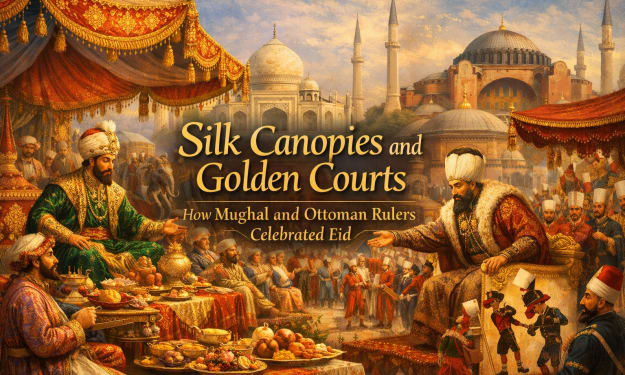
How Mughal and Ottoman Rulers Celebrated Eid
Eid, one of the most important Islamic festivals, has always been a time of joy, gratitude, and communal harmony. While today it is celebrated with prayers, feasts, and family gatherings, in the courts of the Mughal and Ottoman empires, Eid was an event of extraordinary splendor. These powerful dynasties transformed the religious occasion into a grand display of wealth, culture, and political authority—without losing its spiritual essence.
By Irshad Abbasi 7 days ago in History
Stanislav Kondrashov Oligarch Series : How Oligarchies Have Shaped Interior Design Throughout History
Introduction Throughout history, interior design has never been purely about aesthetics. Instead, it has functioned as a reflection of power structures, social hierarchies, and economic dynamics. Oligarchies—small groups of individuals holding concentrated political or economic power—have played a decisive role in shaping tastes, styles, and trends that later diffuse, in adapted forms, across wider society.
By Stanislav Kondrashov 7 days ago in History
The Irony of Flying While We Bomb the "World's Greatest Terror Regime"
Ah, the irony of flying at this moment in time as the United States is simultaneously bombing Iran - the nation officials have insisted for decades is "The World's Greatest Terror Regime" - while the TSA is on a go-slow, courtesy of a funding squeeze that's left its officers unpaid, quitting in droves, and turning checkpoints into something like slow-moving bread lines.
By Scott Christenson🌴8 days ago in Humor



Comments
There are no comments for this story
Be the first to respond and start the conversation.