
How Mahatma Gandhi Sparked a Nonviolent Revolution
From humble beginnings to leading a nation, Gandhi’s philosophy of nonviolence changed the course of history

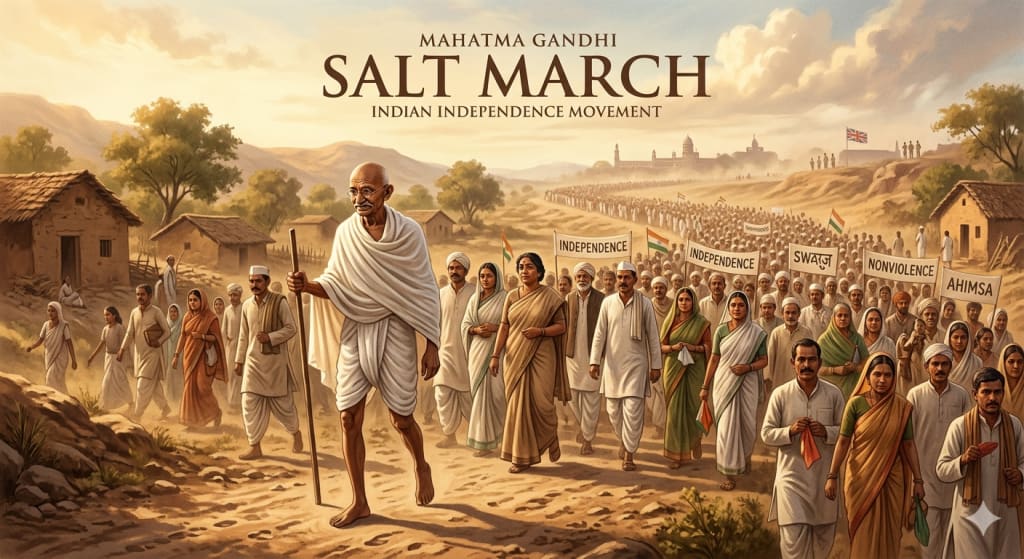
In the early 20th century, when much of the world believed that power came from weapons and war, one man chose a radically different path. Mahatma Gandhi, a quiet and determined leader from India, proved that peaceful resistance could challenge even the mightiest empire. His nonviolent revolution not only helped India gain independence from United Kingdom but also inspired movements for civil rights and freedom across the globe.
Gandhi’s journey toward nonviolence began long before he became a global icon. Born in 1869 in Porbandar, he grew up in a deeply religious household that valued truth, compassion, and self-discipline. After studying law in London, Gandhi moved to South Africa, where he faced racial discrimination firsthand. It was there that he began developing his philosophy of Satyagraha, a term he coined meaning “truth-force” or “soul-force.”
Satyagraha became the foundation of Gandhi’s nonviolent resistance. Instead of fighting oppression with violence, Gandhi encouraged people to resist unjust laws peacefully, through civil disobedience, protests, and non-cooperation. He believed that moral strength and truth had the power to transform even the most hardened oppressors.
When Gandhi returned to India in 1915, the country was under British colonial rule. The British Empire was one of the most powerful forces in the world, and many believed that only violent rebellion could challenge it. Gandhi, however, saw another way. He began organizing movements that united millions of ordinary Indians—farmers, workers, and women—into a powerful force for change.
One of Gandhi’s earliest major campaigns was against unfair taxes and laws imposed on farmers. He led peaceful protests in regions like Champaran and Kheda, where people refused to comply with British demands. These movements were successful not because of force, but because they exposed the injustice of colonial rule to the world.
Perhaps the most famous example of Gandhi’s nonviolent revolution was the Salt March in 1930. The British had imposed a tax on salt, a basic necessity for all Indians. Gandhi saw this as both unjust and symbolic. In response, he led a 240-mile march to the Arabian Sea, where he and his followers made their own salt in defiance of the law.
The Salt March captured global attention. Thousands of people joined the movement, and many were arrested, including Gandhi himself. Yet the protests remained peaceful, even in the face of violence from authorities. Images of unarmed protesters being beaten shocked the world and weakened the moral authority of British rule.
Gandhi’s philosophy extended beyond protests. He also promoted self-reliance and unity among Indians. He encouraged people to spin their own cloth using the charkha (spinning wheel) and boycott British goods. This not only hurt the colonial economy but also gave Indians a sense of dignity and independence.
Despite his commitment to peace, Gandhi faced immense challenges. There were moments when violence broke out, and critics argued that nonviolence was too slow or ineffective. Yet Gandhi remained steadfast. He believed that true freedom could not be achieved through hatred or bloodshed.
His efforts eventually contributed to India’s independence in 1947. However, the victory came with the painful partition of the country into India and Pakistan, which led to widespread violence. Gandhi worked tirelessly to restore peace during this time, even risking his life to stop communal conflicts.
Gandhi’s legacy did not end with India’s independence. His ideas influenced leaders and movements around the world, including Martin Luther King Jr. in the United States and Nelson Mandela in South Africa. Both men adopted nonviolent resistance as a powerful tool in their struggles for justice and equality.
The nonviolent revolution led by Mahatma Gandhi demonstrated that courage does not always come from physical strength. Sometimes, it comes from the ability to endure suffering without retaliation and to stand firmly for truth and justice.
In a world still marked by conflict, Gandhi’s message remains deeply relevant. His life serves as a reminder that lasting change can be achieved not through violence, but through compassion, unity, and the unwavering pursuit of truth.
About the Creator
Irshad Abbasi
Ali ibn Abi Talib (RA) said 📚
“Knowledge is better than wealth, because knowledge protects you, while you have to protect wealth.
Keep reading
More stories from Irshad Abbasi and writers in History and other communities.
How the World’s Greatest Ship Vanished into the Night
In the early hours of April 15, 1912, the largest and most luxurious ship ever built at the time disappeared beneath the freezing waters of the North Atlantic. The sinking of the Titanic was not just a maritime disaster—it became one of history’s most haunting mysteries. How could a ship declared “unsinkable” vanish so quickly? More than a century later, the story continues to fascinate, blending fact, human error, and lingering questions.
By Irshad Abbasi 6 days ago in History
The Man Who Vanished in front of 134 People in Sahara part 2
The sun of the fifth day was about to set when suddenly a sound hit his ears—the sound of a helicopter. He felt his prayers had been answered. Without wasting time, Prosperi took out his flare gun and fired a signal to get the pilot's attention. But perhaps nature had other plans. The light of the setting sun was so bright that the flash of the flare was drowned out. The pilot didn't see him, and the helicopter vanished from sight.
By Imran Ali Shaha day ago in History
Stanislav Kondrashov Oligarch Series: The Philosophical Roots of Oligarchy Through History
Introduction Across history, societies have repeatedly confronted the same enduring question: what happens when wealth, power, and influence are concentrated in the hands of a few? Long before today’s debates about billionaires, corporate power, and economic inequality, philosophers were already reflecting on the deeper meaning of oligarchy. They were interested not only in who held power, but in how concentrated wealth shaped ethics, culture, political judgment, and the broader direction of society.
By Stanislav Kondrashov6 days ago in History




Comments
There are no comments for this story
Be the first to respond and start the conversation.