
From the Streets of Constantinople to the Throne
How a woman from the margins of society became one of the most powerful and influential queens of the Byzantine Empire

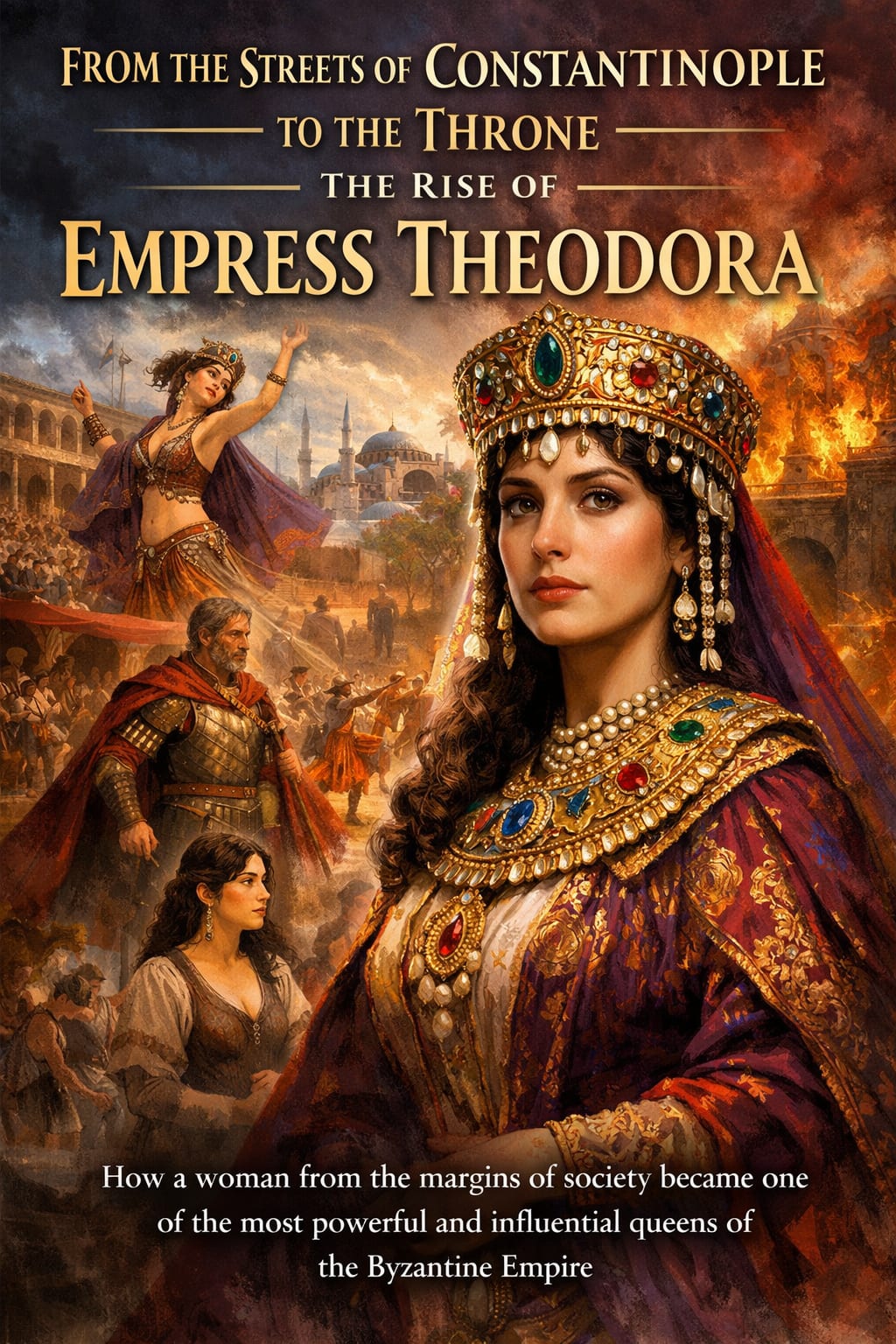
History is filled with extraordinary stories of transformation, but few are as dramatic and compelling as that of Theodora, the woman who rose from the fringes of society to become the Empress of the Byzantine Empire. Her life challenges the rigid class structures of the ancient world and stands as a testament to resilience, intelligence, and destiny.
Born around 500 CE in Constantinople (modern-day Istanbul), Theodora’s early life was far from royal. According to historical accounts, particularly those of the historian Procopius, she was the daughter of a bear trainer who worked at the Hippodrome—the massive arena that served as the social and political heart of the city. After her father’s death, her family struggled to survive, and Theodora was forced into a life on the margins.
As a young woman, she became associated with the entertainment world of Constantinople. In that era, actresses were often linked with scandal and were considered socially inferior. Some sources even suggest she worked as a courtesan. Whether exaggerated or not, these stories underline a crucial fact: Theodora began her life in a position of vulnerability and limited opportunity.
Yet, her story was never destined to remain ordinary.
At some point in her early adulthood, Theodora left Constantinople and traveled across the eastern Mediterranean, reportedly spending time in North Africa. During these years, she underwent a significant transformation—both spiritually and intellectually. She is believed to have embraced a form of Christianity known as Monophysitism, which would later influence her political stance as empress.
When she eventually returned to Constantinople, she was no longer the same woman. She had gained experience, confidence, and a sharp understanding of power and society. It was during this period that she met Justinian, the future emperor of the Byzantine Empire.
Their relationship defied social norms. Roman law at the time prohibited men of high status from marrying actresses. However, Justinian was deeply impressed by Theodora’s intelligence, wit, and strength of character. Determined to marry her, he persuaded his uncle, Emperor Justin I, to change the law. This single act not only altered Theodora’s fate but also marked the beginning of one of the most powerful partnerships in imperial history.
In 527 CE, Justinian ascended the throne as emperor, and Theodora was crowned empress. Unlike many royal consorts, she was not a passive figure. Instead, she became an active and influential partner in शासन (governance), participating in decision-making at the highest level.
Her most defining moment came during the Nika Riots of 532 CE—one of the most dangerous uprisings in Byzantine history. As mobs filled the streets and the imperial palace was threatened, many advisors urged Justinian to flee. It was Theodora who famously refused.
According to historical accounts, she declared that “royalty is a fine burial shroud,” insisting that it was better to die as rulers than live in exile. Her courage and resolve convinced Justinian to stay and fight. The rebellion was ultimately crushed, and the empire was saved. Without Theodora’s intervention, history might have taken a very different course.
Beyond her political influence, Theodora is remembered for her progressive social reforms. She advocated strongly for women’s rights—an extraordinary stance for her time. She supported laws that protected women from forced prostitution, improved divorce rights, and provided greater legal protections against abuse. She also established shelters for former prostitutes, offering them a chance at a new life.
Her policies suggest that she never forgot her own difficult past. Instead of hiding it, she used her position to bring change for others facing similar struggles.
Theodora remained empress until her death in 548 CE. Though her life was often the subject of controversy and criticism—especially from writers like Procopius—modern historians increasingly recognize her as a complex and powerful figure who reshaped the Byzantine Empire.
Her journey from the streets of Constantinople to the imperial throne is more than a tale of luck or fate. It is a story of determination, transformation, and the ability to rise above societal limitations. In a world where birth often determined destiny, Theodora proved that strength of character could rewrite the rules.
Today, she stands as one of history’s most remarkable women—a symbol of how even the most unlikely beginnings can lead to greatness.
About the Creator
Irshad Abbasi
Ali ibn Abi Talib (RA) said 📚
“Knowledge is better than wealth, because knowledge protects you, while you have to protect wealth.
Keep reading
More stories from Irshad Abbasi and writers in History and other communities.
The Princess Who Crossed Boundaries
In an era when royal women were expected to remain confined within palace walls, Anna Komnene stood apart as a bold intellectual and historian. Born in 1083 in Constantinople, she was the daughter of Emperor Alexios I Komnenos, one of the most powerful rulers of the Byzantine Empire. While most princesses were trained in courtly etiquette, Anna was educated in philosophy, medicine, astronomy, and history—fields rarely accessible to women of her time.
By Irshad Abbasi 6 days ago in History
🔥 Edge of Fire: Iran, USA, and Israel Push the World Toward Global War
🔥 Edge of Fire: Iran, USA, and Israel Push the World Toward Global War The world is once again gripped by fear as tensions between Iran, the United States, and Israel erupt into open confrontation. What began as a series of strategic warnings and limited strikes has now evolved into a dangerous and unpredictable conflict. Across the Middle East, explosions, air raid sirens, and military mobilizations are no longer isolated incidents—they are part of a growing crisis that threatens global stability.
By Wings of Time 6 days ago in History
Calakmul: The Three Stones and Two Pyramids of the Ancient Maya City
Calakmul is a genuinely lost ancient Maya city. It is located on the Yucatan Peninsula of Mexico, deep within the Petén Basin's lush forests. The magnificent metropolis was quickly recovered by the jungle once it was abandoned.
By Francis Dami6 days ago in History




Comments
There are no comments for this story
Be the first to respond and start the conversation.