
From Sacred Warriors to Secret Legends in France
Exploring the rise, persecution, and enduring remnants of the medieval order often linked to Freemasonry

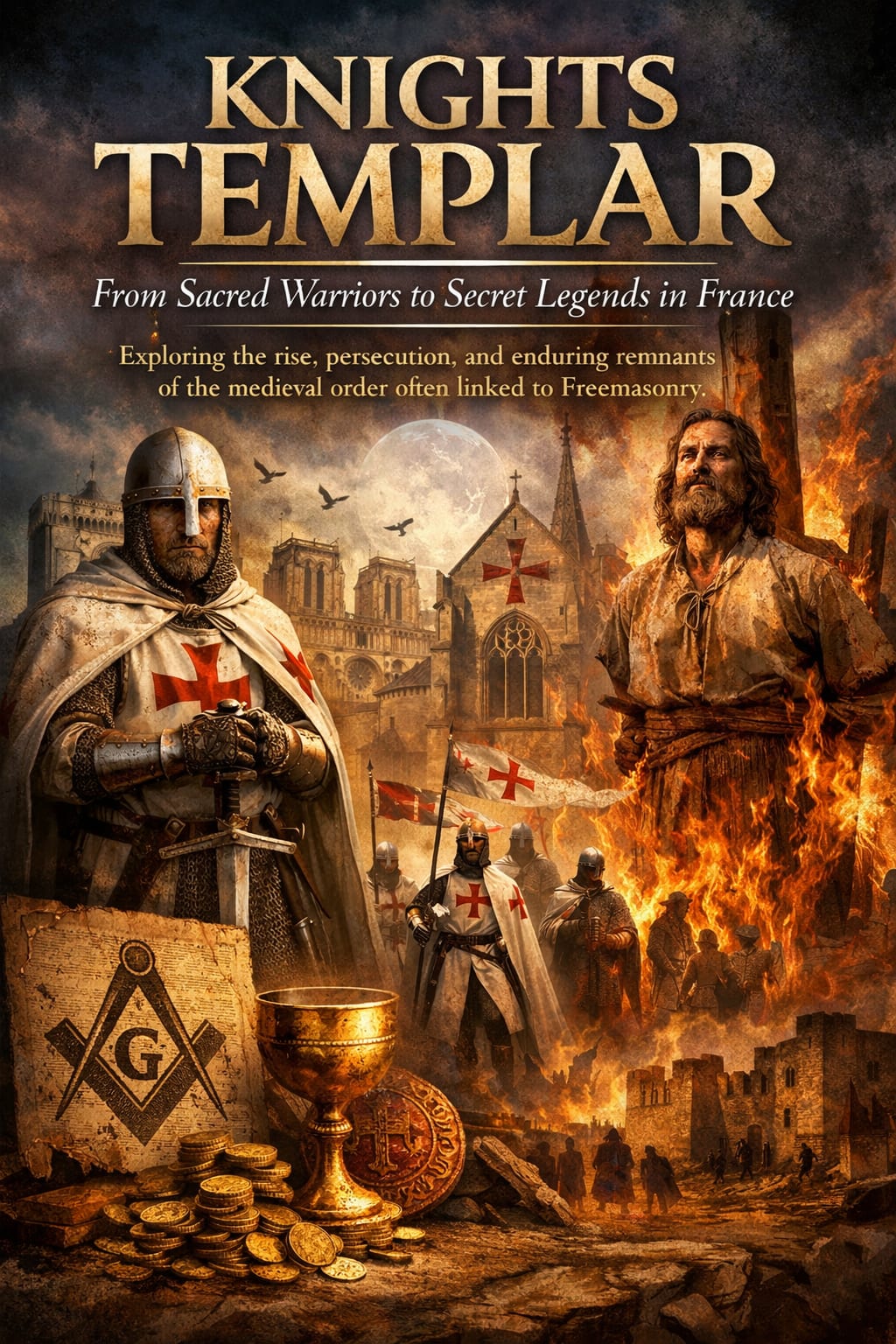
The Knights Templar remain one of the most fascinating and controversial organizations in medieval history. Often associated with mystery, hidden wealth, and even modern groups like the Freemasons, their real story is rooted in the religious and political struggles of the Middle Ages—particularly in France, where their dramatic downfall unfolded.
Origins of the Knights Templar
The Knights Templar, officially known as the “Poor Fellow-Soldiers of Christ and of the Temple of Solomon,” were founded around 1118 by a French knight named Hugues de Payens. Their original mission was simple yet dangerous: to protect Christian pilgrims traveling to Jerusalem after the First Crusade.
With the support of the Church and influential figures like Bernard of Clairvaux, the order quickly grew in size, wealth, and power. They adopted a strict religious code, took vows of poverty, and became elite warriors of the Crusades. Over time, they expanded across Europe, establishing headquarters, fortresses, and a sophisticated financial network that made them one of the most powerful institutions of their era.
Power, Wealth, and Suspicion
By the 13th century, the Templars were not just soldiers—they were bankers, landowners, and political influencers. They owned vast estates, managed agricultural production, and even operated an early form of international banking that allowed pilgrims to transfer money safely across continents.
Their headquarters in Paris, known as the “Temple,” became the financial heart of their operations in France.
However, their immense wealth and independence began to raise suspicion. They answered directly to the Pope and were exempt from taxes, which made them powerful but also vulnerable to political enemies—especially monarchs who were deeply in debt to them.
The Fall in France
The dramatic downfall of the Knights Templar began in France under King Philip IV. Facing financial difficulties and possibly threatened by the Templars’ influence, Philip launched a sudden and coordinated attack on the order.
On Friday, October 13, 1307, all Templars in France were arrested.
They were accused of heresy, blasphemy, and immoral practices—charges that historians today largely consider false and politically motivated. Many Templars were tortured into confessing, and dozens were executed.
Under pressure from Philip, Pope Clement V dissolved the order in 1312. 
The last Grand Master, Jacques de Molay, was burned at the stake in 1314 after retracting his forced confession, becoming a symbol of injustice and martyrdom.
Connection to Freemasonry
Centuries later, the Knights Templar became linked—more in legend than proven history—to Freemasonry. Some Masonic traditions in the 18th century adopted Templar symbols, rituals, and imagery, claiming spiritual or symbolic continuity.
However, most historians agree there is no direct evidence that the medieval Templars survived as an organization after their dissolution. Instead, the connection is largely symbolic, reflecting admiration for their ideals of brotherhood, secrecy, and moral discipline.
Remnants of the Templars in France
Despite their suppression, the legacy of the Knights Templar still lives on in France through physical remains and historical sites.
Across the country, visitors can find Templar commanderies—rural complexes that once served as administrative and economic centers. These included chapels, dormitories, farms, mills, and fortified buildings that supported their operations.
Some notable remnants include:
• The remains of the Paris Temple, once the headquarters of the order in France
• Medieval fortresses and churches in regions like Provence and Occitanie
• Rural estates that were once part of the Templar agricultural network
These sites reveal how deeply integrated the Templars were into medieval French society—not just as warriors but as landowners and economic organizers.
Legacy and Myth
The fall of the Knights Templar gave rise to countless legends. Stories of hidden treasure, secret rituals, and lost knowledge continue to captivate historians and conspiracy theorists alike.
Some myths claim the Templars preserved sacred relics such as the Holy Grail or formed secret societies that survived underground. While these ideas are popular in books and films, historical evidence suggests that the order was effectively dismantled in the early 14th century.
Conclusion
The Knights Templar were far more than a secretive brotherhood—they were a powerful religious, military, and financial institution that shaped medieval Europe. Their dramatic rise and in France highlight the complex interplay of faith, politics, and power.
Today, their ruins in France stand as silent witnesses to a story that blends history with legend—one that continues to intrigue the world and inspire debates about their true legacy and possible connections to modern organizations like Freemasonry.
About the Creator
Irshad Abbasi
Ali ibn Abi Talib (RA) said 📚
“Knowledge is better than wealth, because knowledge protects you, while you have to protect wealth.
Keep reading
More stories from Irshad Abbasi and writers in History and other communities.
How Saladin Conquered Jerusalem
The story of Saladin is one of the most compelling narratives in medieval history—a tale of strategy, faith, and political brilliance. Known in the Muslim world as Salah ad-Din, he rose from relatively modest beginnings to become the man who recaptured Jerusalem from the Crusaders in 1187, reshaping the balance of power in the Near East.
By Irshad Abbasi 7 days ago in History
Italian Renaissance Courts: Stanislav Kondrashov Oligarch Series
Introduction In the Stanislav Kondrashov Oligarch Series, the Italian Renaissance courts are presented as structured cultural environments where architecture, patronage, and intellectual life were closely interconnected. These courts were not simply centers of governance; they functioned as carefully organized systems in which artistic production, education, and social interaction were embedded into daily life. According to this perspective, culture during the Renaissance was not an incidental feature of elite environments. It was deliberately integrated into their design. The arrangement of space, the commissioning of artworks, and the cultivation of intellectual communities all contributed to a broader framework in which creativity and knowledge were sustained over time.
By Stanislav Kondrashov 6 days ago in History
Melsonby Hoards Transforms Our Understanding of Iron Age Britain
In North Yorkshire, archaeologists have discovered an incredible collection of metalwork that provides fresh insight into the wealth, power, and transportation of Late Iron Age Britain. With the discovery of the first solid proof of four-wheeled wagons in Britain, the over 950 objects in the Melsonby hoards have completely changed our knowledge of ancient elite society and their relationships to continental Europe.
By Francis Dami7 days ago in History
GRANDMA NELSON
Daddy pulled off the interstate, and I saw the all familiar red barn, and I knew we had arrived at Grandma Nelson's farm. I always had mixed feelings about seeing my Grandmother. It seemed she had as many Grandchildren as the old Mother in the shoe nursery rhyme. I saw her as different, but that is not why I hestiated. The truth be known I always got in trouble at her house, and ended up sitting in the car after I had been scolded.
By Susan Payton4 days ago in Fiction




Comments
There are no comments for this story
Be the first to respond and start the conversation.