
From Ayyubid Courts to Mongol Tents
A story of resilience, diplomacy, and survival in the shifting power struggles of the medieval Middle East

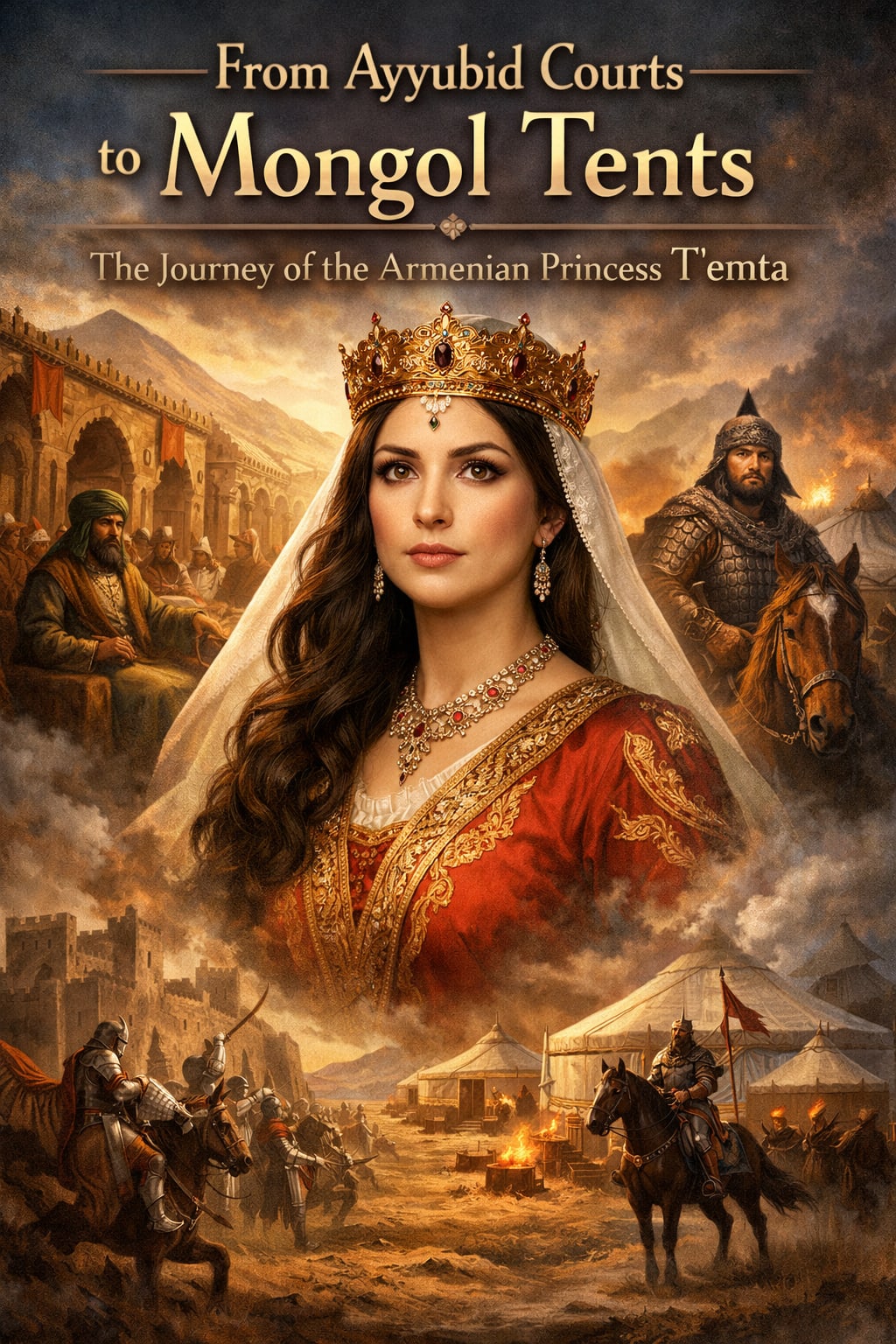
In the turbulent political landscape of the 13th-century Middle East, where empires rose and fell with startling speed, the lives of royal women were often shaped by forces beyond their control. Yet, within these constraints, some women carved out remarkable paths of influence and endurance. Among them was T‘emta, an Armenian princess whose life journey stretched from the refined courts of the Ayyubid dynasty to the stark and formidable encampments of the Mongol Empire.
T‘emta was born into the Armenian nobility, likely connected to the ruling houses of Cilician Armenia, a Christian kingdom strategically positioned between powerful Muslim states and the expanding Mongol forces. Her early life would have been steeped in courtly traditions, religious devotion, and the awareness that marriage was not merely a personal union, but a political instrument. For noblewomen of her time, identity was often shaped by alliances, and T‘emta’s fate would soon reflect this reality.
She was married into the Ayyubid dynasty, the Muslim ruling family established by Saladin. This marriage was not unusual for the time; cross-cultural unions were often arranged to secure peace or reinforce alliances. For T‘emta, this transition meant entering a new world—one defined by Islamic customs, Arabic language, and the intricate politics of Ayyubid rule. Despite the cultural differences, such marriages often required adaptability, and T‘emta likely navigated her new environment with intelligence and tact.
However, stability in the region was fragile. The Ayyubid domains were not a unified empire but a network of semi-independent principalities, often ruled by competing family members. Internal rivalries, combined with external pressures from Crusaders and Mongols, created an atmosphere of constant uncertainty. It was within this volatile setting that T‘emta’s life took a dramatic turn.
At some point, she fell into Mongol hands—whether through capture, political transfer, or strategic negotiation remains debated among historians. The Mongol Empire, rapidly expanding westward under leaders like Hülegü Khan, was reshaping the political map of the region. For many, Mongol rule brought devastation; for others, it offered unexpected opportunities.
T‘emta’s presence in the Mongol camp marks a significant transformation in her life. Unlike many captives, elite women of noble birth could sometimes retain a degree of status and influence within Mongol society. The Mongols, known for their pragmatic approach to governance, often incorporated individuals from diverse backgrounds into their administrative and social structures. Women, in particular, could wield considerable authority within Mongol culture compared to many contemporary societies.
In this new environment, T‘emta may have acted as a cultural intermediary, bridging Armenian, Islamic, and Mongol worlds. Her knowledge of languages, customs, and political networks would have made her a valuable figure. While direct records of her actions are scarce, her survival and continued prominence suggest a capacity for adaptation that went beyond mere endurance.
Her story reflects a broader pattern of how women in medieval Eurasia navigated power. Though often excluded from formal authority, they exercised influence through marriage, diplomacy, and cultural exchange. T‘emta’s journey—from Armenian princess to Ayyubid consort, and then to a figure within the Mongol sphere—illustrates how identity in this period was fluid and contingent.
It is also a story of resilience. Each transition in her life required her to leave behind familiar worlds and adapt to new ones, often under circumstances she did not choose. Yet, rather than disappearing from the historical record, she remained a figure of note, suggesting a strength of character and an ability to negotiate her position in vastly different political contexts.
T‘emta’s life also underscores the interconnectedness of the medieval world. Far from being isolated regions, Armenia, the Ayyubid territories, and the Mongol Empire were part of a dynamic network of trade, warfare, and diplomacy. Individuals like T‘emta moved across these boundaries, carrying with them ideas, traditions, and influence.
In the end, the story of T‘emta is not just about one woman’s journey; it is about the shifting nature of power and identity in a world defined by change. Her life reminds us that even in times of upheaval, individuals—especially women often overlooked by traditional histories—could play crucial roles in shaping the course of events.
Through her passage from royal courts to nomadic tents, T‘emta stands as a symbol of endurance, adaptability, and the quiet but profound influence of women in history.
About the Creator
Irshad Abbasi
Ali ibn Abi Talib (RA) said 📚
“Knowledge is better than wealth, because knowledge protects you, while you have to protect wealth.
Keep reading
More stories from Irshad Abbasi and writers in History and other communities.
The Queen Who Defied a Crusade
In the shifting political landscape of the 13th century, few figures stand out as boldly as Shajar al-Durr, a woman who rose from slavery to rule Egypt and confront one of the most formidable military campaigns of her time. Her story is not only one of ambition and intelligence but also of resilience, strategy, and ultimately, tragedy. From the shadows of servitude to the heights of political power, she carved a legacy that challenged both societal norms and invading armies.
By Irshad Abbasi 7 days ago in History
Corinne Griffith (1894-1979)
By Brian D’Ambrosio Corinne Griffith, born November 21, 1894, in Waco, Texas, became one of the most admired figures of the silent film era, celebrated for her elegance, poise, and expressive subtlety on screen. Known as “The Orchid Lady of the Screen,” Griffith cultivated an image of refinement and emotional restraint that set her apart from her contemporaries. Beneath the Hollywood persona lay a Texas childhood shaped by her Italian ancestry and the civic prominence of her maternal family, whose accomplishments left a lasting impression on her sense of artistry, ambition, and cultural awareness.
By Brian D'Ambrosio 4 days ago in History
5 Battles in History Where Divine Intervention Changed Everything
War has been a part of human history for as long as we can remember. From defending territories to protecting loved ones, humans have always found a reason to fight. While strategy, planning, and leadership often decide the outcome of battles, there are moments when fate or perhaps something greater intervenes to tip the scales. Here are five of history’s most decisive battles that were allegedly won thanks to divine intervention.
By Areeba Umair5 days ago in History
The Devil's Lettuce
We're all sitting here in a world where you can buy cannabis infused seltzer at a boutique shop that looks like an Apple store... but for about 80 years, the government treated this plant like it was a literal demon from the seventh circle of Hell. Why? Was it because it was actually dangerous? Please. If being dangerous was the criteria, we would have also banned lawn darts and gender reveal parties decades ago.
By Sara Wilson6 days ago in Potent


Comments
There are no comments for this story
Be the first to respond and start the conversation.