
Wood Pulp Market To Reach USD 261.5 Billion by 2035 at 3.7% CAGR
Sustainable Growth in the Global Wood Pulp Market: 2025–2035 Forecast

Market Overview
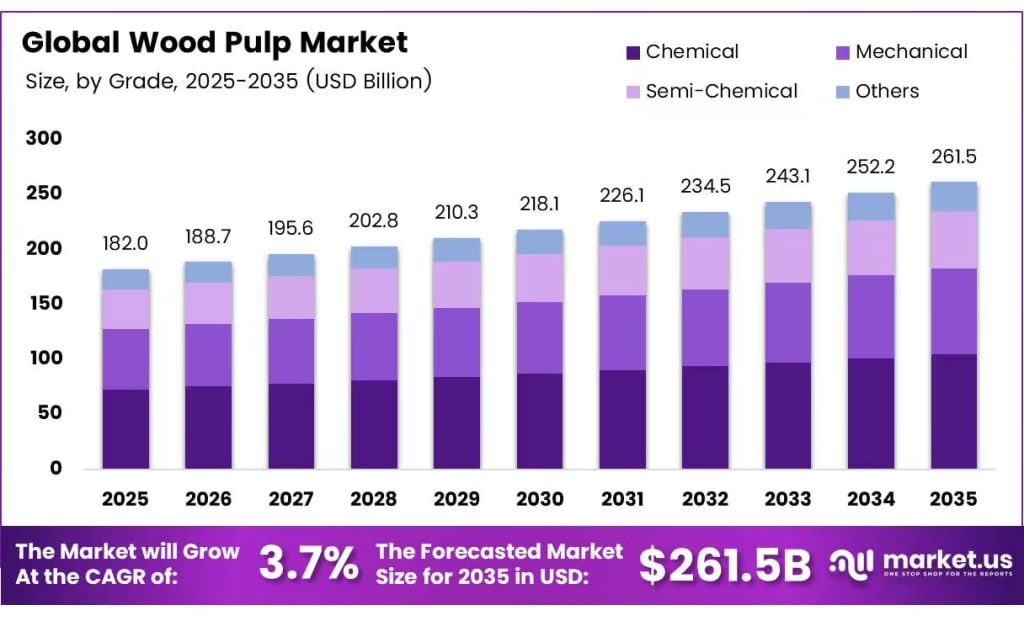
The Global Wood Pulp Market is projected to grow from USD 182.0 billion in 2025 to approximately USD 261.5 billion by 2035, registering a compound annual growth rate (CAGR) of 3.7% during the forecast period from 2026 to 2035. Wood pulp is a fibrous, cellulose-based material obtained from processed wood and serves as the primary raw material for manufacturing paper, packaging, hygiene products, and specialty textiles. Its essential role across multiple industries makes it a critical commodity in global supply chains.
The market is segmented by product types, including chemical pulp, mechanical pulp, and semi-chemical pulp. Among these, chemical pulp continues to dominate due to its superior fiber strength, brightness, and versatility in high-quality applications. Additionally, the industry is witnessing a strong shift toward sustainable and responsibly sourced wood fiber, influencing global production and processing practices.
According to World Bank WITS, China imported USD 612.161 million worth of semi-chemical wood pulp in 2024, equivalent to 1,223,320,000 kg. This substantial import volume highlights China’s massive domestic demand and underscores the Asia Pacific region’s position as the world’s largest consumer of wood pulp products.
Key Takeaways
- The Global Wood Pulp Market is valued at USD 182.0 billion in 2025 and is projected to reach USD 261.5 billion by 2035, at a CAGR of 3.7% during the forecast period 2026 to 2035.
- Hardwood pulp holds the dominant position with a 61.4% market share in 2025.
- Chemical pulp leads with a 51.7% share, driven by demand for high-strength fiber applications.
- Packaging captures the largest share at 56.8%, fueled by e-commerce and sustainable packaging trends.
- Asia Pacific dominates the global market with a 39.1% share, valued at USD 71.2 billion.
By Type Analysis
In 2025, hardwood pulp accounted for the largest share in the by-type segment, capturing 61.4% of the market. Hardwood pulp features shorter fibers that deliver smooth, premium-quality surfaces ideal for tissue, printing, and packaging papers. Its excellent compatibility with chemical pulping processes further strengthens its preference among global manufacturers.
By Grade Analysis
In 2025, chemical pulp held a dominant position in the by-grade segment with a 51.7% market share. The chemical pulping process effectively removes lignin, resulting in high-purity, strong fibers that are well-suited for premium paper and packaging applications. Its compatibility with advanced bleaching technologies also supports the growing demand from hygiene product and specialty paper producers.
By End Use Analysis
In 2025, the packaging segment dominated the by-end-use category, holding a 56.8% share of the global wood pulp market. Rapid growth in e-commerce and retail logistics has significantly increased the need for corrugated boxes, cartons, and paper-based wrapping materials. Furthermore, many brands are actively replacing plastic with sustainable pulp-based alternatives to comply with environmental regulations and meet consumer sustainability expectations.
Regional Analysis
The Asia Pacific region leads the global wood pulp market, commanding a 39.1% share valued at USD 71.2 billion in 2025. China remains the primary driver of demand as the world’s largest importer of wood pulp, fueled by its massive paper and packaging production needs. Rapid industrialization, booming e-commerce, and rising hygiene standards in India, Japan, and Southeast Asia are further boosting regional consumption.
North America maintains a robust position as both a major producer and consumer of wood pulp. The United States and Canada collectively supply significant volumes of chemical and semi-chemical pulp to both domestic and international markets. Growing tissue production capacity and the adoption of sustainable packaging solutions continue to support steady demand growth in the region.
Key Players Analysis
- APRIL Group: A major player with large-scale pulp and paper production facilities in Indonesia and across the Asia Pacific. The company emphasizes sustainable fiber sourcing and continuous investment in mill efficiency. It supplies high-quality hardwood pulp to international markets for packaging, tissue, and specialty paper applications.
- ARAUCO: A leading integrated forestry and pulp company headquartered in Chile with extensive global operations. The company manages vast plantation forests in South America and ranks among the world’s largest producers of pulp and wood products.
- Canfor Corporation: A prominent North American wood products and pulp manufacturer based in Canada. The company operates softwood pulp mills integrated with its lumber business and exports significant volumes of kraft pulp to Asian markets, particularly for tissue and packaging applications.
- Metsä Group: A Finnish forest industry leader specializing in chemical pulp production. The company focuses on bio-economy solutions and sustainable forestry practices. Its innovative bioproduct mill concept integrates pulp manufacturing with bio-energy and biomaterial production, creating both environmental and commercial value.
Conclusion
The Global Wood Pulp Market is poised for steady and sustainable growth through 2035, driven by rising demand for eco-friendly packaging, hygiene products, and paper-based materials. While Asia Pacific continues to dominate consumption, North America and other regions play vital roles in production and innovation. Increasing focus on sustainability, responsible sourcing, and technological advancements in pulping processes will remain key factors shaping the industry’s future.
About the Creator
Hayden Kulas
I am blogger, digital marketing pro since 5 years and writes for Market.us. Computer Engineer by profession. I love to find new ideas that improve websites' SEO. He enjoys sharing knowledge and information about many topics.
Keep reading
More stories from Hayden Kulas and writers in Futurism and other communities.
Termite Bait Systems Market Report: USD 603.3 Million by 2035 at 5.5% CAGR
Market Overview The Global Termite Bait Systems Market is projected to grow from USD 352.6 million in 2025 to USD 603.3 million by 2035, registering a CAGR of 5.5% during the forecast period from 2026 to 2035.
By Hayden Kulasabout 6 hours ago in Futurism
The Fears of AI And How Much Fun It Can Be
ChatGPT has come a long way, as has AI in general. There are those people who are scared of it, and for understandable reasons. People fear that as technologies advance, they’ll be replaced in the workforce. Then, there are the fears that AI could evolve into something that brings us to the brink of extinction.
By The Man Behind The Maskabout 20 hours ago in Futurism
AI in FMCG and Retail Market to hit USD 1,564.9 Billion By 2033
According to the latest Market.us industry insights, the AI in FMCG and Retail market is experiencing strong expansion, driven by the increasing adoption of intelligent technologies to enhance customer experience, optimize supply chains, and improve operational efficiency. The market is projected to reach approximately USD 1,564.9 Billion by 2033, growing from USD 158.9 Billion in 2023, at a CAGR of 8.9% during the forecast period. This growth is supported by the rising use of AI for demand forecasting, inventory management, and personalized marketing across retail environments.
By Roberto Crum7 days ago in Futurism



Comments
There are no comments for this story
Be the first to respond and start the conversation.