
The Planet Nine Hypothesis: A Hidden Giant at the Edge of Our Solar System
Space

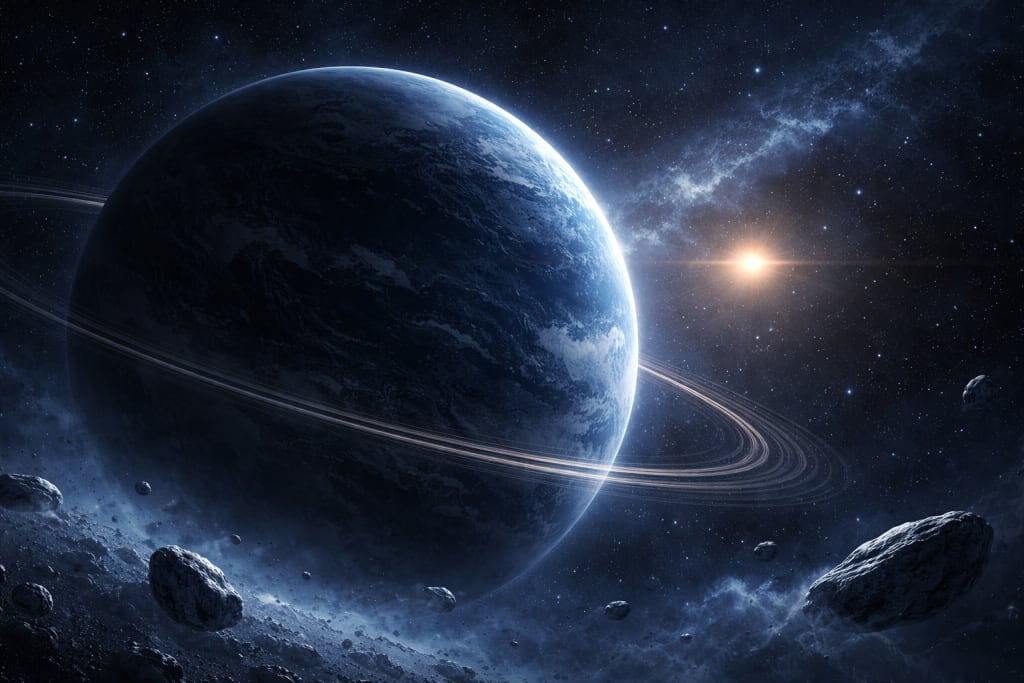
For decades, astronomers believed the architecture of our Solar System was largely settled: eight planets orbiting the Sun, with smaller bodies distributed across regions like the asteroid belt and the Kuiper Belt. Beyond these, the distant Oort Cloud was thought to mark the outer boundary of the Sun’s gravitational influence. Yet, in recent years, this seemingly complete picture has been challenged by a compelling and mysterious idea — the existence of a hidden world known as Planet Nine.
The Clues in the Darkness
The story begins in the Kuiper Belt, a vast region beyond Neptune filled with icy remnants from the early Solar System. Objects in this region, often called trans-Neptunian objects (TNOs), typically follow a wide variety of orbits. However, astronomers noticed something unusual: several of the most distant TNOs appeared to cluster together in a very specific way.
Their orbits were not randomly distributed. Instead, they shared similar orientations, as if something massive were gravitationally shepherding them into alignment. This pattern is statistically unlikely to occur by chance, which led researchers to propose the existence of an unseen planet exerting its influence from afar.
What Might Planet Nine Look Like?
Based on mathematical models and simulations, Planet Nine is thought to be a substantial object — likely between five and ten times the mass of Earth. That would place it in a category often referred to as a “super-Earth,” a type of planet commonly found in other star systems but curiously absent in our own — or so we thought.
Its orbit would be extremely elongated, carrying it far beyond Neptune at distances potentially hundreds of times greater than Earth’s orbit around the Sun. One full revolution could take anywhere from 10,000 to 20,000 years. At such distances, sunlight is incredibly weak, making the planet extraordinarily cold and faint.
To put this into perspective, imagine Neptune — already a distant, frigid world — and then travel dozens of times farther out. Planet Nine would exist in a realm where the Sun appears as just another bright star in the sky.
Why Haven’t We Found It Yet?
Given its predicted size, one might expect Planet Nine to be easy to detect. However, distance changes everything. The farther an object is, the less sunlight it reflects, and the slower it appears to move across the sky. These factors make detection extremely challenging.
Most telescopes rely on visible light, but a cold and distant planet would emit very little of it. Instead, astronomers search in the infrared spectrum, where even faint heat signatures might be detectable. Still, scanning the vastness of the sky for a dim, slow-moving object is like trying to spot a drifting grain of sand in a desert.
Even powerful observatories must carefully compare images taken months or years apart to identify subtle motion against a backdrop of countless stars and galaxies.
Alternative Explanations
While the Planet Nine hypothesis is compelling, it is not universally accepted. Some scientists argue that the observed clustering of TNO orbits could be explained without invoking a new planet.
One possibility is that the combined gravitational effects of many smaller objects in the Kuiper Belt could create similar patterns. Another explanation involves observational bias — the idea that we are more likely to detect objects in certain regions of the sky, which could create the illusion of clustering.
There are also theories suggesting that a passing star in the distant past may have perturbed the orbits of these objects, leaving behind the patterns we observe today.
Despite these alternatives, many simulations show that a single, massive planet provides the most consistent explanation for the data.
Why This Matters
The discovery of Planet Nine would be a landmark moment in astronomy. It would not only expand our Solar System but also reshape our understanding of how planetary systems form and evolve.
For example, one theory suggests that Planet Nine may have formed closer to the Sun and was later ejected into a distant orbit through gravitational interactions with other giant planets. Another intriguing possibility is that it originated in a different star system and was captured by the Sun during a close encounter in the early days of stellar formation.
Both scenarios imply a far more dynamic and chaotic history for our Solar System than previously imagined.
The Search Continues
Astronomers are actively searching for Planet Nine using increasingly sophisticated tools. Upcoming surveys and next-generation telescopes are expected to dramatically improve our ability to detect faint, distant objects.
Wide-field sky surveys are particularly promising, as they can repeatedly scan large portions of the sky and track slow-moving objects over time. With advances in computational analysis and imaging technology, the chances of either confirming or disproving the Planet Nine hypothesis are steadily increasing.
A Reminder of the Unknown
The idea that a massive planet could still be hiding in our own Solar System is both surprising and exciting. It serves as a powerful reminder that even in our cosmic backyard, there are still mysteries waiting to be uncovered.
Whether Planet Nine is eventually found or the hypothesis is replaced by a different explanation, the search itself is pushing the boundaries of modern astronomy — and bringing us closer to understanding the true complexity of the universe we inhabit.
About the Creator
Keep reading
More stories from Holianyk Ihor and writers in Futurism and other communities.
The Mystery of Fast Radio Bursts (FRBs) and Their Possible Origins
In the early 21st century, radio astronomy encountered a phenomenon that quickly evolved into one of the most compelling mysteries in modern astrophysics: Fast Radio Bursts, or FRBs. These signals are extraordinarily brief yet immensely powerful flashes of radio waves arriving from deep space. Each burst lasts only a few milliseconds, but in that fleeting moment it can release as much energy as our Sun emits over several days.
By Holianyk Ihor11 days ago in Futurism
How machines can learn from human behaviour
In order to understand where we are and where we are going, we need to understand where we were first. - Susan Fourtane Could a human behaviour simulator be embedded into a robot or online avatar to the point that it’s hard to distinguish between a real person or artificial intelligence? Scientists have been upping the stakes in this “Turing test” for years, to the point that human-mimicking programmes are ready to answer tricky questions, assist people with online shopping or be companions.
By Susan Fourtané 12 days ago in Futurism
GCC Secondhand Luxury Goods Market Insights: Authentication, Resale Platforms & Trust Factors
According to IMARC Group's latest research publication, the GCC secondhand luxury goods market size reached USD 678.6 Million in 2025. The market is projected to reach USD 1,579.9 Million by 2034, exhibiting a growth rate (CAGR) of 9.55% during 2026-2034.
By Abhay Rajput5 days ago in Futurism


Comments
There are no comments for this story
Be the first to respond and start the conversation.