
The Mystery of Fast Radio Bursts (FRBs) and Their Possible Origins
Space

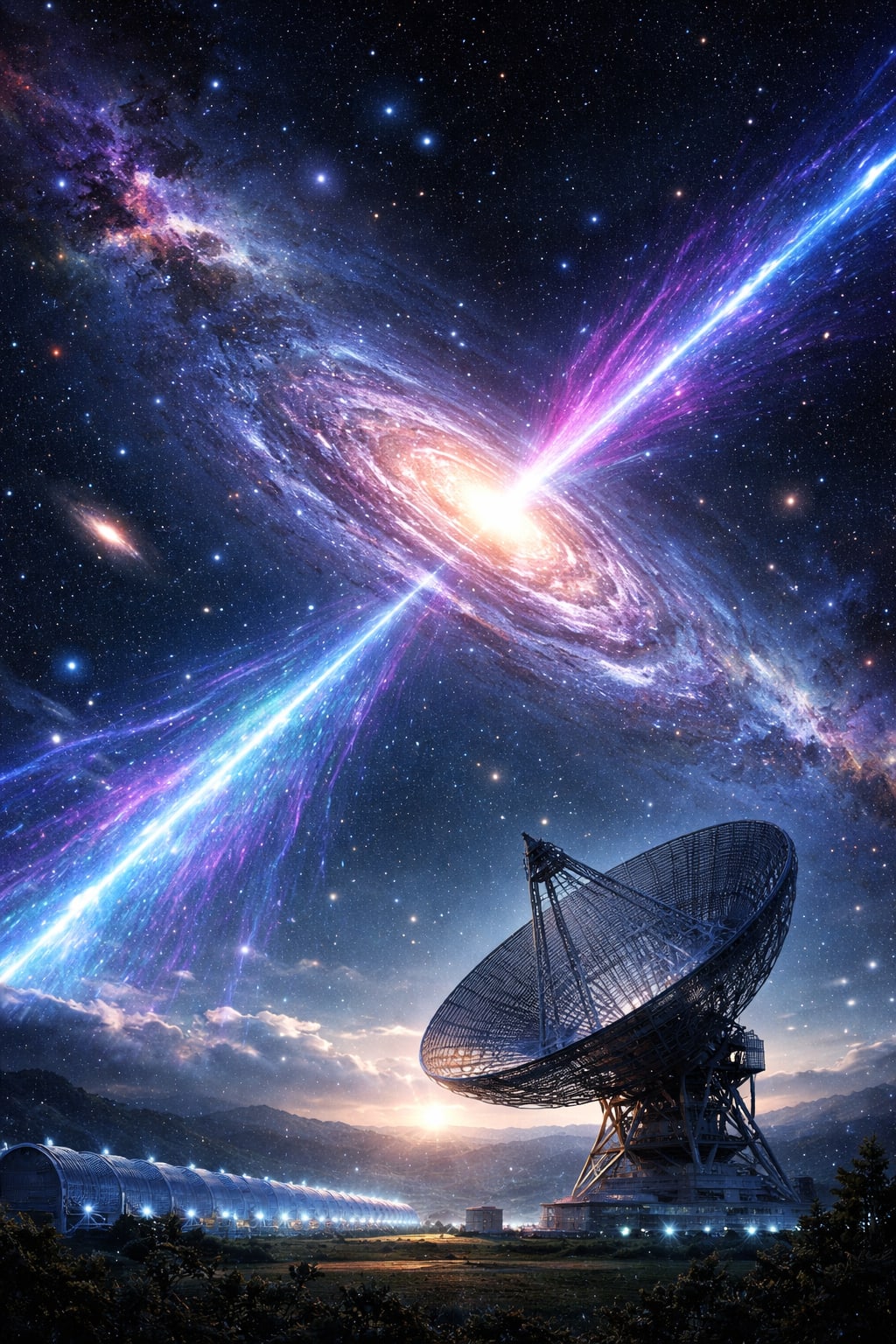
In the early 21st century, radio astronomy encountered a phenomenon that quickly evolved into one of the most compelling mysteries in modern astrophysics: Fast Radio Bursts, or FRBs. These signals are extraordinarily brief yet immensely powerful flashes of radio waves arriving from deep space. Each burst lasts only a few milliseconds, but in that fleeting moment it can release as much energy as our Sun emits over several days.
The first FRB was identified in 2007 during a reanalysis of archival data from the Parkes Observatory. Initially, scientists questioned whether these signals were even real, suspecting terrestrial interference or instrumental artifacts. However, as more detections followed—using different telescopes across the globe—it became clear that FRBs were genuine cosmic events.
How FRBs Are Detected
Detecting FRBs requires highly sensitive radio telescopes capable of monitoring vast regions of the sky. One of the most productive instruments in this field is CHIME (Canadian Hydrogen Intensity Mapping Experiment). Unlike traditional telescopes that point at specific targets, CHIME scans large portions of the sky continuously, allowing it to capture dozens of FRBs regularly.
A defining property of these bursts is their dispersion. As radio waves travel through space, they pass through clouds of charged particles—plasma—that slow down lower-frequency waves more than higher-frequency ones. This creates a measurable delay in the signal across frequencies. By analyzing this dispersion, astronomers can estimate how far the signal has traveled. In most cases, FRBs originate billions of light-years away, confirming their extragalactic nature.
One-Time vs Repeating Signals
Not all FRBs behave the same way. Some appear only once, never to be seen again, while others repeat over time. This distinction is crucial for understanding their origins.
A breakthrough came with the discovery of a repeating source known as FRB 121102. This signal was traced to a distant dwarf galaxy more than three billion light-years away. Because it repeats, scientists were able to observe it multiple times and pinpoint its location with high precision.
Repeating FRBs suggest that at least some sources are not catastrophic events. If every burst were caused by something like a stellar explosion, we would not expect repeated signals from the same location. Instead, repeating FRBs point to long-lived, highly energetic objects capable of producing multiple bursts.
Leading Theories About Their Origins
Despite years of research, no single explanation accounts for all observed FRBs. However, several leading theories have emerged:
Magnetars
The most widely accepted explanation involves magnetars—neutron stars with extremely strong magnetic fields. These objects can produce intense bursts of energy through magnetic reconnection or crustal “starquakes.” In 2020, astronomers detected an FRB-like signal originating from a magnetar within our own galaxy, the Milky Way. This discovery provided strong evidence that magnetars can indeed generate FRBs, at least in some cases.
Collisions of Compact Objects
Another hypothesis involves mergers between neutron stars or black holes. These events release enormous amounts of energy in a very short time, making them plausible sources of one-time FRBs. However, they do not easily explain repeating bursts.
Active Galactic Nuclei
Some researchers propose that FRBs originate near supermassive black holes at the centers of galaxies. The extreme environments around these black holes—featuring powerful jets and turbulent magnetic fields—could potentially produce rapid radio emissions.
Exotic Explanations
More speculative ideas include cosmic strings, evaporating primordial black holes, or even artificial signals from advanced extraterrestrial civilizations. While these concepts capture the imagination, there is currently no empirical evidence supporting them.
Why FRBs Matter
Beyond their mystery, FRBs have become valuable tools for studying the universe. Because their signals travel across vast cosmic distances, they interact with matter distributed between galaxies. This allows scientists to use FRBs as probes of the intergalactic medium.
For example, astronomers have long struggled to locate all the “missing” ordinary matter—known as baryonic matter—in the universe. FRBs provide a way to measure this material indirectly by analyzing how their signals are dispersed. In essence, each burst acts like a flashlight shining through the cosmic web, revealing otherwise invisible structures.
Additionally, FRBs help researchers study magnetic fields on intergalactic scales, offering insights into how galaxies form and evolve over time.
What Comes Next
The future of FRB research looks promising. New and upcoming observatories, such as the Square Kilometre Array, are expected to dramatically increase the number of detected bursts. With better resolution and sensitivity, astronomers will be able to localize sources more precisely and study their environments in greater detail.
It is also becoming increasingly likely that FRBs are not a single phenomenon with one universal cause. Instead, they may represent a class of events with multiple origins—some repeating, some not, each driven by different astrophysical mechanisms.
Conclusion
Fast Radio Bursts are more than just an astronomical curiosity. They sit at the intersection of extreme physics, cosmology, and cutting-edge technology. Each new detection adds another piece to the puzzle, bringing us closer to understanding these enigmatic signals.
Whether they originate from magnetars, cosmic collisions, or something even more unexpected, FRBs are reshaping how we explore the universe. And as detection methods continue to improve, the answers to this cosmic mystery may finally come into focus—revealing not just the nature of FRBs, but deeper truths about the structure and evolution of the cosmos itself.
About the Creator
Keep reading
More stories from Holianyk Ihor and writers in Futurism and other communities.
The “Silent Collapse” of a Star: A New Type of Stellar Death Discovered in Andromeda
For more than a century, astronomers believed that the death of a massive star was always one of the most dramatic events in the universe. When a giant star exhausts its nuclear fuel, its core collapses under gravity and the outer layers explode outward in a spectacular supernova. These explosions are so powerful that, for a brief time, a single star can shine brighter than an entire galaxy.
By Holianyk Ihor22 days ago in Futurism
The Fears of AI And How Much Fun It Can Be
ChatGPT has come a long way, as has AI in general. There are those people who are scared of it, and for understandable reasons. People fear that as technologies advance, they’ll be replaced in the workforce. Then, there are the fears that AI could evolve into something that brings us to the brink of extinction.
By The Man Behind The Maska day ago in Futurism
Nanoceramic Powder Market Outlook: Advanced Materials Innovation and High-Performance Applications Growth Opportunities
According to IMARC Group's latest research publication, The global nanoceramic powder market size reached USD 10.1 Billion in 2024. Looking forward, IMARC Group expects the market to reach USD 35.6 Billion by 2033, exhibiting a growth rate (CAGR) of 14.31% during 2025-2033.
By Michael Richard5 days ago in Futurism



Comments
There are no comments for this story
Be the first to respond and start the conversation.