literature
Science fiction's most popular literary writers from Isaac Asimov to Stephen King and Frank Herbert, and the rising stars of today.
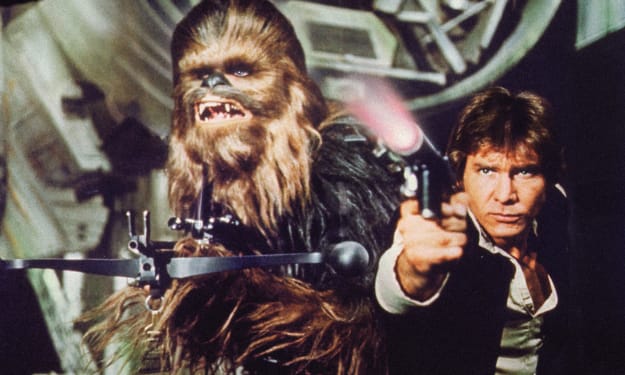
Best 'Star Wars' Han Solo And Chewbacca Books
Every Star Wars fan knows the famous duo of Han Solo and Chewbacca well. While Han Solo was a human smuggler known for being a member of the Rebel Alliance and later the New Republic, he originates from the planet Corellia where he was orphaned at an early age. Taken by the pirate Garris Shrike to serve with his crew, Han was treated cruelly, which is the main reason he became a smuggler. After entering the Imperial Academy at Carida where he served with distinction, his life changed when he refused to beat a Wookiee named Chewbacca with a neuronic whip and the two eventually fled from the imperials together. That was the moment Han Solo and Chewbacca bonded, and Chewbacca became his partner in crime as his life debt to Solo. The adventures of Han Solo and Chewbacca are present in many Star Wars books. Here are our picks for the best Han Solo and Chewbacca books.
By James Lizowski9 years ago in Futurism
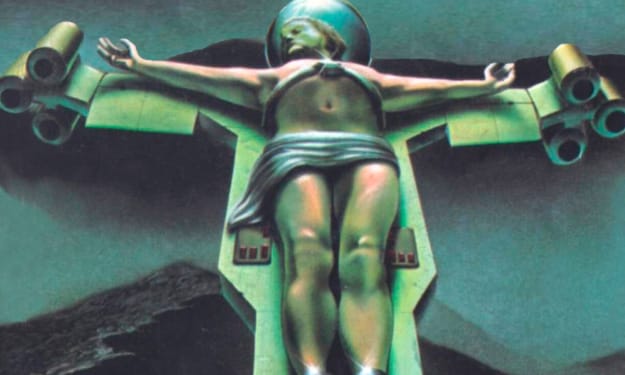
Philip K. Dick's VALIS Analyzes Religious Destiny
If you really think about it, the story of Jesus is a work of science fiction. He's a man with superpowers that include turning water to wine, healing others, and coming back from the dead. All jokes aside, religion and science fiction truly go hand in hand although people often try to separate the two. Some of the religious themes that permeate sci-fi stories include the idea of the afterlife, reincarnation, original sin, fictional religions, Messianism, and many other themes that can be found in the works of Philip K. Dick. As a science fiction writer, Dick wrote 44 novels and 121 short stories including Do Androids Dream of Electric Sheep?,A Scanner Darkly, Flow My Tears, the Policeman Said, VALIS, and many others. Some of the films that have been adapted from these stories include Blade Runner, Total Recall, A Scanner Darkly, Minority Report, Paycheck, Next, Screamers, The Adjustment Bureau, and Impostor. Throughout his lifetime, he won several awards including three Hugo Awards, five Nebula Awards, one British Science Fiction Association Award, and many others. There is even a Philip K. Dick Award that was established in 1983 which honors the previous year's best science fiction paperback original published in the US. In 2007, Dick became the first science fiction writer to be included in The Library of America series. The writer died in 1982 after suffering two strokes at the age of 53, but his legacy lives on today in his stories such as VALIS.
By Mackenzie Lu9 years ago in Futurism
Science Fiction Feminist Dorris Lessing
Doris Lessing, made famous by her epic novel of the female experience, The Golden Notebook, was also a prolific writer of science fiction. She was not a fan of genre distinctions. She called science fiction "some of the best social fiction of our time," writing woozy, difficult books about psychic women and fallen paradises.
By Stephanie Gladwell9 years ago in Futurism
Surprising Science Fiction Stories from the Ancient World
Some think of Mary Shelley’s Frankenstein as the beginning of science fiction. Others would say that it didn’t really begin until H.G. Wells began writing down his marvelous, speculative stories in which he imagined terrible - and wonderful - possibilities for the futures. While these might be the beginnings of science fiction or speculative fiction as we define it today, there are many stories from the ancient world and early cultures all over the planet that contained elements of science and speculation similar to the ones we love today.Whether they’re early tales from Japan or surprising elements of the Bible, these stories will inspire you to take a closer look at what you consider the origins of your favorite genre.
By Sarah Quinn9 years ago in Futurism
Best Sci-Fi Graphic Novels for Kids
It can be challenging to find science fiction graphic novels for children that aren’t too scary or violent, but also don’t demean kids or gloss over their interests. While you have to make the call for your own kids, here are six great choices for all the youngsters on your Christmas list. Whether they’re preschoolers who can’t yet read or high school students who’ve been adoring fans of the genre for years, you’re sure to find something that’s just right. (And yes, it’s totally ok to devour it from front to back before you wrap it and pass it on to them. I won’t tell.)
By Sarah Quinn9 years ago in Futurism
The Most Amazing Quotes About Science Fiction
Science fiction is a world worked in and lived in by necessity, not by choice. If we as readers are seeking a world so dark and revealing when we could be visiting Rivendell instead, we’re seeking it because we need it. Why? The answer depends on the person. Some of us are in a perpetual state of near-frantic scientific curiosity that demands more satisfaction than our own research can give us. Some of us are struggling with mental illness, and the world of science fiction is a reassuring reminder that every world has its horrors. Some of us need to hear that we are not the only ones who would turn tail and run in the face of almost-certain death and unimaginable horrors. No matter why we seek it, there are always certain passages that speak the thoughts we can’t put into words, and in so doing give us a peace we can hardly explain. Here are a few; they’re just a sample of the many inspiring words from speculative authors, scientists, and visionaries.
By Sarah Quinn9 years ago in Futurism
To Preserve a Demon
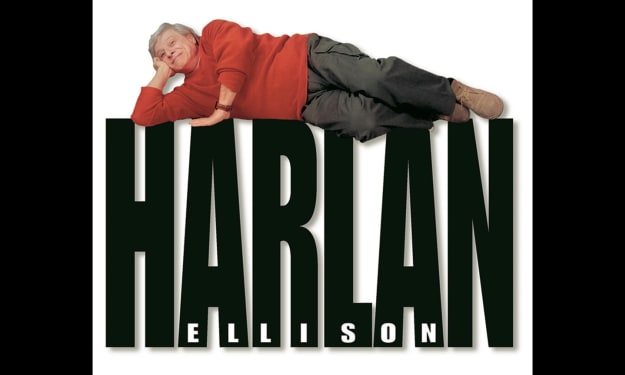
Writer/editor Jason Davis has a special ambition -- to catalog, digitize, edit, correct, annotate and re-publish (or publish for the first time, in some cases) all of Harlan Ellison's writings. Twenty-six four-foot-wide drawers of typescripts, over 100 feet of paper if stacked, the lifework of a man who is easily one of the most influential and cantankerous authors of the 20th century. Jason is spearheading the Harlan Ellison Books Preservation Project, a grand undertaking "To create definitive versions of all Harlan Ellison's writings, fiction and non-fiction, to preserve in print for posterity."
By Joshua Sky9 years ago in Futurism
Pain & Paranoia
The itching in his leg consumed Jason’s attention as he sat in his bland, beige cubicle. He scratched at his shin with the heel of his shoe, while trying to keep a smooth rhythm of clacking on his keyboard. He answered his phone without stopping the rubbing at the front of his shin, just above his ankle. The digging of his shoe heel caused an aching and a bruise throughout his shin, but only stopped the itching momentarily.
By Jeff Sherwood9 years ago in Futurism
Thought Provoking Political Dystopian Books
If 2016 can teach us anything, it is that fiction can become reality. As a common rule, humanity strives for constant progress; movement towards a superior standard of living. But what happens when everything goes wrong instead? As humans we constantly question the 'what if' scenario. The dystopia genre is the anthesis of utopia and is a mainstay of science fiction writing over the years. The genre has taken the 'what if' to speculate about a future where every aspect of life has taken a distinct and frightening turn for the worse. Within the classic dystopian genre there lies the more thought provoking political dystopian theme. A typical tale involves a future society with an oppressive government that demands conformity. Sometimes this is in the wake of a disaster that has befallen humanity or society as a whole has taken a dark and oppressive turn for the worse. Often times there are no beautiful endings in these political dystopian books, only a joyless and dysfunctional future with glimpses into the light.
By George Gott9 years ago in Futurism
The Science Fiction of Music
My first novel, Big in Japan, is about a neurotic American prog-rocker coming of age in Japan. My second, Jellyfish Dreams, is about a biologist’s quest to reanimate his dead fiancée at the instigation of a black hole beneath his sofa. Readers who’ve read both books usually remark on how different they are, but I don’t see it that way. For one thing: crazy artist, mad scientist—same difference. For another, even if you agree with (a quote I’ve seen attributed to) sf comics genius Warren Ellis that “Prog rock was sick and wrong then and it is sick and wrong now,” one can’t deny that prog drinks as liberally from the sf well as it does from the epic and fantasy ones. And so, a primer on some of history’s more salient prog-sf conjunctions:
By M. Thomas Gammarino9 years ago in Futurism