
Space-Based Geoengineering: Can We Cool the Earth from Orbit?
Space

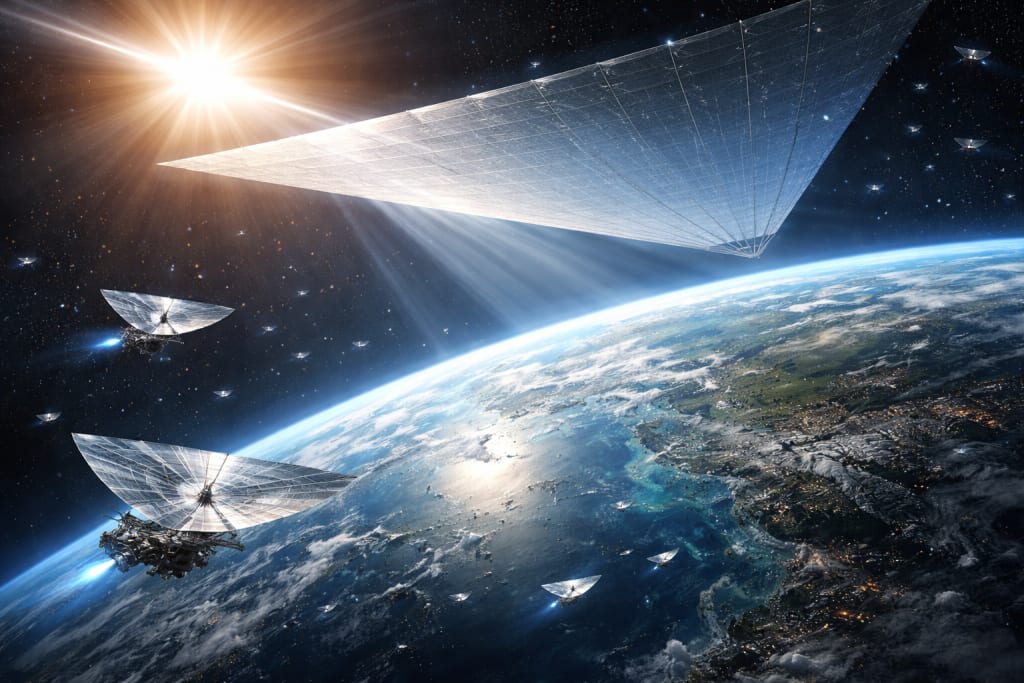
As global temperatures continue to rise, the conversation around climate intervention is becoming more urgent—and more unconventional. Among the most ambitious ideas is space-based geoengineering: using structures placed in orbit to reduce the amount of solar energy reaching Earth. It sounds like science fiction, but researchers have been seriously exploring whether cooling our planet from space could one day become a viable option.
Why Look to Space?
At its core, global warming is driven by an imbalance in Earth’s energy system. Greenhouse gases trap heat, preventing it from escaping into space. Most climate solutions focus on reducing emissions or removing carbon dioxide from the atmosphere. However, there is another approach: adjusting how much sunlight Earth receives in the first place.
Space offers a unique advantage here. Instead of altering the atmosphere directly, orbital systems could act on incoming solar radiation before it even reaches the planet. This avoids some of the chemical side effects associated with atmospheric geoengineering methods, such as injecting aerosols into the stratosphere.
The Concept of a Solar Shield
One of the most widely discussed proposals involves placing a विशाल “solar shield” at the L1 Lagrange point—a location about 1.5 million kilometers from Earth, where the gravitational forces of the Earth and Sun balance out. Objects positioned there can remain relatively stable, making it an ideal spot for a long-term structure.
The idea is simple in principle: block or deflect a small fraction of sunlight. Surprisingly, even a reduction of just 1–2% in solar radiation could significantly offset the warming caused by increased levels of carbon dioxide.
But the scale of such a project is staggering. Scientists estimate that a single विशाल structure would need to span thousands of square kilometers. Because launching something that massive in one piece is unrealistic, many proposals suggest deploying millions—or even billions—of tiny, lightweight elements, such as thin reflective disks or refractive lenses. Together, they would function as a distributed الشمس shield, subtly dimming the sunlight that reaches Earth.
Orbital Mirrors: A More Flexible Approach
An alternative concept replaces the idea of blocking sunlight with redirecting it. Instead of a single shield, fleets of orbital mirrors could reflect solar radiation back into space or redirect it toward less sensitive areas.
For example, mirrors could be used to reduce heat in tropical regions, where warming has the most dramatic effects, while leaving other areas relatively unchanged. In theory, they could even be adjusted seasonally—reducing sunlight during summer months and allowing more through during winter.
There are also more speculative applications. Some researchers have suggested using orbital mirrors to illuminate polar regions during long periods of darkness, potentially supporting agriculture or reducing energy demand. However, this flexibility comes at a cost: controlling large numbers of mirrors with high precision would be an enormous technical challenge. A slight misalignment could unintentionally concentrate sunlight and create dangerous hotspots.
The Engineering Challenges
Despite the elegance of these ideas, the practical barriers are immense.
Cost remains the biggest obstacle. Even with the rapid decline in launch costs driven by reusable rockets, sending millions of tons of material into space would require unprecedented investment. Current estimates run into trillions of dollars.
Material science is another limiting factor. The structures would need to be incredibly lightweight yet durable enough to withstand radiation, temperature extremes, and impacts from micrometeoroids. Developing such materials at scale is still an ongoing challenge.
Long-term stability and control are equally critical. Any system designed to regulate Earth’s temperature must operate reliably for decades, if not centuries. A sudden failure—such as a collapse of the shielding system—could lead to rapid and severe temperature spikes, a phenomenon sometimes referred to as “termination shock.”
Space debris adds another layer of risk. Deploying vast numbers of objects increases the likelihood of collisions, potentially creating cascading debris fields that could damage both the geoengineering system and other satellites.
Risks and Unintended Consequences
Cooling the planet from space might sound like a clean solution, but Earth’s climate system is highly complex. Even small changes in solar radiation could have uneven effects across different regions.
For instance, reducing sunlight might lower global temperatures, but it could also disrupt rainfall patterns. Monsoons could weaken, agricultural cycles might shift, and ecosystems that depend on specific light conditions could be affected. In other words, stabilizing temperature does not guarantee a stable climate overall.
There are also geopolitical concerns. If one country—or a small group of countries—controlled such a system, they would effectively hold the “thermostat” of the planet. Deciding how much cooling is appropriate, and for whom, could become a source of international tension.
How Does It Compare to Earth-Based Solutions?
Compared to atmospheric geoengineering methods, such as injecting sulfur particles into the stratosphere, space-based solutions are often seen as “cleaner.” They do not directly alter the chemical composition of the atmosphere and, in theory, can be reversed simply by turning the system off.
However, they are far more expensive and technologically demanding. Atmospheric interventions could be deployed within decades, while space-based geoengineering may take much longer to develop and scale.
Science Fiction or Future Reality?
At present, space-based geoengineering remains in the conceptual and experimental phase. No large-scale systems exist, and many of the required technologies are still in development. However, trends in the space industry are gradually making such ideas more plausible.
Launch costs are decreasing. Autonomous robotic systems are improving. Large satellite constellations have already demonstrated that humanity can manage thousands of objects in orbit simultaneously.
Some experts suggest that small-scale prototypes could be tested in the latter half of the 21st century. These would not be full climate-control systems, but rather experiments to validate key technologies and measure real-world effects.
Final Thoughts
Cooling Earth from orbit is one of the most ambitious engineering ideas ever proposed. It sits at the intersection of climate science, space technology, and global policy. Technically, it may be possible. Practically, it remains an enormous challenge.
Perhaps the most important point is that space-based geoengineering is not a substitute for reducing greenhouse gas emissions. At best, it could serve as a supplementary tool—a way to buy time if climate change accelerates beyond control.
The question is no longer just whether we can build such a system, but whether humanity is prepared to take responsibility for managing the planet on such a масштабный scale.
About the Creator
Keep reading
More stories from Holianyk Ihor and writers in Futurism and other communities.
The Planet Nine Hypothesis: A Hidden Giant at the Edge of Our Solar System
For decades, astronomers believed the architecture of our Solar System was largely settled: eight planets orbiting the Sun, with smaller bodies distributed across regions like the asteroid belt and the Kuiper Belt. Beyond these, the distant Oort Cloud was thought to mark the outer boundary of the Sun’s gravitational influence. Yet, in recent years, this seemingly complete picture has been challenged by a compelling and mysterious idea — the existence of a hidden world known as Planet Nine.
By Holianyk Ihor10 days ago in Futurism
How machines can learn from human behaviour
In order to understand where we are and where we are going, we need to understand where we were first. - Susan Fourtane Could a human behaviour simulator be embedded into a robot or online avatar to the point that it’s hard to distinguish between a real person or artificial intelligence? Scientists have been upping the stakes in this “Turing test” for years, to the point that human-mimicking programmes are ready to answer tricky questions, assist people with online shopping or be companions.
By Susan Fourtané 11 days ago in Futurism
Network Automation Market Insights: Real-Time Analytics, Network Orchestration & Industry Forecast to 2033
The rapid expansion of digital infrastructure and the surge in global data traffic are transforming how enterprises manage their connectivity, making manual network oversight a thing of the past. Modern business environments now demand seamless, self-healing infrastructures to maintain 24/7 operational continuity. According to IMARC Group’s latest data, the global network automation market size reached USD 24.1 Billion in 2025. Looking forward, IMARC Group estimates the market to reach USD 103.6 Billion by 2033, exhibiting a CAGR of 16.7% from 2025-2033.
By Andrew Sullivanabout 13 hours ago in Futurism
Rousseau's Last Tour
This was a strange comfort to me these last few weeks. Actually, more than a few weeks. I began this book at the beginning of the year, and put it aside as I realized that I was reading not a fictional account of a life, but the very true thoughts of a writer who has put his fingerprints over much of what I know of French thought in that era.
By Kendall Defoe 8 days ago in BookClub




Comments
There are no comments for this story
Be the first to respond and start the conversation.