
Shaving Market Analysis: Disposable Razors, Sustainability & Forecast to 2033
How demand for affordable disposable razors, environmental concerns, and sustainable product innovation are driving change in the shaving industry

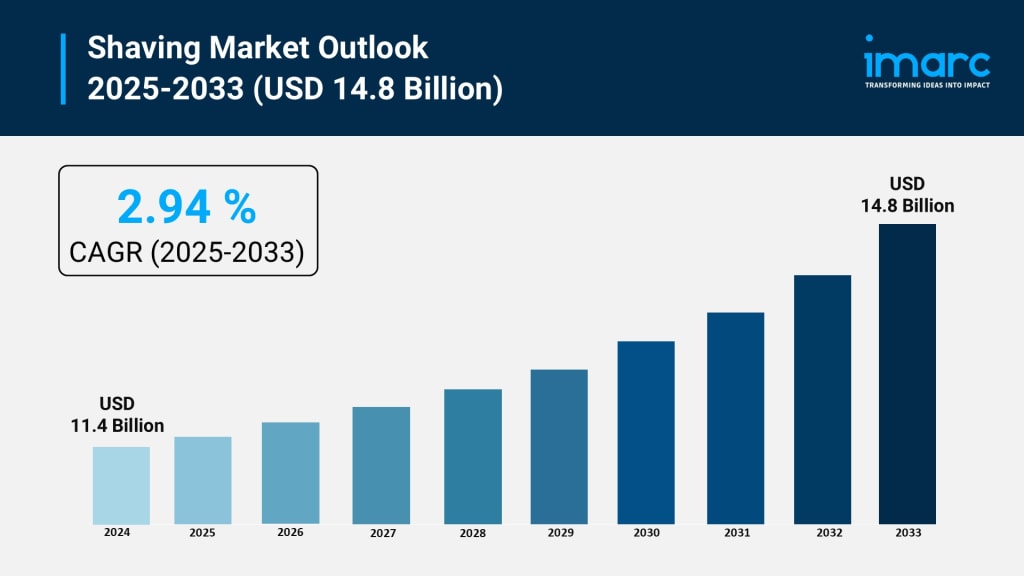
Growing consumer focus on personal grooming, rapid product innovation, and the expansion of e-commerce are reshaping the global shaving industry. According to IMARC Group's latest research, the global shaving market size reached USD 11.4 Billion in 2024. Looking forward, IMARC Group expects the market to reach USD 14.8 Billion by 2033, exhibiting a growth rate (CAGR) of 2.94% during 2025–2033. North America currently dominates the market, holding a market share of over 39.6% in 2024.
Shaving has evolved well beyond a daily grooming routine. Today it sits at the center of the broader personal care ecosystem where performance, convenience, and lifestyle identity intersect. Razors and blades continue to lead the market, accounting for 38.22% of total global product demand, but electric grooming devices and multi-step shaving kits are gaining ground quickly. In the United States, online channels now contribute roughly 18% of total grooming product sales, according to Procter & Gamble's latest reports, as consumers increasingly rely on platforms like Amazon for discovery, reviews, and repeat purchases. The category now spans everything from cartridge razors and beard moisturizers to pre-shave creams and aftershave emulsions, turning what used to be a simple task into a full grooming routine.
Another major shift shaping the industry is generational behavior. Millennials and Gen Z consumers increasingly view grooming as an extension of personal identity and self-expression, rather than just hygiene. This change is reflected in buying patterns as shoppers gravitate toward premium products, skin-friendly ingredients, and convenient subscription models. While Gillette still holds the largest global brand share at around 14%, digitally native direct-to-consumer brands such as Harry's and Dollar Shave Club are steadily capturing younger audiences through competitive pricing, transparent branding, and subscription-based convenience.
Shaving Market Growth Drivers
Rising Grooming Consciousness Across Genders and Demographics
Personal grooming is increasingly becoming a lifestyle priority rather than a simple routine, especially in urban populations. Companies across the grooming ecosystem are seeing this shift translate directly into product demand. For example, Philips India reported more than 75% growth in its premium grooming category, highlighting how consumers are upgrading to higher-quality tools and devices. The female grooming segment is also expanding rapidly as workforce participation rises. According to the U.S. Bureau of Labor Statistics, women's employment reached 55.2% in 2024, increasing demand for convenient grooming products that support professional appearance. Social media platforms further amplify grooming trends, setting aspirational standards that influence purchasing behavior globally.
Technology Innovation Making Shaving Smarter and More Comfortable
Innovation in shaving technology has significantly improved the consumer experience, turning basic grooming tools into high-performance personal devices. Philips' Series 9000 Prestige, equipped with SkinIQ technology, automatically adapts to hair density during use, contributing to a 15% improvement in comfort satisfaction ratings among users. Across the industry, manufacturers are investing heavily in smart features, with over 30% of new electric shavers expected to incorporate AI-driven capabilities. Meanwhile, cartridge innovation continues as well. Gillette's GilletteLabs Exfoliating Razor, which combines exfoliation and shaving in a single stroke, exceeded its launch sales projections by 20%, demonstrating strong consumer appetite for performance-focused grooming solutions.
Rising Disposable Incomes and Urbanization Fueling Premium Product Adoption
Higher disposable incomes across emerging markets are encouraging consumers to upgrade from basic razors to multi-blade cartridges, electric shavers, and full grooming kits. China alone generated around USD 6.4 billion in shaving market revenue in 2024, making it the largest single national market. Across the Asia-Pacific region, which accounts for roughly 33% of global shaving product demand, rapid urbanization and a growing middle class are driving spending on personal care products. To capture this opportunity, brands are introducing tiered product portfolios that combine aspirational branding with accessible pricing. Subscription services and direct-to-consumer platforms are also gaining traction, now contributing around 18% of Procter & Gamble's grooming revenue.
Shaving Market Trends
Sustainability and Eco-Friendly Products Gaining Mainstream Traction
Sustainability is quickly becoming a central consideration in the grooming industry as consumers demand environmentally responsible products. Many shoppers are now opting for bamboo razors, refillable cartridges, and plastic-free packaging, reflecting a broader shift toward sustainable personal care. Panasonic's Palm Shaver, manufactured using NAGORI eco-materials, has already reduced plastic usage by around 40% compared to conventional models. Meanwhile, companies like EcoBlade Systems are piloting cartridge recycling programs across European markets, encouraging consumers to return used blades for responsible disposal. These initiatives are helping brands build stronger trust among environmentally conscious consumers, particularly younger buyers.
Direct-to-Consumer and Subscription Models Reshaping How People Buy
Distribution models in the shaving market are evolving rapidly as digital-first brands challenge traditional retail channels. Direct-to-consumer platforms and subscription services allow companies to build long-term customer relationships while ensuring predictable revenue streams. Brands such as Harry's and Flamingo have built strong followings by offering convenient refill deliveries and transparent pricing structures. Meanwhile, Procter & Gamble reports that e-commerce now accounts for approximately 18% of its grooming product revenue, highlighting how online channels are reshaping consumer purchasing habits. Strategic acquisitions are also reinforcing this trend — Edgewell acquired Billie Inc. for USD 310 million, specifically targeting the fast-growing women's DTC grooming segment.
Premiumization and Personalization Driving Higher Spend per Consumer
Consumers are increasingly willing to pay more for grooming products that deliver superior performance and personalized experiences. Brands are responding by launching premium devices equipped with advanced features. Philips' i9000 Series electric shaver includes AI-assisted cutting power adjustments and UV self-cleaning capabilities, appealing to buyers who view grooming tools as long-term investments. Similarly, MANSCAPED introduced The Chairman Pro, featuring SkinSafe technology and full waterproofing to target the premium male grooming segment. Marketing campaigns are also evolving to emphasize lifestyle positioning — BIC's global campaign “Your Time to Shine” integrates connected TV, dating apps, and podcasts to connect grooming with confidence and personal identity.
Recent News and Developments in the Shaving Market
July 2025: Unilever completed its USD 1.5 billion acquisition of Dr. Squatch, a premium men's grooming brand known for natural ingredient formulations and a strong direct-to-consumer model. The acquisition significantly strengthens Unilever's position in the fast-growing premium grooming segment.
October 2025: Philips launched the OneBlade Intimate, a unisex grooming device designed for sensitive body areas. The launch reflects the company's strategy to expand beyond traditional male shaving products and address the growing demand for gender-inclusive grooming solutions.
September 2024: MANSCAPED introduced The Chairman Pro electric foil shaver, featuring proprietary SkinSafe Technology and a waterproof design. The product marks the company's expansion into facial shaving, targeting consumers seeking high-performance alternatives to legacy razor brands.
Note: If you require specific details, data, or insights that are not currently included in the scope of this report, we are happy to accommodate your request. As part of our customization service, we will gather and provide the additional information you need, tailored to your specific requirements. Please let us know your exact needs, and we will ensure the report is updated accordingly to meet your expectations.
About the Creator
Suhaira Yusuf
I specialize in Consumer Insights, focusing on transforming detailed market data into strategic business solutions that accelerate growth and improve customer engagement.
Keep reading
More stories from Suhaira Yusuf and writers in Futurism and other communities.
Customer Relationship Management Market Trends: AI Integration, Automation & Forecast to 2034
Market Overview The global Customer Relationship Management (CRM) market is expanding rapidly as businesses increasingly focus on delivering better customer experiences and improving operational efficiency. According to the latest industry analysis, the global CRM market size reached USD 76.9 Billion in 2025. Looking ahead, the market is expected to reach USD 165.8 Billion by 2034, growing at a compound annual growth rate (CAGR) of 8.65% during 2026–2034. Currently, North America dominates the global CRM market due to strong adoption of advanced digital technologies and the presence of leading software providers.
By Suhaira Yusuf5 days ago in Futurism
The Fears of AI And How Much Fun It Can Be
ChatGPT has come a long way, as has AI in general. There are those people who are scared of it, and for understandable reasons. People fear that as technologies advance, they’ll be replaced in the workforce. Then, there are the fears that AI could evolve into something that brings us to the brink of extinction.
By The Man Behind The Maska day ago in Futurism
Telecom Order Management Market Trends: 5G Expansion, Real-Time Processing & Industry Forecast to 2034
The rapid global expansion of 5G infrastructure, coupled with the rising demand for seamless digital connectivity, is fueling the telecom order management market. As communication service providers (CSPs) transition toward automated, cloud-native ecosystems to handle complex service bundles, the need for robust orchestration has never been higher. According to IMARC Group’s latest data, the global telecom order management market size was valued at USD 4.95 Billion in 2025. Looking forward, IMARC Group estimates the market to reach USD 12.55 Billion by 2034, exhibiting a CAGR of 10.55% from 2026-2034.
By Andrew Sullivan5 days ago in Futurism
Paul and John's 47-Words Short Story Unofficial Challenge
UPDATE - Republished to update the list of entries, with the 40 we've had so far. Completely smashed last unofficial challenge which recieved 31 entries. And there is still time. If you have yet to enter and fancy winning a bit of money or just challenging yourself or both or just making two old geezers job harder - please enter!
By Paul Stewarta day ago in Writers



Comments
There are no comments for this story
Be the first to respond and start the conversation.