
Predictive Maintenance Market Trends: Industry 4.0 Adoption, Sensor Technologies & Forecast to 2034
How Industry 4.0 adoption, connected devices, and advanced data analytics are enabling proactive maintenance approaches and improving asset performance across manufacturing and energy industries

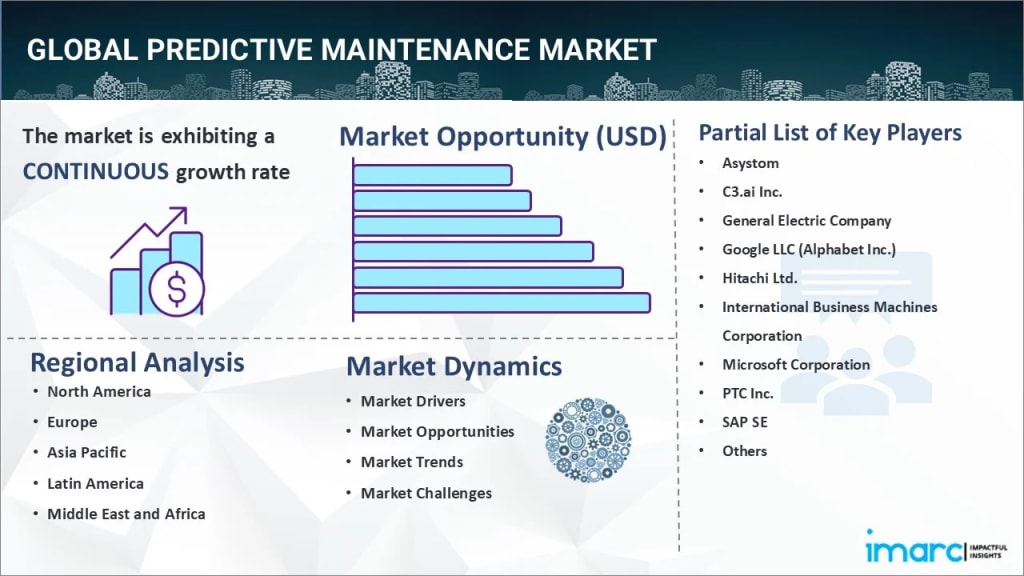
The global transition toward Industry 4.0 and smart manufacturing is fundamentally reshaping how industrial assets are managed. As enterprises strive to eliminate unplanned downtime and extend the lifespan of critical machinery, data-driven maintenance strategies have become a competitive necessity. According to IMARC Group’s latest data, the global predictive maintenance market size was valued at USD 15.6 Billion in 2025. Looking forward, IMARC Group estimates the market to reach USD 91.0 Billion by 2034, exhibiting a CAGR of 21.01% from 2026-2034. North America currently dominates the market, holding a market share of over 33.4% in 2025.
Predictive maintenance now represents a vital technological pillar for asset-heavy industries, providing the ability to forecast equipment failures before they occur. This proactive approach relies on the integration of Industrial Internet of Things (IIoT) sensors, advanced data analytics, and cloud-based platforms. By shifting from traditional reactive "fix-it-when-it-breaks" models to condition-based interventions, organizations can achieve maintenance cost reductions of 25% to 30% and a significant 70% decrease in equipment downtime. Major segments include vibration monitoring, oil analysis, and infrared thermography, with the manufacturing and energy sectors prioritizing these solutions to safeguard high-value infrastructure and optimize operational throughput.
Predictive Maintenance Market Growth Drivers:
- Urgent Need to Reduce Operational Downtime
Unplanned downtime remains one of the most significant drains on industrial profitability, with some manufacturing sectors losing between USD 30,000 and USD 50,000 per hour during equipment failures. Predictive maintenance addresses this by using real-time sensor data to identify anomalies weeks before a breakdown occurs. By implementing these data-driven strategies, facilities often see a 20% to 25% increase in production capacity. This economic reality forces large-scale enterprises to move away from reactive repairs, which typically cost three to five times more than planned, preemptive maintenance activities.
- Massive Proliferation of IIoT and Sensor Technology
The rapid deployment of smart sensors across industrial landscapes is providing the raw data necessary for high-fidelity predictive modeling. Global IoT connections are projected to reach over 23 billion recently, creating a dense network of connected assets that monitor temperature, vibration, and power signatures. As sensor prices continue to decline, even small and medium-sized enterprises (SMEs) can now afford to instrument their machinery. This connectivity allows for continuous data streams that fuel machine learning algorithms, enabling the detection of subtle performance drifts that manual inspections often overlook.
Request Your Free "Predictive Maintenance Market" Sample Report in Seconds!
- Government Initiatives and Infrastructure Modernization
Global governments are incentivizing the adoption of advanced manufacturing technologies to bolster national industrial competitiveness. For instance, India’s Performance-Linked Incentive (PLI) scheme and the U.S. Executive Order 14017 on critical supply chains have accelerated investments in smart factory transitions. In the European Union, modernization of transportation and energy grids requires sophisticated monitoring to ensure safety and reliability. These public-sector pushes, combined with subsidies for technology upgrades, provide the financial and regulatory framework necessary for industries to integrate predictive maintenance into their core long-term asset management strategies.
Predictive Maintenance Market Trends:
- Integration of Generative AI and Advanced Analytics
The market is moving beyond simple threshold-based alerts toward sophisticated AI-driven diagnostics that can interpret complex datasets. Recent innovations allow for the use of Generative AI to enhance user interaction with maintenance platforms, enabling technicians to "ask" systems about equipment health in natural language. These AI models process vast amounts of historical and real-time data to refine failure predictions, significantly reducing "false positives." This trend is particularly evident in the aerospace and defense sectors, where high-precision diagnostics are critical for maintaining mission-readiness and ensuring the safety of complex flight systems.
- Rise of Digital Twin Technology for Virtual Simulation
Enterprises are increasingly adopting Digital Twins—virtual replicas of physical assets—to simulate various operating conditions and stress test maintenance schedules. By mirroring a physical machine in a digital environment, engineers can predict how specific components will wear over time under different workloads. This trend supports a 35% to 45% improvement in asset utilization by allowing operators to optimize performance without risking actual hardware. The ability to run "what-if" scenarios digitally before performing physical maintenance is becoming a standard practice for managing turbines, locomotives, and heavy manufacturing lines.
- Shift Toward Cloud-Based and Edge Computing Architectures
There is a growing preference for hybrid deployment models that combine the scalability of the cloud with the low latency of edge computing. While cloud platforms handle deep historical analysis and long-term storage, edge devices process data directly at the source, allowing for near-instantaneous fault detection on the factory floor. This is vital in remote environments, such as offshore oil rigs or mining sites, where constant cloud connectivity is unreliable. Currently, the software and services segment accounts for over 80% of market revenue, reflecting the industry’s shift toward integrated digital ecosystems over isolated hardware.
Recent News and Developments in Predictive Maintenance Market
- September 2025: Siemens announced a major update to its Senseye Predictive Maintenance solution, incorporating enhanced machine learning models that reduce the initial configuration time for new industrial assets by nearly 40%.
- January 2026: C3 AI reached a milestone in its collaboration with Shell, successfully bringing over 10,000 pieces of equipment under its predictive maintenance program, utilizing a network of more than 3 million sensors to monitor global operations.
- February 2026: A leading aerospace manufacturer launched a proprietary predictive health management platform for its next-generation engines, utilizing real-time flight data to schedule maintenance only when actual component wear is detected, rather than at fixed intervals.
Note: If you require specific details, data, or insights that are not currently included in the scope of this report, we are happy to accommodate your request. As part of our customization service, we will gather and provide the additional information you need, tailored to your specific requirements. Please let us know your exact needs, and we will ensure the report is updated accordingly to meet your expectations.
About the Creator
Andrew Sullivan
Hello, I’m Andrew Sullivan. I have over 9+ years of experience as a market research specialist.
Keep reading
More stories from Andrew Sullivan and writers in Futurism and other communities.
Insulated Concrete Form Market Trends: Residential Expansion, Energy Savings & Industry Outlook to 2034
Rising demand for energy-efficient buildings, stringent green construction regulations, and the need for disaster-resilient infrastructure are driving the insulated concrete form (ICF) market. These factors are supported by continuous advancements in material technology and expanding urban development globally. According to IMARC Group’s latest data, the global insulated concrete form market size was valued at USD 1,059.5 Million in 2025. Looking forward, IMARC Group estimates the market to reach USD 1,544.5 Million by 2034, exhibiting a CAGR of 4.15% from 2026-2034. North America currently dominates the market, holding a market share of over 36.6% in 2025.
By Andrew Sullivan12 days ago in Futurism
The Fears of AI And How Much Fun It Can Be
ChatGPT has come a long way, as has AI in general. There are those people who are scared of it, and for understandable reasons. People fear that as technologies advance, they’ll be replaced in the workforce. Then, there are the fears that AI could evolve into something that brings us to the brink of extinction.
By The Man Behind The Maskabout 18 hours ago in Futurism


Comments
There are no comments for this story
Be the first to respond and start the conversation.