
Luxury Furniture Market Trends: Premium Living Demand, Smart Interiors & Forecast to 2034
Increasing consumer focus on aesthetics, sustainability, and smart home integration is driving demand for high-end furniture across residential and commercial luxury spaces worldwide.

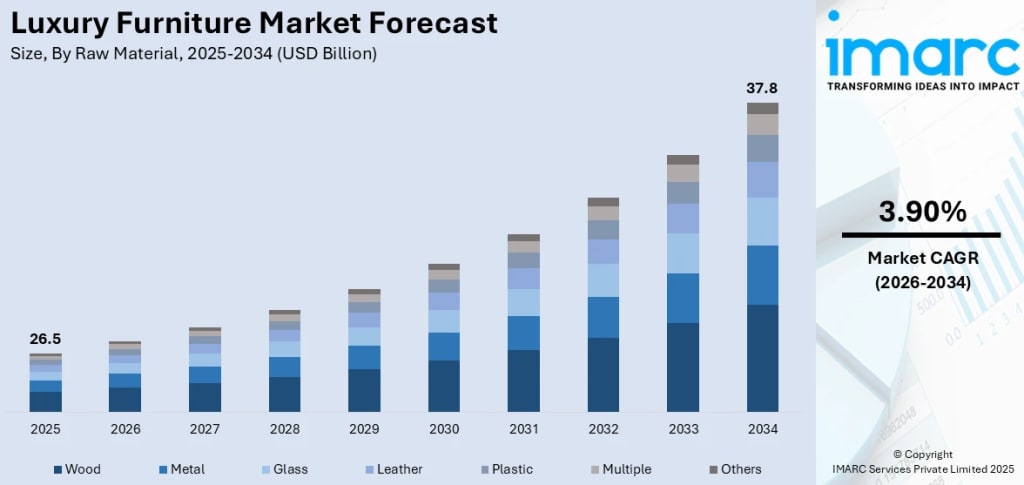
Market Snapshot
The global luxury furniture market is on a firm upward trajectory, fueled by rising affluence, a growing appetite for premium home aesthetics, and rapid expansion in high-end real estate and hospitality sectors worldwide. According to IMARC Group's latest research:
Market Size (2025): USD 26.5 Billion
Market Forecast (2034): USD 37.8 Billion
Growth Rate (2026–2034): 3.90% CAGR
Dominant Region: Europe (35.6% share in 2025)
Europe leads the charge, thanks to its centuries-old artisanal heritage, powerhouse brands from Italy and France, and a design culture anchored by flagship events like Salone del Mobile in Milan and Maison & Objet in Paris. Meanwhile, North America is seeing a surge driven by ultra-premium real estate — over 1,700 homes priced at USD 10 million or above were sold in the US in 2024 alone, a staggering 350% jump from the previous year.
Get a Sample Report for Actionable Market Insights
Key Market Segments at a Glance
By Raw Material
Wood leads with ~23.7% market share in 2025. Premium hardwoods like teak, walnut, mahogany, and oak remain top choices for their natural beauty, heritage value, and craftsmanship potential — especially in bespoke installations and heirloom-grade pieces.
By Application
Domestic use dominates with ~71.0% market share. High-net-worth individuals investing in curated living rooms, home offices, and vacation villas are the primary demand drivers, with home renovation trends and social media's influence on interior aesthetics playing significant roles.
By Distribution Channel
Specialty stores hold the largest share at ~49.2%, offering experiential, personalized shopping environments that resonate with discerning buyers. These venues drive loyalty through curated collections, expert guidance, and exclusive product launches.
By Design
Contemporary design leads at ~68.0% share, appealing to consumers who prefer clean lines, understated elegance, and seamless compatibility with modern architecture and smart home technology.
Luxury Furniture Market Growth Drivers
Rising Disposable Incomes and Wealth Concentration
There's a clear and growing link between rising incomes and demand for high-end furniture. In OECD nations, the average household net adjusted disposable income per capita stands at USD 30,490 annually — and as that number grows, so does the willingness to invest in premium furnishings. Affluent buyers increasingly see luxury furniture not just as decor but as a statement of identity and social standing. In regions like the Middle East and Asia Pacific, rapid wealth accumulation is opening entirely new consumer segments, with buyers seeking bespoke craftsmanship and exclusive designs that reflect their lifestyle and aspirations.
Booming Luxury Real Estate and Hospitality Sectors
The luxury real estate boom is one of the strongest tailwinds for the furniture market. In the US alone, ultra-luxury home sales jumped 350% year-over-year in 2024. In India, the real estate market is projected to hit USD 1 trillion by 2030 — and with upscale hotels, resorts, and branded residences proliferating across Asia Pacific and the Middle East, demand for premium, architect-specified interiors has never been stronger. Saudi Arabia and the UAE are particularly active, with large-scale hospitality and residential megaprojects driving bulk procurement of high-end furnishings.
Personalization, Customization, and Technological Innovation
Today's luxury buyer doesn't just want furniture — they want furniture designed for them. A 2024 research study highlighted how 3D scanning technology is transforming furniture manufacturing, enabling rapid prototyping, antique restoration, and tighter quality control. These tools allow brands to offer truly bespoke pieces at scale. Virtual customization platforms and immersive digital showrooms are also reshaping how customers interact with luxury brands — making it easier to visualize, personalize, and commit to high-value purchases. Brands that invest in these capabilities are winning the loyalty of a new generation of design-conscious, tech-savvy affluent consumers.
Luxury Furniture Market Trends
Sustainability Is No Longer Optional
Eco-conscious luxury is rapidly becoming a baseline expectation, not a differentiator. High-end buyers — especially in Europe and North America — are scrutinizing material sourcing, manufacturing processes, and end-of-life recyclability like never before. Brands responding to this include those adopting FSC-certified woods, reclaimed materials, and carbon-neutral production processes. A standout example: Wriver's flagship Experience Center in Gurgaon, which opened in December 2024, anchors its offering around the Lithic Series — furniture crafted from upcycled wood, metal shavings, and paper. That's not a niche story; it's a preview of where the entire premium segment is heading.
Premiumization and Global Boutique Expansion
Luxury furniture brands are thinking far beyond domestic borders. DIVIANA made history in November 2024 by becoming the first Indian luxury furniture company to open a flagship store in Milan — right on the prestigious Via Monte di Pieta in the Montenapoleone Fashion District — backed by a 50 million euro investment. This move signals the global ambitions of emerging market brands and validates the appetite for diverse design perspectives in traditionally European-dominated luxury retail. Meanwhile, Perigold announced the opening of its second US physical store in Houston in 2025, reflecting how online-first luxury platforms are increasingly investing in immersive, in-person retail experiences.
Interior Design Culture Driving Aspirational Spending
Interior design has gone mainstream in a big way. Platforms like Instagram and Pinterest have turned home aesthetics into a form of personal expression, and the results are showing up in the furniture market. India's interior design market, for instance, is forecast to grow at a strong clip through 2033, and similar trends are visible across Latin America, where 88.1% of the population now lives in urban areas — a demographic increasingly drawn to curated, style-forward living spaces. The global home decor market, valued at USD 779.8 billion in 2024, is expected to surpass USD 1.1 trillion by 2033, underscoring just how central interior aesthetics have become to modern consumer culture.
Recent News and Developments
December 2024: Wriver inaugurated its 24,000 sq. ft. Experience Center in Gurgaon, India, showcasing its Lithic Series built from upcycled materials — a flagship statement for luxury sustainability.
November 2024: DIVIANA became the first Indian luxury furniture brand to open in Milan's Montenapoleone Fashion District, backed by a EUR 50 million investment — marking a landmark moment for Indian design on the global stage.
November 2024: Perigold announced its second US physical store, opening in spring 2025 in Houston's Highland Village, expanding its premium in-store experience for American consumers.
August 2024: Durian entered the Kerala market with a new 4,500 sq. ft. store in Thiruvananthapuram, reinforcing its pan-India luxury retail expansion.
May 2024: Remax Furnitures launched its premier store in India, offering personalized, high-end home decor and bespoke interior design solutions to growing luxury consumers.
Competitive Landscape
The luxury furniture space is intensely competitive and increasingly global. Key players are pursuing three parallel strategies: sustainability integration (eco-sourcing, responsible manufacturing), digital transformation (virtual showrooms, AI-based customization tools), and exclusive creative collaborations with designers and artists. Leading brands profiled in the IMARC report include:
• Cassina S.p.A.
• Williams-Sonoma, Inc.
• Turri S.r.l.
• Scavolini Spa
• Duresta Upholstery Ltd.
• Heritage Home Group LLC
• Grayson Luxury
• Nella Vetrina
• Muebles Picó S.A.
• iola Furniture Limited
These companies are not just competing on product quality — they're competing on experience, story, and sustainability credentials. The brands that can articulate a compelling narrative around craftsmanship, origin, and environmental responsibility are clearly gaining ground with today's luxury consumer.
About the Creator
Rahul Pal
Market research professional with expertise in analyzing trends, consumer behavior, and market dynamics. Skilled in delivering actionable insights to support strategic decision-making and drive business growth across diverse industries.
The Fears of AI And How Much Fun It Can Be
ChatGPT has come a long way, as has AI in general. There are those people who are scared of it, and for understandable reasons. People fear that as technologies advance, they’ll be replaced in the workforce. Then, there are the fears that AI could evolve into something that brings us to the brink of extinction.
By The Man Behind The Maskabout 23 hours ago in Futurism
Nanoceramic Powder Market Outlook: Advanced Materials Innovation and High-Performance Applications Growth Opportunities
According to IMARC Group's latest research publication, The global nanoceramic powder market size reached USD 10.1 Billion in 2024. Looking forward, IMARC Group expects the market to reach USD 35.6 Billion by 2033, exhibiting a growth rate (CAGR) of 14.31% during 2025-2033.
By Michael Richard5 days ago in Futurism




Comments
There are no comments for this story
Be the first to respond and start the conversation.