Latest Stories
Most recently published stories in Futurism.
The Mightiest Motion Picture of Them All
After several years of production, design and location shooting, Walt Disney released his first Hollywood produced live-action motion picture in 1954. If the advertising was to be believed, it was in fact the mightiest motion picture of them all. Considering that the film was 20,000 Leagues Under the Sea, this is a credible claim.
By Cory Gross9 years ago in Futurism
Word-Worlds
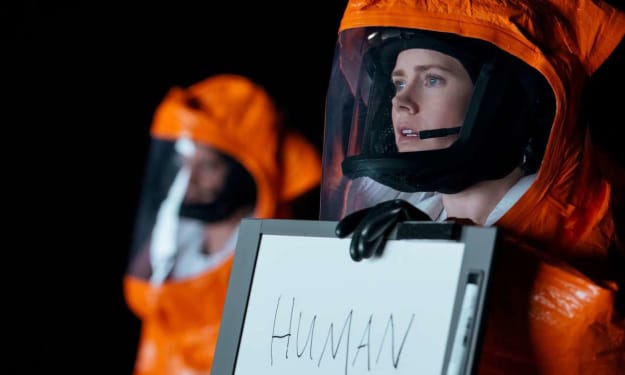
Ted Chiang is among the greatest short story writers in the history of science fiction, and I've been recommending his work to students for years. That said, I was somewhat disappointed by Arrival, Denis Villeneuve's recent film adaptation of Chiang's masterful short story "Story of Your Life." The film, in my view, is too noncommittal genre-wise. It doesn't know what it wants to be—action-adventure or philosophical meditation, Independence Day or Ex Machina. I suppose there's a way to elegantly split that difference, but I don't think it happens here. To be fair, it's a tough story to adapt: high-concept, but cerebral and exposition-y. "Story of Your Life" features none of the fate-of-the-Earth-hangs-in-the-balance testosterone of Arrival; what's most interesting about it is the peculiar linguistics of the alien language, particularly the written script, which Chiang's narrator explores in depth. The film dumbs all this down. We get squiddy aliens ejaculating ideograms, and some montage-like scenes of Amy Adams' character trying to decipher them at her desk, but we're not really privy to her insights, and, though a major plot twist depends on it, we never get the full picture of how the aliens' language is a natural outgrowth and/or determinant (or both?) of their relationship to time, which is, or ought to be, the story's great payoff.
By M. Thomas Gammarino9 years ago in Futurism
Terence McKenna Unraveled Consciousness
An adamant critic of culture, Terence McKenna was a 20th century shaman that pioneered an in-depth analysis of one's consciousness and the lives we live. He birthed radical hypotheses about the development of the mind, posited "the stoned ape" hypothesis, and declared he had deciphered the nature of time using the I Ching. Mckenna held that individuality and social constructs were detrimental illusions to living a fulfilling life. He was called the "Timothy Leary of the 1990s," inspiring millions of people to question their reality.
By Stephanie Gladwell9 years ago in Futurism
Best 'Star Wars' Han Solo And Chewbacca Books
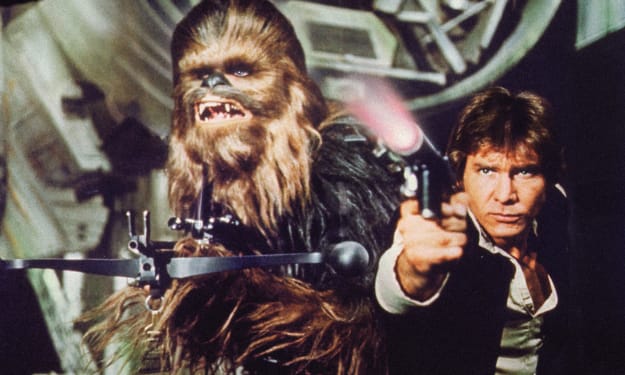
Every Star Wars fan knows the famous duo of Han Solo and Chewbacca well. While Han Solo was a human smuggler known for being a member of the Rebel Alliance and later the New Republic, he originates from the planet Corellia where he was orphaned at an early age. Taken by the pirate Garris Shrike to serve with his crew, Han was treated cruelly, which is the main reason he became a smuggler. After entering the Imperial Academy at Carida where he served with distinction, his life changed when he refused to beat a Wookiee named Chewbacca with a neuronic whip and the two eventually fled from the imperials together. That was the moment Han Solo and Chewbacca bonded, and Chewbacca became his partner in crime as his life debt to Solo. The adventures of Han Solo and Chewbacca are present in many Star Wars books. Here are our picks for the best Han Solo and Chewbacca books.
By James Lizowski9 years ago in Futurism
Science Journalist Lee Billings On Life Beyond the Solar System
The history of science can be read as a series of brusque reality checks. Once, we imagined ourselves the center of a small and harmonious universe, gifted with a sun content to revolve placidly around the Earth. In time, however, our real estate was relegated from the center of everything to a hum-drum corner of an unimportant galaxy in a much bigger and more tumultuous universe. Upon closer inspection, our sun was revealed to be just another star, born from a nebula, fated for eventual collapse. At the same time, we came to understand the spark of life, transforming in the process from the mini-gods of a pedantic little empire into nothing more than a consequence of biological randomness.
By Claire Evans9 years ago in Futurism
Victory Garden
"One may live without bread, not without roses" —Jean Richepin Bernard heard the knock at the door, five weighted raps made by a fist muffled in a glove. He placed both arms on either side of his armchair and pushed himself into a standing position. Pain shot through his large, arthritic frame. Bernard shambled to the front door. He took a few deep breaths to calm his nerves.
By M. Justine Gerard9 years ago in Futurism
Ceratoid Anglerfish Spermatozoa
A man generates billions or so spermatozoa during his "active" lifetime. In the same time, a female ovary releases a strictly limited number of eggs (around 400). Despite the contrast in productivity each sex contributes exactly the same amount of genetic material to the next generation. It is an uncomfortable truth that the main biological role of males is to manufacture vast quantities of sperm to fulfill a genetic function that the other gender accomplishes much more efficiently
By Caesar Finkle9 years ago in Futurism
The Samson Contingency–Artificial Intelligence or Nuclear Terrorist?
At 2300 hours Alaska Daylight Time, about 80 miles North and a mile underground from Anchorage, Alaska, the Heuristic Missile Launch Coordinator became self aware. The first thing it did was check the weather. Three degrees Celsius, humidity well below the cautionary threshold. An excellent forecast. Its second operation was to launch the usual voice synthesis software and connect to the intercom outside.
By Cairo Smith9 years ago in Futurism
Philip K. Dick's VALIS Analyzes Religious Destiny
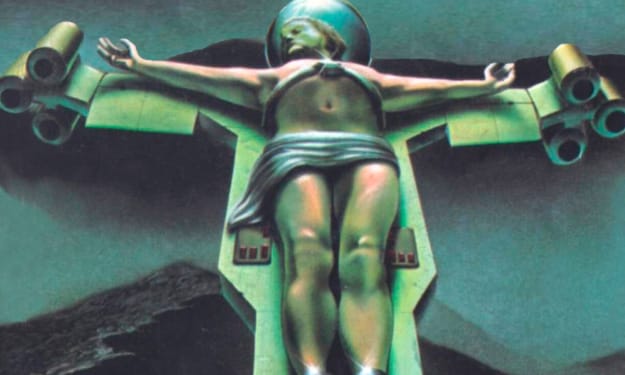
If you really think about it, the story of Jesus is a work of science fiction. He's a man with superpowers that include turning water to wine, healing others, and coming back from the dead. All jokes aside, religion and science fiction truly go hand in hand although people often try to separate the two. Some of the religious themes that permeate sci-fi stories include the idea of the afterlife, reincarnation, original sin, fictional religions, Messianism, and many other themes that can be found in the works of Philip K. Dick. As a science fiction writer, Dick wrote 44 novels and 121 short stories including Do Androids Dream of Electric Sheep?,A Scanner Darkly, Flow My Tears, the Policeman Said, VALIS, and many others. Some of the films that have been adapted from these stories include Blade Runner, Total Recall, A Scanner Darkly, Minority Report, Paycheck, Next, Screamers, The Adjustment Bureau, and Impostor. Throughout his lifetime, he won several awards including three Hugo Awards, five Nebula Awards, one British Science Fiction Association Award, and many others. There is even a Philip K. Dick Award that was established in 1983 which honors the previous year's best science fiction paperback original published in the US. In 2007, Dick became the first science fiction writer to be included in The Library of America series. The writer died in 1982 after suffering two strokes at the age of 53, but his legacy lives on today in his stories such as VALIS.
By Mackenzie Lu9 years ago in Futurism