
Electric Truck Market Insights: Last-Mile Delivery Boom, Cost Reduction & Industry Forecast to 2034
How battery advancements, expanding charging infrastructure, and supportive government policies are accelerating adoption of electric trucks across logistics, freight, and last-mile delivery applications globally

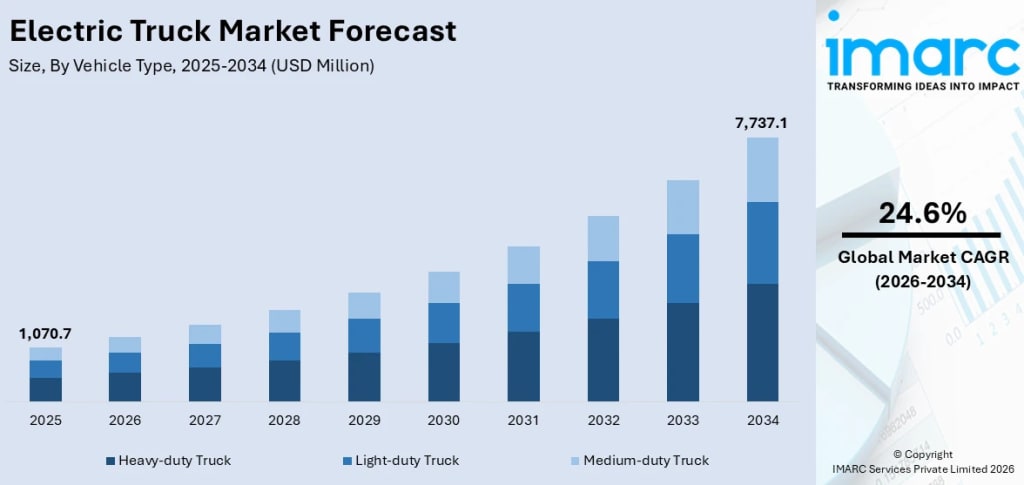
Rising government mandates for zero-emission transport, declining battery costs, and the rapid expansion of charging infrastructure are propelling the electric truck demand. Logistics and fleet operators are increasingly transitioning to electrified heavy-duty and light commercial vehicles to achieve sustainability targets and lower long-term operational expenses. According to IMARC Group’s latest data, the global electric truck market size was valued at USD 1,070.7 Million in 2025. Looking forward, IMARC Group estimates the market to reach USD 7,737.1 Million by 2034, exhibiting a CAGR of 24.6% from 2026-2034. North America currently dominates the market, holding a market share of over 31% in 2025.
Electric trucks now represent a critical frontier in the global effort to decarbonize the transportation sector. Demand is driven by a combination of stringent environmental regulations, such as the U.S. EPA’s Clean Truck Plan, and the massive growth of the e-commerce sector, which requires efficient, low-emission last-mile delivery solutions. Major segments include light-duty, medium-duty, and heavy-duty trucks, with battery electric vehicles (BEV) leading the propulsion category. Key industries, including logistics, construction, and municipal services, are prioritizing these vehicles as advancements in megawatt charging and high-energy-density batteries make long-haul electric freight a reality.
Electric Truck Market Growth Drivers:
- Stringent Government Regulations and Emission Mandates
Governments worldwide are enforcing aggressive decarbonization targets to combat climate change, forcing a shift away from internal combustion engines. In the United States, the Safer Affordable Fuel-Efficient (SAFE) regulations and the EPA’s Clean Truck Plan are setting the bar for commercial vehicle emissions. Similarly, the European Union's Euro 7 standards are pushing manufacturers to prioritize zero-emission powertrains. These mandates are often backed by substantial financial weight; for example, India’s PM E-DRIVE program recently allocated approximately USD 1.3 billion to accelerate EV adoption, including dedicated subsidies for electric trucks to bridge the price gap with diesel.
- Total Cost of Ownership (TCO) and Operational Efficiency
While the initial purchase price of an electric truck can be two to three times higher than a diesel equivalent, the long-term economic benefits are becoming undeniable. Electric drivetrains have significantly fewer moving parts, leading to maintenance savings of nearly 30% compared to traditional trucks. Furthermore, the volatility of diesel prices—which averaged over USD 3.80 per gallon in certain regions recently—makes electricity a more stable and cost-effective fuel source. Fleet operators are realizing that high-utilization routes, particularly in urban logistics, allow for a rapid return on investment through energy savings and reduced downtime.
Get Instant Access to "Electric Truck Market" Sample PDF – Download Today
- Rapid Expansion of Charging and Hydrogen Infrastructure
The viability of electric trucks is directly tied to the availability of high-capacity charging networks. Significant investments are being funneled into "electric corridors" and megawatt charging systems (MCS) that can recharge a heavy-duty truck during a driver’s mandatory rest period. In 2025, the U.S. Department of Energy announced a USD 68 million investment under the SuperTruck Charge initiative to develop public charging hubs at ports and distribution centers. This infrastructure build-out, combined with the development of hydrogen refueling stations for fuel-cell trucks, is removing the "range anxiety" that previously hindered the adoption of electric heavy-duty haulage.
Electric Truck Market Trends:
- Advancements in Battery Technology and Range Capabilities
Innovation in battery chemistry is significantly enhancing the performance and payload capacity of electric trucks. Manufacturers are moving toward high-density lithium-ion and solid-state battery research to increase vehicle range without adding excessive weight. For instance, Volvo Trucks recently introduced a heavy-duty electric model capable of traveling 600 km on a single charge, a milestone that opens the door for regional and inter-city freight. Additionally, the industry is seeing a shift toward longer battery warranties—some reaching up to 1.2 million kilometers—which helps maintain the residual value of the vehicles and lowers financing hurdles for small-scale fleet owners.
- Integration of Telematics and Smart Fleet Management
Modern electric trucks are becoming "data centers on wheels," equipped with sophisticated telematics that optimize energy consumption in real-time. These systems allow operators to monitor battery health, plan routes based on charging station availability, and utilize regenerative braking data to extend range. Real-world applications show that smart software can improve a fleet's energy efficiency by up to 15%. This trend is particularly strong in the e-commerce sector, where companies like Amazon and FedEx use integrated data to manage massive delivery networks, ensuring that vehicles are charged and deployed with maximum precision during peak demand.
- Growth in Urban Zero-Emission Zones and Last-Mile Delivery
Cities are increasingly designating "Zero-Emission Zones" (ZEZs) to improve air quality and reduce noise pollution, creating a massive market for light and medium-duty electric trucks. In the Netherlands, electric commercial van sales reached over 80% in early 2025 following the implementation of such municipal policies. This trend is reshaping urban logistics, as electric trucks are quieter and more efficient for frequent "stop-and-go" cycles common in parcel delivery. Consequently, manufacturers are diversifying their portfolios to include specialized electric box trucks and refrigerated vans that meet the specific noise and emission requirements of dense metropolitan environments.
Recent News and Developments in Electric Truck Market:
- January 2026: MAN Truck & Bus reported a major turning point, moving from pilot projects to full-scale series production of its heavy-duty electric truck portfolio, with over 600 units delivered to European customers within the year.
- March 2025: Eicher Trucks and Buses partnered with Magenta Mobility to supply an initial order of 100 Eicher Pro X small electric trucks, specifically targeting the surging demand for sustainable middle-mile and last-mile logistics.
- September 2024: The Indian government approved the PM E-DRIVE scheme with a ₹109 billion outlay, specifically earmarking ₹5 billion to incentivize the procurement and deployment of electric trucks across the country's major transport hubs.
Note: If you require specific details, data, or insights that are not currently included in the scope of this report, we are happy to accommodate your request. As part of our customization service, we will gather and provide the additional information you need, tailored to your specific requirements. Please let us know your exact needs, and we will ensure the report is updated accordingly to meet your expectations.
About the Creator
Andrew Sullivan
Hello, I’m Andrew Sullivan. I have over 9+ years of experience as a market research specialist.
Keep reading
More stories from Andrew Sullivan and writers in Futurism and other communities.
Vegan Ice Cream Market Trends: Health-Conscious Consumers, Low-Calorie Options & Industry Forecast to 2034
The global vegan ice cream market is witnessing a major transformation as plant-based diets move from niche lifestyle choices to mainstream consumer habits. Driven by a surge in lactose intolerance, ethical concerns, and a growing appetite for sustainable indulgence, manufacturers are rapidly innovating with creamy bases like coconut, almond, and oat milk. According to IMARC Group’s latest data, the global vegan ice cream market size was valued at USD 732.1 Million in 2025. Looking forward, IMARC Group estimates the market to reach USD 1,075.9 Million by 2034, exhibiting a CAGR of 4.24% from 2026-2034. Europe currently dominates the market, supported by a sophisticated retail infrastructure and a high density of health-conscious consumers.
By Andrew Sullivan9 days ago in Futurism
The Fears of AI And How Much Fun It Can Be
ChatGPT has come a long way, as has AI in general. There are those people who are scared of it, and for understandable reasons. People fear that as technologies advance, they’ll be replaced in the workforce. Then, there are the fears that AI could evolve into something that brings us to the brink of extinction.
By The Man Behind The Maska day ago in Futurism


Comments
There are no comments for this story
Be the first to respond and start the conversation.