
Education Apps Market Trends: AI Tutors, Adaptive Learning & Forecast to 2034
How increasing demand for personalized learning, AI tutors, and smart content delivery is accelerating innovation in the global education apps market

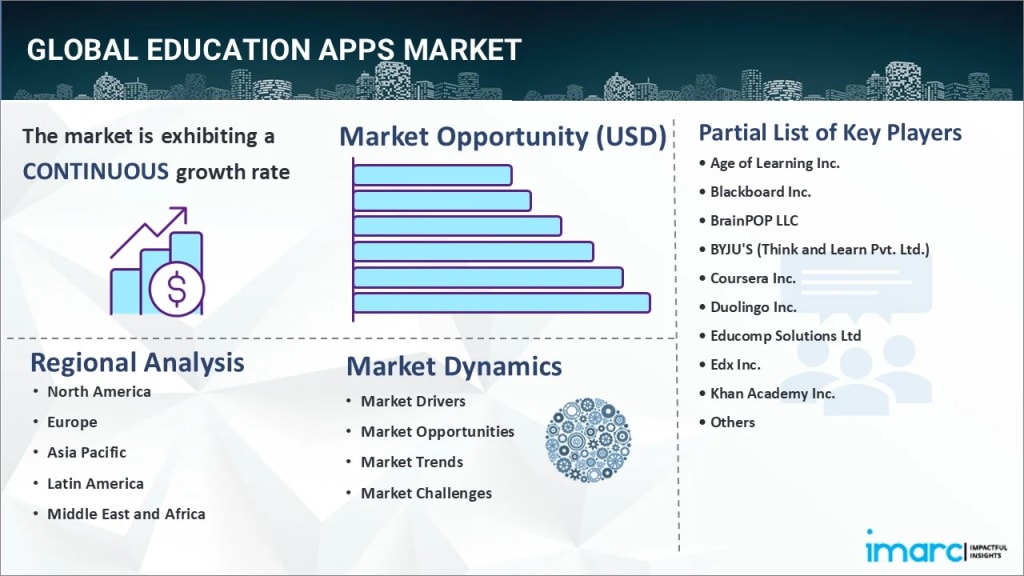
The global education apps market is on a remarkable growth trajectory, fueled by rising smartphone adoption, demand for flexible learning solutions, and the rapid integration of AI into digital education platforms. According to IMARC Group’s latest research, the global education apps market size reached USD 6.2 Billion in 2024. Looking forward, IMARC Group expects the market to reach USD 41.6 Billion by 2033, exhibiting a CAGR of 21.5% during 2025–2033. Notably, the education app category ranks as the second largest on the Google Play Store and the third largest on the Apple App Store, underscoring just how central these tools have become to everyday learning.
Education apps now span everything from kindergarten literacy tools to advanced professional certification platforms. Whether it’s a six-year-old using ABCmouse, a high-schooler prepping for exams on Khan Academy, or a working professional upskilling through Coursera, these platforms serve learners across every age group and income level. Mobile-based apps dominate the market thanks to their portability and widespread accessibility, while AI-powered personalization is rapidly becoming the new standard rather than a differentiating feature. The sector generated over USD 6 billion in app revenue in 2024 alone, with online course platforms like Udemy, Coursera, and LinkedIn Learning accounting for more than a third of that figure.
Education Apps Market Growth Drivers:
Surging Smartphone Penetration and Affordable Internet Access
With over 6.8 billion smartphone users worldwide and mobile data costs falling sharply across emerging markets, education apps are now accessible to learners who once had no viable alternative to traditional classrooms. In India alone, education app downloads surged past 1 billion cumulatively, driven by affordable data plans and government digital literacy programs like Digital India. This mobile-first shift means platforms are no longer competing just for urban, tech-savvy users—they’re reaching rural students, first-generation learners, and working adults who fit study sessions around packed daily schedules.
Demand for Flexible, Self-Paced Learning Models
Today’s learners—students and professionals alike—want education that fits their schedule, not the other way around. Self-learning apps account for over 56% of the online learning mode share, and platforms offering bite-sized, on-demand content are seeing consistently strong retention. Corporate training is a particular hotspot: companies invest in platforms like Coursera for Business and Degreed to upskill teams without pulling them off the job. McKinsey estimates that 60% of employees will need reskilling in the coming years, and education apps are a practical, cost-effective answer—delivering up to USD 30 return for every dollar invested, according to IBM’s internal L&D benchmarks.
Government Initiatives Driving EdTech Integration in Schools
Governments across the globe are actively pushing digital learning into classrooms, creating a powerful institutional tailwind for the education apps market. Japan’s GIGA School Program equipped every student with a personal device and high-speed internet access. Germany’s USD 6 billion DigitalPakt Schule fund is accelerating ed-tech adoption, with over 60% of German organizations now using e-learning tools. In Saudi Arabia, Vision 2030 has placed education modernization at the center of national policy, with smart classrooms and e-learning platforms being rolled out at scale. These programs don’t just expand the user base—they legitimize and accelerate adoption for entire school systems.
Education Apps Market Trends:
AI-Powered Personalization Is Becoming the New Baseline
Artificial intelligence is no longer a premium feature in education apps—it’s the expected foundation. Adaptive learning platforms, used by 43% of teachers globally, adjust lesson pace and content in real time based on each learner’s performance. In June 2025, Google launched Gemini for Education, giving schools free access to its Gemini 2.5 Pro AI model through Google Workspace, complete with enterprise-grade security and personalized quiz creation tools. Meanwhile, Rocket Learning’s AI tutor ‘Appu,’ backed by Google.org, is targeting 50 million families in India with early childhood literacy support—showing how AI is scaling access far beyond well-funded institutions.
Gamification and Engagement-First Design Driving Retention
Keeping learners engaged is one of the hardest challenges in digital education, and gamification has emerged as one of the most effective responses. Duolingo, the world’s most downloaded language app with USD 748 million in 2024 revenue, built its entire product around streaks, leaderboards, and progress rewards. In April 2025, Duolingo doubled its course catalog to over 300 options by deploying generative AI—a move that would have taken years without automation. Research consistently shows gamified learning improves outcomes: retention rates for digital learning can reach 25–60% compared to traditional classroom settings, making engagement-first design a strategic priority rather than a nice-to-have.
Expansion into Professional Development and Corporate Learning
Education apps are increasingly crossing over from classrooms into boardrooms. Platforms like Coursera, Degreed, and Go1 now serve both institutional and enterprise clients, and corporate learners are one of the fastest-growing user segments—expanding at a notably high pace year-on-year. Enterprise subscriptions command significantly higher average revenue per user than consumer plans, making this segment particularly attractive for investors. Speak for Business, for instance, reports 85% internal adoption within client firms after deployment. The result is a maturing market that’s no longer just about K–12 apps—it’s a full-spectrum learning ecosystem stretching from preschool to professional certification.
Recent News and Developments in the Education Apps Market
June 2025: Google introduced Gemini for Education at ISTE 2025, providing schools with free access to its Gemini 2.5 Pro AI model integrated into Google Workspace for Education. The platform offers AI-powered tools such as automated summaries, personalized quizzes, and interactive learning resources with enterprise-level security.
May 2025: Duolingo launched Treehouse, a free early-childhood language learning initiative in Pittsburgh community centers. The program focuses on preschool learners and combines play-based activities with expert-designed language education.
April 2025: Duolingo expanded its course library by releasing 148 new language courses powered by generative AI, enabling faster content creation and broader language accessibility for global learners.
March 2025: Rocket Learning, supported by a USD 1.5 million grant from Google.org, introduced Appu, an AI-powered tutor in India designed for children aged 3–6, focusing on early literacy, numeracy, and socio-emotional development.
Note: If you require specific details, data, or insights that are not currently included in the scope of this report, we are happy to accommodate your request. As part of our customization service, we will gather and provide the additional information you need, tailored to your specific requirements. Please let us know your exact needs, and we will ensure the report is updated accordingly to meet your expectations.
About the Creator
Suhaira Yusuf
I specialize in Consumer Insights, focusing on transforming detailed market data into strategic business solutions that accelerate growth and improve customer engagement.
Keep reading
More stories from Suhaira Yusuf and writers in Futurism and other communities.
Superfoods Market Analysis: Organic Products, Rising Awareness & Forecast to 2034
Rising health awareness, preventive healthcare adoption, and surging demand for nutrient-dense functional foods are powering the global superfoods market. According to IMARC Group’s latest research, The global superfoods market size was valued at USD 187.7 Billion in 2025. Looking forward, IMARC Group estimates the market to reach USD 272.2 Billion by 2034, exhibiting a CAGR of 4.20% from 2026–2034. North America currently dominates the market, holding a market share of over 39.8% in 2025.
By Suhaira Yusuf12 days ago in Futurism
The Fears of AI And How Much Fun It Can Be
ChatGPT has come a long way, as has AI in general. There are those people who are scared of it, and for understandable reasons. People fear that as technologies advance, they’ll be replaced in the workforce. Then, there are the fears that AI could evolve into something that brings us to the brink of extinction.
By The Man Behind The Maska day ago in Futurism
Aeroderivative Sensor Market Outlook: Turbine Monitoring and Precision Sensing Growth Opportunities
According to IMARC Group's latest research publication, The aeroderivative sensor market size reached USD 338.5 Million in 2024. Looking forward, IMARC Group expects the market to reach USD 747.5 Million by 2033, representing a growth rate (CAGR) of 8.74% during 2025-2033.
By Michael Richard5 days ago in Futurism



Comments
There are no comments for this story
Be the first to respond and start the conversation.