
Digital Printing Market Trends: On-Demand Printing, Packaging Innovation & Forecast to 2033
Increasing adoption of print-on-demand services, sustainable inks, and digital workflows is driving efficiency and innovation across the global Digital Printing Market.

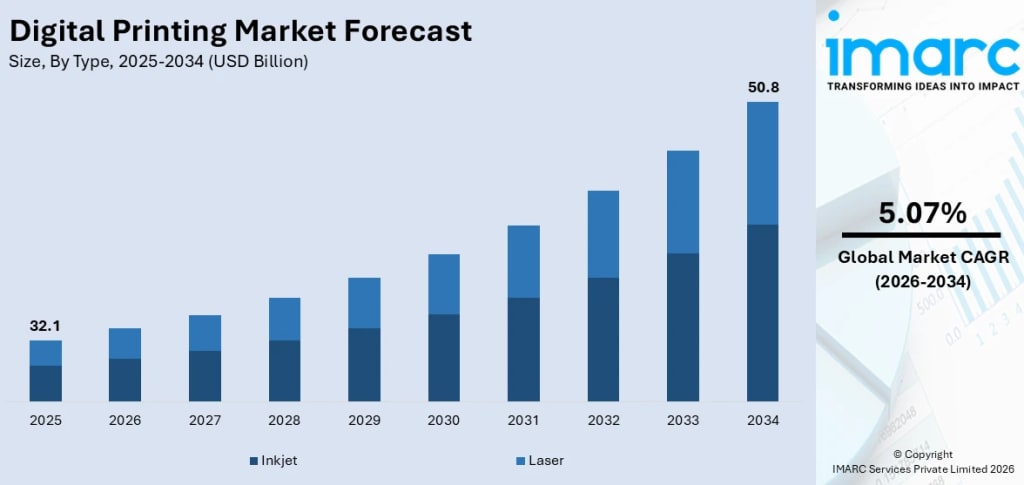
Growing demand for personalized packaging, rapid e-commerce expansion, and a decisive industry-wide shift toward eco-friendly production are reshaping the printing landscape worldwide. Digital printing is increasingly becoming the go-to choice for brands that need speed, flexibility, and customization without the cost burden of traditional plate-based methods. According to IMARC Group's latest data, the global digital printing market size reached USD 32.1 Billion in 2025. Looking forward, IMARC Group estimates the market to reach USD 50.8 Billion by 2034, exhibiting a CAGR of 5.07% during 2026–2034. North America currently dominates the market, accounting for the largest share, driven by early adoption of digital technologies and a strong presence of key industry players.
Digital printing today covers a wide and growing range of applications — from customized packaging on plastic film and foil to fabric printing, ceramic décor, glass decoration, and commercial paper-based output. The shift away from traditional analog printing is accelerating as businesses prioritize shorter production runs, zero-plate setup, and the ability to swap designs without incurring re-tooling costs. Inkjet technology leads the way, driven by its ability to print on virtually any substrate. Meanwhile, aqueous inks are gaining ground as brands respond to mounting pressure to eliminate volatile organic compounds from their production lines and meet tightening environmental regulations.
Get a Sample Report for Actionable Market Insights
Digital Printing Market Growth Drivers:
• Rising Demand for Short-Run and On-Demand Printing
Brands across retail, FMCG, and publishing increasingly need small, targeted print runs rather than large fixed batches. Traditional offset printing makes this expensive because every job requires plates. Digital printing eliminates that barrier entirely. The U.S. Department of Commerce reinforced this shift when it issued preliminary countervailing duty rates of 38.50% to 231.98% on aluminum lithographic printing plates imported from China — a clear signal that plate-dependent methods face growing cost and supply-chain uncertainty. As on-demand printing becomes standard practice, digital presses are the natural beneficiary across commercial and consumer applications.
• E-Commerce Boom Fueling Customizable Packaging Demand
The explosion of e-commerce is one of the most direct growth catalysts for digital printing. Online sellers need distinctive, brand-consistent packaging for thousands of SKUs — often in small quantities and with frequent design updates. UNCTAD data shows that during a key surveyed period, online shoppers among internet users rose from an average of 53% to 60% across 66 countries, reflecting just how fast e-commerce volumes are scaling. Digital printing meets this demand head-on: no plates, short runs, variable data, and fast turnaround. ProAmpac's acquisition of Specialty Packaging — a specialist in digitally printed plastic film and foil — is a concrete example of industry consolidation around this opportunity.
• Sustainability Pressures Accelerating the Switch from Analog
Environmental compliance is no longer optional for manufacturers, and digital printing has a clear advantage over traditional methods. Epson's heat-free inkjet technology uses up to 96% less energy than conventional laser printers — a staggering efficiency gap that translates directly into lower carbon footprints and operating costs. Aqueous inks, which dominate the ink-type segment, emit minimal volatile organic compounds and are increasingly specified by brands with aggressive sustainability targets. As regulatory frameworks tighten across North America and Europe, the cost of staying with analog printing — in both compliance burden and reputational risk — is rising fast.
Digital Printing Market Trends:
• Inkjet Technology Expanding Into New Substrates and Industries
Inkjet printing's versatility is pushing it well beyond paper. It now prints on ceramics, fabrics, three-dimensional objects, glass, and flexible packaging substrates — often with non-contact precision that protects sensitive materials from damage. Canon's rebranding of its ink tank lineup to PIXMA MegaTank and MAXIFY MegaTank signals how manufacturers are repositioning inkjet systems as high-yield, low-cost production platforms suited to home offices, SMEs, and light commercial users. With the printed packaging market valued at USD 22.6 Billion and projected to reach USD 40.3 Billion, inkjet's substrate flexibility is opening opportunities that plate-based printing simply cannot compete with on cost or speed.
• Eco-Friendly Ink Innovation Reshaping Product Development
Ink chemistry is becoming a competitive battleground. Fujifilm's AQUAFUZE technology — merging water-based and UV-curable inks in a single formulation — is a good example of where the industry is heading. Launching in Autumn 2024, it delivers stretchability, durability, and odorless output on plastic film and foil, all while minimizing printhead clogging and reducing image thickness for a cleaner finish. At the same time, KRONOS introduced its 9900 aqueous white pigment concentrate for inkjet systems, addressing one of the longstanding technical challenges of white ink printing with improved stability, opacity, and regulatory compliance. These aren't incremental updates — they are category-expanding innovations.
• Convergence of Digital Printing with Workflow Automation and IT
Digital printing is increasingly being integrated with broader production IT systems — creating smarter, faster, and more efficient print workflows. The collaboration between print technology providers and software developers is driving automation in job submission, color management, and print-floor scheduling, reducing manual intervention and error rates. Glenroy Inc.'s 2023 upgrade to Automatic SAMM 2.0 flexographic plate mounting technology demonstrates how even adjacent technologies are being modernized to support faster, more accurate production. As manufacturers invest in end-to-end digital workflows, the value of digital printing extends well beyond the hardware — it becomes a connected node in a fully automated production ecosystem.
Recent News and Developments in the Digital Printing Market
• Autumn 2024: Fujifilm introduced AQUAFUZE inkjet ink technology, combining water-based and UV-curable inks for wide-format printing on plastic film and foil. The innovation offers stretchability, durability, and odorless output — ideal for indoor signage and wallpaper — while minimizing printhead clogging and prioritizing user safety.
• March 2023: Glenroy Inc., a leader in sustainable flexible packaging, upgraded its operations with the Automatic SAMM 2.0 plate mounting and demounting system, improving efficiency, accuracy, and safety across its flexographic printing production line, reinforcing its commitment to quality and sustainable manufacturing.
• March 2022: ProAmpac, a leading flexible packaging company, acquired Specialty Packaging Inc. — a family-owned manufacturer specializing in digital printing on plastic film and foil. The move expanded ProAmpac's footprint in the food service sector and strengthened its position in digitally printed packaging.
• February 2022: Canon launched an advanced, automated water-based polymer ink manufacturing facility in Venlo, Netherlands, designed to produce top-quality CMYK inks at scale and meet rising global demand for inkjet production printing while reducing manufacturing waste.
• December 2021: Fujifilm Holdings introduced the Jet Press 750S High-Speed Model, a new digital printing press delivering improved productivity and print quality — targeting high-volume commercial printers looking to transition from offset to digital without sacrificing output standards.
Note: If you require specific details, data, or insights that are not currently included in the scope of this report, we are happy to accommodate your request. As part of our customization service, we will gather and provide the additional information you need, tailored to your specific requirements. Please let us know your exact needs, and we will ensure the report is updated accordingly to meet your expectations.
About the Creator
Rahul Pal
Market research professional with expertise in analyzing trends, consumer behavior, and market dynamics. Skilled in delivering actionable insights to support strategic decision-making and drive business growth across diverse industries.
How machines can learn from human behaviour
In order to understand where we are and where we are going, we need to understand where we were first. - Susan Fourtane Could a human behaviour simulator be embedded into a robot or online avatar to the point that it’s hard to distinguish between a real person or artificial intelligence? Scientists have been upping the stakes in this “Turing test” for years, to the point that human-mimicking programmes are ready to answer tricky questions, assist people with online shopping or be companions.
By Susan Fourtané 12 days ago in Futurism
Thirty (one) and Neither Flirty nor Thriving.
I'm thirty-one and orbiting the same few mistakes like they're landmarks. London is already awake before I am (or before I've slept) - sirens somewhere far enough to ignore, buses sighing at stops, people moving with purpose I can't quite borrow. I lie there for a bit, tasting last night at the back of my throat, trying to remember if I meant to drink that much or if it just...happened again.
By Stacey Vella5 days ago in Psyche




Comments
There are no comments for this story
Be the first to respond and start the conversation.