
Digital Printing Market Outlook: Customization Growth, Speed Efficiency & Future Insights 2034
How automation in printing processes, growing need for personalization, and sustainable ink solutions are driving strong growth in the global Digital Printing Market.

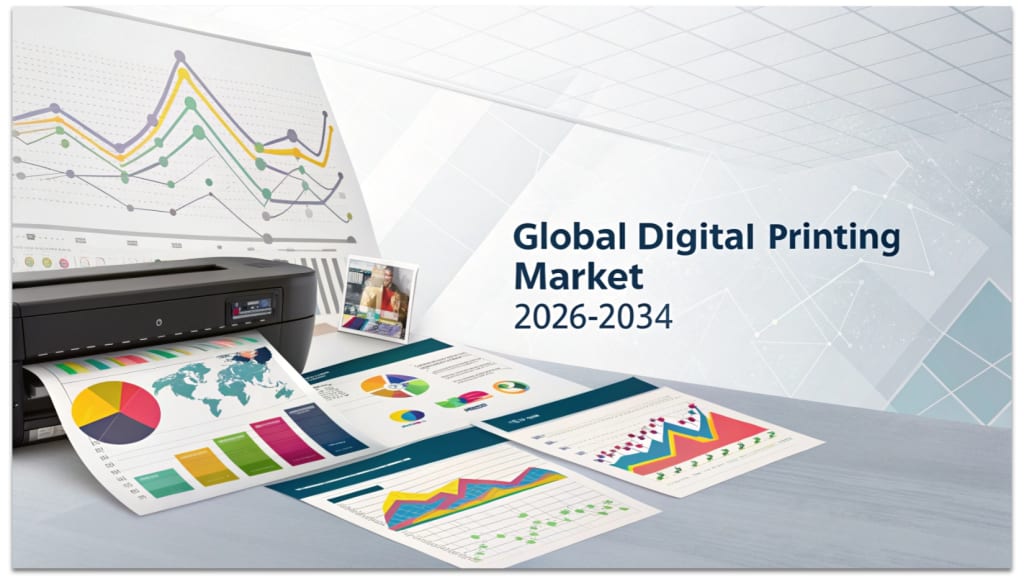
The way businesses print, brand, and package their products is quietly going through a major transformation. Digital printing has steadily replaced traditional offset and screen methods across industries, and it's not hard to see why — shorter run lengths, faster turnaround times, no printing plates, and the ability to personalize every single piece. From pharmaceutical labels to custom fashion apparel, digital printing is now embedded in supply chains that were once the exclusive domain of analog technologies.
According to IMARC Group's latest research, the global digital printing market size reached USD 32.1 Billion in 2025. The market is projected to reach USD 50.8 Billion by 2034, at a CAGR of 5.07% during 2026–2034. North America currently leads with a dominant market share, driven by the early adoption of digital technologies and a strong base of established industry players. Asia-Pacific, meanwhile, is emerging as the fastest-growing region, fueled by rapid e-commerce expansion and rising retail digitization.
Get a Sample Report for Actionable Market Insights
Digital Printing Market Growth Drivers:
• Surging Demand for Short-Run and On-Demand Printing
Traditional offset printing requires costly plate setup, making small-batch jobs economically unviable. Digital printing eliminates that barrier entirely. Across sectors like publishing, pharmaceutical packaging, and retail labels, businesses now routinely order runs of a few hundred units rather than thousands — and digital presses deliver those jobs in hours, not days. This flexibility is especially valuable for brands launching seasonal or limited-edition products. The U.S. Department of Commerce's countervailing duty determination on Chinese aluminum printing plates — carrying rates of 38.50% to 231.98% — has further accelerated the shift away from plate-dependent traditional methods.
• E-Commerce Growth Driving Custom Packaging Needs
The explosion of online retail has created a packaging challenge: every brand wants distinctive, high-quality boxes and labels that stand out at the doorstep. Digital printing handles this perfectly — it can accommodate variable data, short print runs, and frequent design changes without retooling. Over 60% of the commercial printing industry has already shifted to digital workflows to stay competitive with e-commerce timelines. Brands partnering with digital print providers report faster product launches and stronger visual consistency across SKUs, which directly translates into higher consumer engagement and repeat purchases.
• Technological Advances Improving Quality and Sustainability
Print quality that once required expensive offset equipment is now achievable digitally, at a fraction of the lead time. Epson's heat-free inkjet technology, for instance, uses up to 96% less energy compared to traditional laser systems. Mimaki's TRAPIS eco-textile platform, launched commercially, cuts wastewater by 90% while maintaining high image accuracy across multiple fabric types. These aren't incremental improvements — they represent a redefinition of what digital printing can do. As sustainability requirements tighten across the EU and North America, energy-efficient digital systems are increasingly the only viable choice for compliant print buyers.
Digital Printing Market Trends:
• Inkjet Technology Dominating Across Substrates
Inkjet holds the largest segment position, accounting for approximately 58.83% of market revenue. The reason is simple: no other technology handles such a diverse range of substrates — ceramics, fabric, glass, rigid board, flexible film — with comparable consistency. Canon's varioPrint iX platform can now toggle between toner and aqueous inkjet modes without swapping hardware, cutting setup time by 30% in early production deployments in Germany and Japan. Meanwhile, HP's Indigo 200K series achieves offset-equivalent gloss on coated stock while switching jobs in minutes, making digital economically competitive even at higher volumes.
• Textile and Apparel Sector Driving New Growth Avenues
Dye sublimation printing for textiles is growing at over 8%, as athletic and fashion brands migrate polyester jersey production entirely to digital workflows. Kornit Digital's partnership with PVH Corp — covering a USD 25 million deployment of Apollo direct-to-garment units across Portugal and Mexico — signals that major apparel groups are making long-term structural bets on digital textile production. Seiko Epson's SureColor F10000 now handles fabric widths up to 1.6 meters, opening the upholstery and curtain segments. These moves are broadening digital printing's commercial footprint well beyond its traditional commercial print base.
• AI Integration and Automation Reshaping Production Workflows
AI and IoT-connected systems are changing how digital print floors operate. Xerox introduced an AI-based commercial printing system that delivers real-time print accuracy and variable data integration, improving workflow efficiency by around 31%. HP launched HP Print AI — the industry's first AI-integrated printing service — automating job routing, predictive maintenance, and error detection across enterprise print environments. These developments reduce operator dependency and dramatically cut downtime. As brands demand faster, zero-defect production with full digital traceability — particularly under drug serialization and EU packaging compliance rules — AI-enabled digital presses are quickly becoming the standard, not the exception.
Recent News and Developments in the Digital Printing Market
• January 2026 — HP Commits USD 150 Million to Expand Indigo Production in Israel
HP announced a USD 150 million investment to scale up its HP Indigo manufacturing operations in Israel, with additional R&D capacity focused specifically on food-safe aqueous inks. This move positions HP to capture rising demand from pharmaceutical and food packaging converters who require stringent ink safety certifications alongside high-speed digital performance.
• October 2025 — Xerox Acquires Toshiba Tec's Inkjet Division for USD 180 Million
Xerox completed its acquisition of Toshiba Tec's inkjet printhead business, bringing a dedicated Shizuoka manufacturing plant and a team of 120 engineers into the fold. The acquisition strengthens Xerox's in-house printhead engineering for its Iridesse and Baltoro platforms, reducing reliance on third-party components and accelerating R&D cycles for high-speed production printing.
• May 2025 — Seiko Epson Launches Three New PrecisionCore Industrial Printheads
Epson unveiled three new commercial and industrial inkjet printheads based on its PrecisionCore technology, targeting rising demand across label production, textile printing, and corrugated packaging. The new heads offer improved print speeds and broader media compatibility, extending Epson's OEM partner network and reinforcing its position as a key printhead supplier to third-party press manufacturers globally.
• February 2025 — Mimaki Introduces Waterless Direct Textile Inkjet Printers
Mimaki Engineering launched the Tx330-1800 and Tx330-1800B direct textile inkjet printers, introducing a fully waterless digital textile printing process. The system maintains high image quality across multiple fabric types while significantly reducing environmental impact — a direct response to growing regulatory and brand sustainability requirements across the European and North American fashion supply chains.
About the Creator
Rahul Pal
Market research professional with expertise in analyzing trends, consumer behavior, and market dynamics. Skilled in delivering actionable insights to support strategic decision-making and drive business growth across diverse industries.
How machines can learn from human behaviour
In order to understand where we are and where we are going, we need to understand where we were first. - Susan Fourtane Could a human behaviour simulator be embedded into a robot or online avatar to the point that it’s hard to distinguish between a real person or artificial intelligence? Scientists have been upping the stakes in this “Turing test” for years, to the point that human-mimicking programmes are ready to answer tricky questions, assist people with online shopping or be companions.
By Susan Fourtané 11 days ago in Futurism
Telecom Order Management Market Trends: 5G Expansion, Real-Time Processing & Industry Forecast to 2034
The rapid global expansion of 5G infrastructure, coupled with the rising demand for seamless digital connectivity, is fueling the telecom order management market. As communication service providers (CSPs) transition toward automated, cloud-native ecosystems to handle complex service bundles, the need for robust orchestration has never been higher. According to IMARC Group’s latest data, the global telecom order management market size was valued at USD 4.95 Billion in 2025. Looking forward, IMARC Group estimates the market to reach USD 12.55 Billion by 2034, exhibiting a CAGR of 10.55% from 2026-2034.
By Andrew Sullivan4 days ago in Futurism
Paul and John's 47-Words Short Story Unofficial Challenge
UPDATE - Republished to update the list of entries, with the 40 we've had so far. Completely smashed last unofficial challenge which recieved 31 entries. And there is still time. If you have yet to enter and fancy winning a bit of money or just challenging yourself or both or just making two old geezers job harder - please enter!
By Paul Stewartabout 3 hours ago in Writers



Comments
There are no comments for this story
Be the first to respond and start the conversation.