
Cooling Tower Market Growth: Data Centers, Industrial Cooling & Forecast to 2034
How rising demand from data centers, industrial cooling needs, and energy-efficient systems is driving growth in the global cooling tower market

Cooling towers might not be the most glamorous piece of industrial equipment, but they are quietly indispensable. From keeping power plants running to maintaining stable temperatures inside data centers and pharmaceutical facilities, these systems sit at the heart of modern industrial operations. And right now, the market for them is in a particularly interesting place — steady, purposeful growth driven by real-world pressures: rising energy costs, stricter environmental regulations, and a wave of industrial expansion across Asia, the Middle East, and beyond.
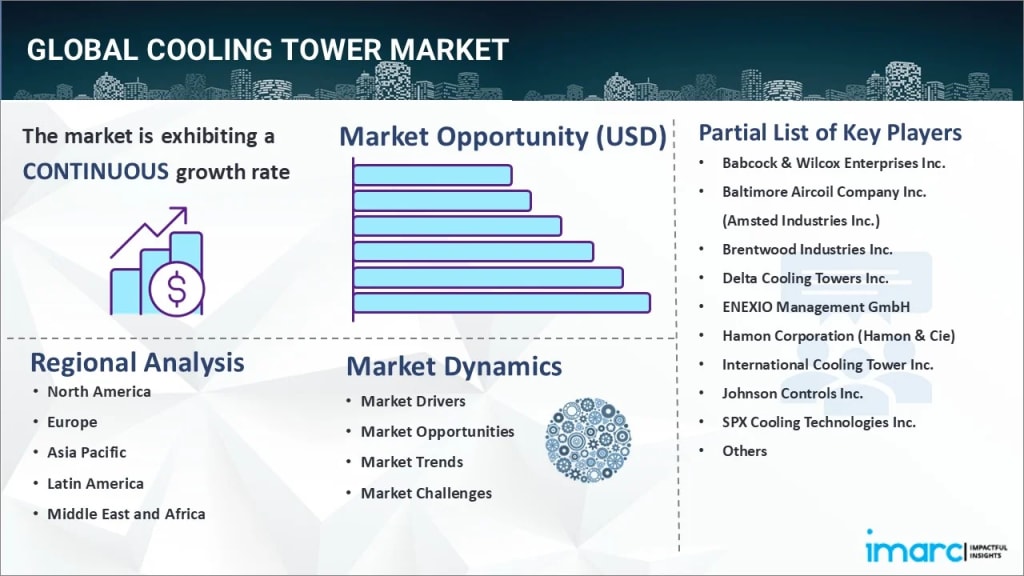
According to IMARC Group's latest research, the global cooling tower market size reached USD 3.3 Billion in 2025. Looking forward, IMARC Group expects the market to reach USD 4.5 Billion by 2034, exhibiting a growth rate (CAGR) of 3.50% during 2026-2034. Asia Pacific currently dominates the market, accounting for the largest regional share due to rapid industrialization and surging power generation needs.
The global cooling tower market spans a wide range of tower types — open-circuit, closed-circuit, and hybrid systems — serving industries as varied as oil and gas, power generation, HVAC, chemicals, and food and beverage processing. Wet (evaporative) cooling towers currently dominate the installed base, holding over 44% of the global market share by type, largely because of their cost efficiency and proven performance in high heat-load environments. Meanwhile, hybrid towers are the fastest-growing segment, driven by tightening water-use regulations and the push for lower emissions. The HVAC segment is also accelerating fast, powered by a global construction boom and growing demand for energy-smart climate control in commercial buildings.
Cooling Tower Market Growth Drivers:
Surging Industrial Energy Costs Pushing Efficiency Upgrades
Energy expenditure is one of the largest operational costs for heavy industries — and cooling systems are significant contributors to that bill. As electricity prices have climbed sharply across major markets, operators in power generation, petrochemicals, and manufacturing are under real pressure to squeeze more performance out of every kilowatt. Modern cooling towers equipped with Variable Frequency Drive (VFD) motors can cut fan energy consumption by up to 50% compared with fixed-speed alternatives. Governments in the U.S., EU, and India are also backing efficiency upgrades through subsidy schemes and green infrastructure incentives, creating a compelling economic case for replacing aging installations with high-performance systems.
Rapid Industrialization and Power Infrastructure Expansion in Emerging Economies
Asia Pacific accounts for roughly 42% of global cooling tower demand, and it is not hard to see why. India's total installed power generation capacity surpassed 442 GW as of mid-2024, with further aggressive expansion planned across thermal and renewable sources. China, meanwhile, continues building out manufacturing hubs, chemical complexes, and data center infrastructure at a pace that demands highly reliable heat rejection solutions. Countries like Egypt, Saudi Arabia, and several Eastern European nations are also attracting large-scale industrial investments in desalination, energy, and petrochemicals — all sectors that rely heavily on cooling tower infrastructure.
Data Center Boom and HVAC Demand Creating a Powerful New Growth Engine
The explosion in cloud computing, AI workloads, and digital infrastructure is generating heat — quite literally. Data centers consume enormous amounts of energy, and effective thermal management is non-negotiable for keeping servers running reliably. Cooling towers are a preferred solution for large-scale data center cooling because they offer superior energy efficiency compared with conventional air-cooled systems. At the same time, major airport expansions, hospital construction projects, and commercial real estate development are pushing HVAC demand sharply higher, creating a sustained pipeline of new installations for cooling tower manufacturers.
Cooling Tower Market Trends:
Smart Monitoring and IoT Integration Transforming Operations
Digital technology is changing how cooling towers are managed. IoT-enabled sensors and AI-driven predictive maintenance platforms now allow operators to track performance in real time, catch faults before they escalate, and optimize water and energy use without manual intervention. This shift is particularly valuable for large facilities — a single unplanned shutdown in a chemical plant or data center can cost hundreds of thousands of dollars. Leading manufacturers are embedding intelligent controls directly into new tower designs, and the broader adoption of AIOps is expected to reduce unplanned downtime industry-wide by as much as 30%, making smart cooling a clear operational and financial priority.
Hybrid and Dry Cooling Systems Gaining Ground Amid Water Scarcity Concerns
Water stress is a growing reality in many industrial regions, and regulators are responding with tougher water-use standards. Hybrid cooling towers — which combine evaporative and dry cooling mechanisms — are quickly becoming the go-to solution for operators in water-scarce or environmentally sensitive areas. They significantly reduce water consumption while maintaining thermal efficiency, and they qualify more easily under green building certification standards. Adoption of hybrid systems in the U.S. alone has the potential to save an estimated 2 trillion gallons of water annually. The hybrid segment is currently the fastest-growing tower type in the global market, and that trajectory looks set to continue.
Modular and Prefabricated Designs Shortening Project Timelines
Industrial projects are under increasing pressure to come online faster — and cooling tower procurement is no exception. Modular, factory-built cooling systems are gaining strong traction because they dramatically reduce on-site installation time and allow capacity to be scaled up incrementally as demand grows. Fiber Reinforced Plastic (FRP) construction, which already accounts for around 29% of market revenue by material, offers the added benefits of corrosion resistance and a longer service life compared to traditional materials. For operators in rapidly developing markets where construction timelines are tight, modular FRP towers represent a highly practical, cost-effective solution.
Recent News and Developments in the Cooling Tower Market
January 2025: Delta Cooling Towers launched the TMX Series, its largest-ever HDPE cooling tower line, spanning a capacity range of 300 to 3,250 cooling tons. Built with a seamless 20-foot sump, the series significantly reduces leak risk and simplifies long-term maintenance, targeting heavy industrial operators who need high-capacity, low-maintenance solutions.
June 2025: SPX Cooling Technologies expanded its Marley OlympusV Adiabatic Fluid Cooler line with higher-capacity models, broadening its reach across commercial HVAC, industrial process cooling, and data center applications. The move reinforces SPX's position in the advanced evaporative cooling segment and addresses growing demand for flexible, scalable cooling configurations.
August 2025: SPX Cooling Technologies announced a new line of modular cooling towers engineered for rapid deployment in industrial settings. The modular design cuts installation time considerably and aligns with the industry's broader push toward flexible, customizable cooling infrastructure — particularly relevant for fast-moving construction projects in manufacturing and energy.
Note: If you require specific details, data, or insights that are not currently included in the scope of this report, we are happy to accommodate your request. As part of our customization service, we will gather and provide the additional information you need, tailored to your specific requirements. Please let us know your exact needs, and we will ensure the report is updated accordingly to meet your expectations.
About the Creator
Suhaira Yusuf
I specialize in Consumer Insights, focusing on transforming detailed market data into strategic business solutions that accelerate growth and improve customer engagement.
Keep reading
More stories from Suhaira Yusuf and writers in Futurism and other communities.
Microcontroller Market Outlook: Smart Devices Growth, Automation & Forecast to 2033
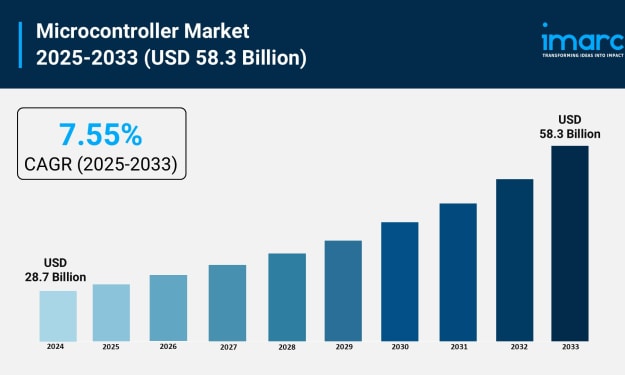
From the chip inside your smartwatch to the control unit managing a factory assembly line, microcontrollers are quietly running the modern world. Surging IoT adoption, the global push toward electrified and autonomous vehicles, and the rapid scaling of healthcare technology are all converging to drive sustained demand for these compact, purpose-built chips. According to IMARC Group’s latest data, the global microcontroller market size reached USD 28.7 Billion in 2024. Looking forward, IMARC Group expects the market to reach USD 58.3 Billion by 2033, exhibiting a growth rate (CAGR) of 7.55% during 2025-2033. The increasing use of microcontrollers in healthcare equipment for monitoring, diagnostics, and treatment applications, the rising demand for energy efficiency, continuous advancements in semiconductor technology, the growing shift toward Industry 4.0, and the increasing need for automation in manufacturing processes are some of the major factors propelling the market.
By Suhaira Yusuf6 days ago in Futurism
The Fears of AI And How Much Fun It Can Be
ChatGPT has come a long way, as has AI in general. There are those people who are scared of it, and for understandable reasons. People fear that as technologies advance, they’ll be replaced in the workforce. Then, there are the fears that AI could evolve into something that brings us to the brink of extinction.
By The Man Behind The Maska day ago in Futurism
Business Intelligence Statistics and Key Facts, Adoption, ROI & Trends
According to InsightMark Research, Business Intelligence (BI) has moved from a back-office reporting function into the strategic nerve center of modern enterprises. In 2025, data-driven decision-making is no longer a competitive differentiator - it is a baseline requirement for survival. This article consolidates the most important statistics across BI market size, adoption rates, ROI, tooling, industry use, data quality challenges, and emerging trends to give a complete picture of where the discipline stands today.
By Internet News Times4 days ago in Futurism



Comments
There are no comments for this story
Be the first to respond and start the conversation.