
THE INVENTORY OF THE VOID:
The Final Audit of the House of Carl

The Great House of Carl sat atop the highest hill in the valley, a sprawling labyrinth of gilded mahogany, reinforced steel, and glass that reflected the sun so fiercely it blinded the peasants in the flats below. For generations, the Carl family didn't just live in the valley; they were the valley. They owned the stream, the air rights above the orchards, and the very shadows cast by the mountains.
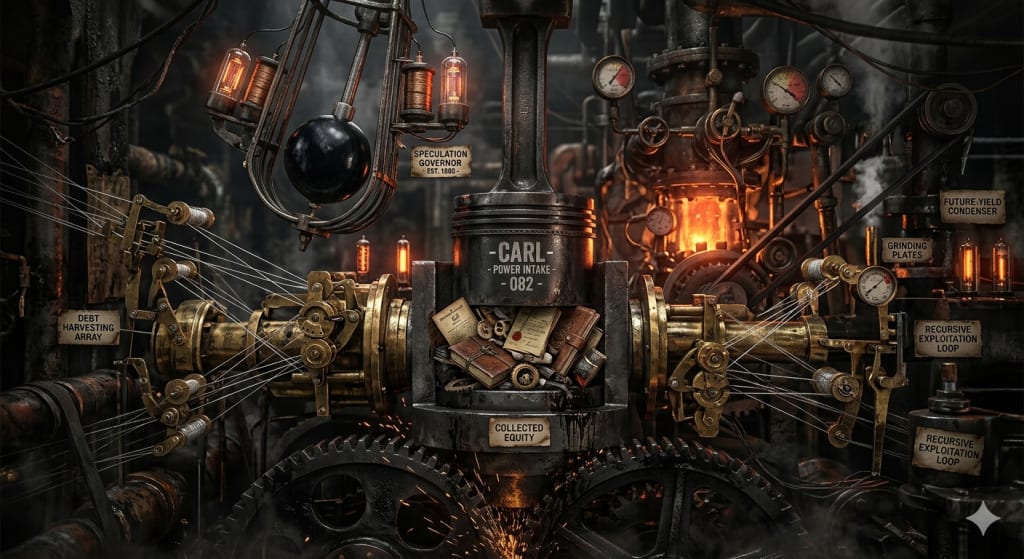
At the heart of the House, buried beneath layers of reinforced concrete and velvet-lined hallways, sat the Engine. It was a masterpiece of parasitic engineering, a mountain of brass pistons, obsidian gears, and humming fiber-optic arrays. It did not create; it converted. It was designed to pull the abstract value of human effort upward through a series of invisible, tension-driven threads.
Its internal mechanics were a nightmare of recursive logic. The "Primary Intake" was a set of grinding plates that pulverized physical assets—deeds, grain, timber—into a digital slurry. This slurry was then pumped through the "Speculation Chambers," where high-frequency brass governors spun so fast they distorted the air, turning the slurry into "Future-Yields." The most horrific part was the "Debt-Cycle Governor," a massive, swinging pendulum of cold iron that kept the entire machine in sync. It relied on the friction of the valley’s desperation to stay lubricated; if the people stopped borrowing, the gears would seize. It worked on a simple, absolute logic: for the House to grow, the valley had to shrink.
Gene Carl, the current patriarch, sat in the Observation Wing, his skin the color of old parchment, translucent and stretched thin over a frame kept alive by the most expensive humors. He watched through a telescope as the fires began.
They weren't fires of revolution—not yet. They were fires of exhaustion. A bakery in the South Quarter had simply burned because the owner couldn't afford the copper to fix the wiring; a granary in the East had gone up because the guards, unpaid for a month, had traded the fire extinguishers for bread.
“The output is down,” Gene croaked, not looking away from the lens.
His Chief Steward, a man named Mason whose suit was so sharp it looked like it could draw blood, checked a glowing ledger. “The threads are snapping, sir. The people… they’ve run out of things to give. We’ve harvested the grain, then the seed, then the soil itself. Now, there is only the dirt.”
“Then sell the dirt,” Gene whispered. “Package it as ‘Heritage Fields.’ Market it to the Northerners.”
“There are no Northerners left to buy it, sir,” Mason said, his voice devoid of emotion. “We bought their markets ten years ago and dismantled them for parts. We are the only ones left with any coin, and the coin only has value because we say so.”
Gene gripped the arm of his chair. The House was groaning, the Machine was hungry. It was a sound like a tectonic plate shifting—a deep, metallic protest. For decades, the House had expanded by adding wings, towers, and flying buttresses, all funded by the debt of the valley. But the debt had reached a mathematical ceiling. The Engine, sensing a lack of fuel, began to turn inward.
The first consequence was the silence of the Great Hall. The musicians had left when the gold leaf began to flake off the ceiling. Then the heat went. Carl wrapped himself in a tapestry depicting the founding of the House, a scene of his great-grandfather, Eugene Carl, "civilizing" the wilderness with a ledger under his left arm and a whip in hand.
Outside, the valley was a graveyard of industries. The factories were hollow carapaces where rusted machines sat like dead insects. The people moved like ghosts, their eyes fixed on the Great House with a mixture of hatred and a strange, terrifying apathy. They weren't coming to storm the gates. They were simply waiting for the House to fall so they could use the wreckage for firewood.
“Sir,” Mason said, entering the room without knocking. His tie was loosened. This was the first sign of the end. “The Western Wing has collapsed.”
“Fix it,” Carl commanded, "Damn-it... Fix-it... I said!" Carl reasserting his demand to Mason.
“With what? The workers have gone home. They found that growing a single potato in their own backyard provides more utility than a thousand Carl Credits.”
“I have the Patents! I own the rights to the very concept of the potato!” Gene Carl screamed, his voice cracking.
“The concept doesn't feed anyone, sir. And the men with the guns—the ones who enforce the Patents—they’ve realized that the House is made of paper. They’ve gone to the valley to carve out their own small kingdoms. They aren't yours anymore.”
The House shuddered again. A crystal chandelier in the foyer, worth more than a decade of the valley’s total output, shattered onto the marble floor. No one came to sweep it up.
Carl walked, with great effort, to the balcony. He looked out over the world his family had "managed" into a desert. He saw the scars of the mines, the gray sludge of the rivers, and the smog that sat like a shroud over the horizon. He had won. He owned every inch of it. Every breath taken in that valley was technically a line item on his balance sheet.
But the balance sheet was a lie told to a dying god.
The Engine beneath the floorboards began to scream. Its internal "Survival Logic" had finally triggered. Having no more external resources to harvest, the gears reversed their pitch. The Speculation Chambers began to grind against the House's own foundation. The pistons, missing their lubrication of human toil, began to glow white-hot, melting the very floor beneath Carl’s feet. It began to consume the House itself. The gold plumbing was pulled into the furnace; the silken curtains were sucked into the vents.
“We can pivot,” Carl muttered to the empty air. “We’ll move to the clouds. We’ll monetize the vacuum.”
He turned to look for Mason, but the Steward was gone. Mason had taken the last functional carriage and a bag of actual, physical silver, and headed for the mountains. He didn't look back.
The end did not come with a bang or a heroic last stand. It came as a slow, grinding dissolution.
Gene sat back in his chair as the floor tilted. The Great House was sliding down the hill it had spent a century denuding. The lack of roots in the soil—trees cut down to make crates for exports—meant there was nothing to hold the earth. A summer rain, heavy and indifferent, turned the hillside into a river of mud.
The House of Carl groaned one last time and buckled. The Observation Wing snapped off, tumbling into the ravine. Carl was thrown against the glass, watching as his ledgers caught fire from a tipped candle, the records of a billion debts turning into gray ash.
The story stops here: not with the birth of a new world, but with the heavy, suffocating weight of the old one’s carcass.
In the valley, the fate of the people, who were left behind, was a quiet, suffocating rot. They were no longer a community, even if that community was predicated upon destruction; they were a collection of atomized survivors picking through the irradiated remains of a dead dream. The "freedom" they inherited was the freedom to starve on land that had been strip-mined of its future. The soil was a black, slick crust of industrial runoff—mercury and arsenic leaking from the Engine’s cooling vents. The children born in the shanties had gray skin and hollow eyes, their very blood saturated with the micro-plastics and chemical byproducts of a century of "growth & consumption" living under the shadow and ill-gotten protection under the House of Carl.
There was no uprising because there was nothing left to seize, and besides the peasants in the valley were too docile to have every grown the courage to overthrow the House of Carl. The factories were stripped of their precious metals and minerals, by desperate men who traded it for a single day’s worth of synthetic meal and bottled water. The knowledge of how to till the earth or mend a roof, had been replaced by the instinct to scroll through dead networks, looking for phantom credits that no longer existed; while the people were enfeebled because all the physical work had been relegated to automation bots. They were now living ghosts who were just haunting a machine that had already finished eating them, a long long time ago.
The Engine was now buried under tons of earth and rubble, still clicking, still looking to extract. In the absolute darkness of the mud, its gears continued to turn, grinding the skeletons of the Carl family into fine dust, still trying to calculate interest on a world that no longer existed. The silver threads were snapped, but the hooks remained embedded in the earth, left jagged, and to collect rust.
The tragedy wasn't that the House fell. The tragedy was what was left behind: a landscape so thoroughly plundered that it could no longer support the life that remained. The people didn't find freedom; they found a wasteland where the very air tasted of iron and decay. They stood in the cold rain, watching the mud swallow the gold leaf, knowing that even if they dug it up, it wouldn't buy back the seasons or the clean water.
The rain continued to fall, washing the last of the Carl family’s name into the gray silt of the river. There was no one to rebuild. There were no seeds left to plant. There was only the long, cold night, and the sound of the Engine, deep underground, counting nothing until the end of time.
About the Creator
Meko James
"We praise our leaders through echo chambers"
Keep reading
More stories from Meko James and writers in Fiction and other communities.
The Silence of the Bone-Dry Noon
The desert sun outside Barstow wasn’t just shining; it was screaming. It was a white-hot hammer of God pounding the hood of my '71 Chevy till the engine block rattled like a skeleton in a tumble-dryer. I pulled into the "Dust & Bone" rest stop, a place that looked like it had been built by a committee of vultures and then abandoned to the lizards.
By Meko James 5 days ago in Fiction
4:37 AM
With a long, exhausted blink, his glued eyes open. A couple more swift blinks followed by a resonating, endless yawn. Then, a sudden twitch, as if a thousand needles pierced his body. “What day is it?! Did I oversleep?!” The world hushed, and all he heard was the pulse of his heart drumming against his eardrums in a manic rhythm. With a still numb hand, he searched in the dark for his phone. Heavy breathing, strong palpitations, His hand picking up the pace. He lifted the blanket, tossed aside pillows, searching. Nothing. The air in the room thickened, and still, he didn’t know. Was it another dawn, or the mids of the night? For too long, his days and nights had blurred into a single, bleak darkness. Finally, he sees a black square resting on the white towel by his bed. His finger tapped the screen manically, and finally, it revealed the time: 4:37 in the morning. The drummer slowed down the beat, and all that fills the room is calming silence.
By George Roast7 days ago in Fiction


Comments
There are no comments for this story
Be the first to respond and start the conversation.