
When First Days of Spring Feel Like Summer, Remember The Truth
Global warming is still an ongoing, existential threat to all humanity, but it's making a nice start to spring.


It’s going to feel like summer as we head into the first days of spring. Do you still think that global warming isn’t a dangerous issue that needs the human species to wisen up and start dealing with it through active scientific measures, as opposed to denial? If so, feel free to continue being the ones with your head in the sand.
No, it’s not all about doom and gloom. And no, it’s not all about you! But it never was. That’s the biggest problem with the global warming and climate change fight. People all think it’s about them, their ideas, and their beliefs. Everbody is guilty of it, and the very worst of those people are likely the politicians.
So, as global warming continues to rear its uglier than waking up with a former spouse head, reminding those who are paying attention to the issue that it isn’t done with us, everybody has a choice to make. No, none of those choices are great. Some of them might inconvenience you, just a tad.
But, imagine doing nothing. If you, your neighbors, and everybody across the globe, all did nothing, where would we end up? The we is refering to the people living in lower lying, coastal regions. The predictions for the future, shold they hold up, aren’t great.
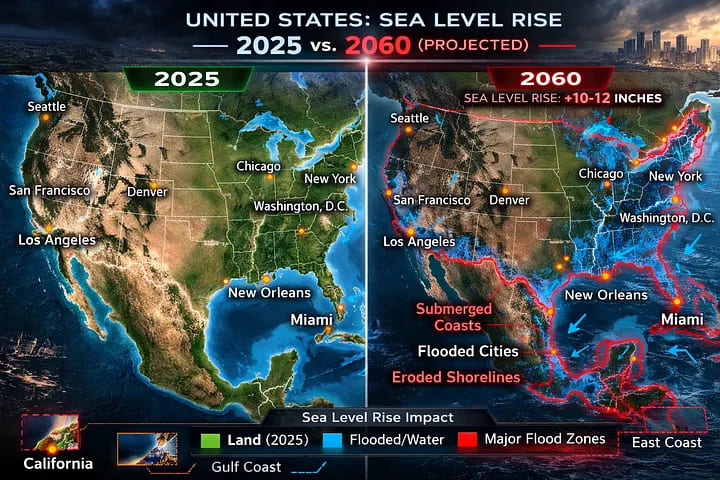
Satellites used by NASA have confirmed that sea level rise has accelerated since they began tracking levels in the 1990s. In the 1990s, levels rose about one eighth of an inch per year.
By October, 2024, the number had doubled. Since then, they’ve compared the data from 30 years ago to the actual outcome and it’s close. Originally, it was projected that sea level rise was going to be about 8 centimeters over 30 years. The actual number was 9 centimeters.
What Are Current Estimates
How much the sea levels rise between now and 2050, or 2100, depend on the amount of greenhouse gas emissions. The more greenhouse gases are added to the atmosphere, the more global sea level will rise.
For the United States, by 2050, we should see 12 inches of sea level rise. Then, by 2100, we likely will see between 2.5 and 4 feet of sea level rise. Higher levels remain a possibility in some areas, such as the Gulf Coast region.
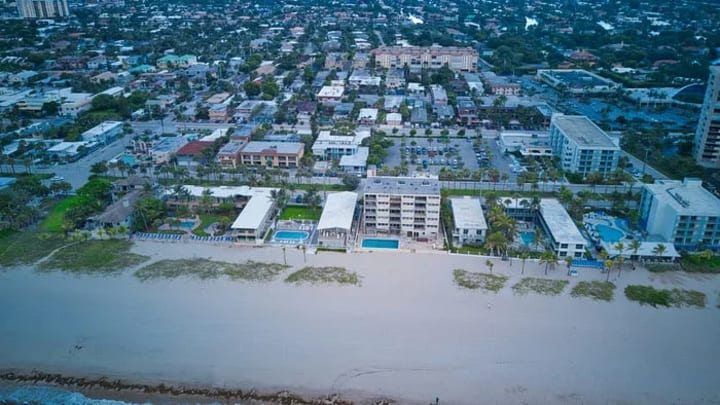
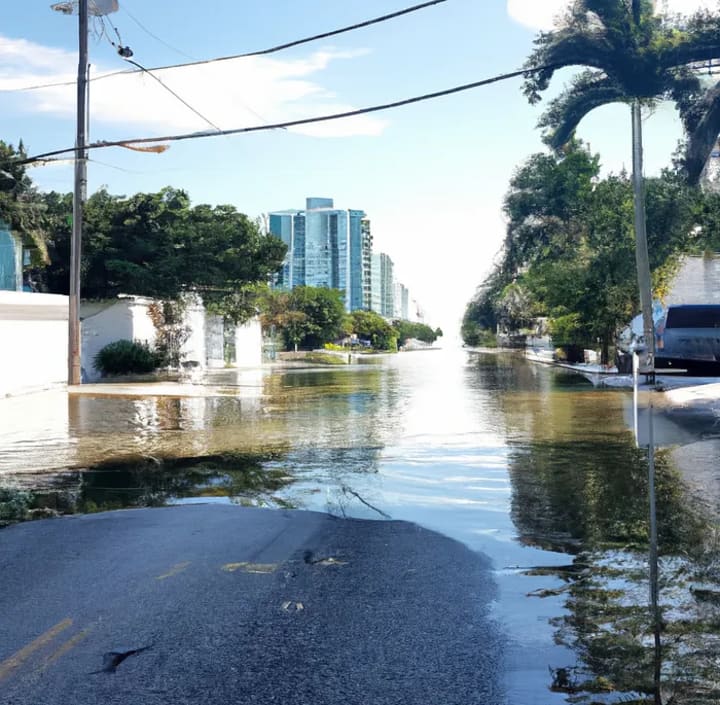
Maybe you won’t be here. Maybe you will be here to see the beginnings of the problem, as the high tides between 2035 and 2040, are predicted to cause catastrophic flooding along the Florida coast, and leave cities like Miami dealing with feet of storm surge flooding the streets instead of inches.
Ultimately, it will be our grandkids and great grandkids who suffer from our short sightedness. But, so will our country. As these coastal areas face being less habitable, millions of American’s will be faced with the loss of their businesses, homes, and livelihoods, forcing a migration inland.
Whether you are a globalist and see a magical world of no borders as a paradise, or you are in favor of securing our borders and controlling who enters the country, one thing is certain. If scientists are correct, the struggles of ICE have only just begun and are going to get worse in the coming years. That’s right, scientists.
How Will Science Affect Populations and Immigration
Last year, 2000 miles from the U.S., Gunas of Cardi Sugdab was one of the first communities that made the news due to a forced relocation of people. That’s right, forced relocation. And it wasn’t some insidious government takeover, or some evil agenda by big business and the filthy rich. They were leaving because of rising sea levels.
And while it isn’t catastrophic today, scientists at NASA and NOAA predict it’s going to get worse. The predictions aren’t in fifty years or a hundred years. It’s believed that by 2035, sea levels will rise enough that low-lying coastal areas will be threatened, especially during storm surges from tropical storms and hurricanes. By 2050, we could see a century of sea level rise.
In the United States alone, millions of people face uncertain futures due to rising sea levels. In 2017, approximately 94 million people lived in coastal counties in the United States. More than 60 million of those people were in the most vulnerable areas to hurricanes. With such dense populations at risk from the future of rising ocean levels and intensifying storms, how will other countries fare?
For years, the intelligence community has coordinated information with the weather services. Operating under the same umbrella of the United States Government, NOAA and NASA most likely coordinate information on the future of climate change with the CIA. When we examine the migratory patterns of different people around the world, the already harsh conditions in areas, and the impoverished conditions in some societies, one could expect that climate change will increase immigration struggles.
How Climate Change Affects Human Migration
The human race’s mobility due to environmental issues isn’t a new idea. Global climate change has created new problems in the area of immigration. The issues will get worse. While the United States is one country with a large coastal population, consider the rest of the world.
The Philippines is a coastal society with over 70 million people, and 60% live in coastal areas. That’s roughly 40 million people who will be displaced due to climate change as ocean temperatures continue to rise and polar ice continues to melt, causing the sea level to rise.
With 15% of our population living within range of a coastal area, two billion people’s lives can be upended due to the threat of rising oceans. All of this is due to climate change, increases in global average temperatures, and rising sea levels.
Whether this gets to the point of a catastrophe in the next ten years or the next thirty, it is going to happen if things don’t change. When it does, people in the lowest-lying areas may be forced to retreat inward. The danger of hurricanes will go up, especially in category four and five storms. Category four and five hurricanes can flood low-lying areas now, and if there’s to be an additional foot of water, more lives will be at risk.
Takeaways
As we break out the barbeques, and the fishing equipment, headed into the warmth of summer in the early spring, it’s important to remember what we do and how it affects our world. We haven’t been kind to it.
We live in a complex world, and we don’t share it well. We haven’t figured out how to bring all of the world into the future, and that creates problems on a cultural level. Hatred and mistrust because of long-standing political, sociological, and religious ideologies continue to keep the world in conflict.
When you look at the world, it’s easy to see that climate change is a very real problem. Whether it’s as much because of the use of fossil fuels is debated because of politics and the need for energy. The oil companies don’t want to go out of a business that generates profits so high that most people can’t fathom that kind of money. How can we blame them? Money’s a wonderful thing.
What we don’t have is an abundance of land. As the population exploded exponentially compared to a century ago, we would see more people and less free space. People expanded faster than technology, and now, there’s an existential threat that the brightest minds continue to alert us to, even though little attention is paid to their way.
Eventually, even people in the United States could face an internal migration issue. If the predictions hold, by 2050, the oceans could rise enough that a category five hurricane could displace millions of people. By 2100, astronauts aboard space stations will be looking at different boundaries between the sea and land.
In a world like ours, it’s either we come together and do what we can, or we face something far uglier. But why listen to the warnings and change now? Most of us won’t be affected. It’s just your children and grandchildren that will have to deal with the worst, if the geniuses that study these patterns are right.
About the Creator
The Man Behind The Mask
From fiction to reality there’s tons to share about this crazy life. From being a single father, an officer, and having had many insane adventures while I learned about the world, my imagination runs wild with ideas.
Keep reading
More stories from The Man Behind The Mask and writers in Earth and other communities.
A Timely Reminder About The One Threat To Us All
It's still a collosal problem. And we are stuck between rocks and hardplaces, and getting more trapped by the year. And while everybody wants to scream, yell, and pound their fists about every other issue they claim to care about, people have slowly begun to voice their feelings much less about how petroleum is both pivotal to our existence, and a source of our problems.
By The Man Behind The Mask14 days ago in Earth
Urban Demolition Challenges: Efficient Trucking Strategies in High-Density Construction Zones
Urban demolition is no longer a niche segment of construction. As cities continue to grow vertically and older structures are cleared to make way for new developments, demolition and excavation projects are increasingly concentrated in dense, high-traffic areas. This shift brings a new layer of complexity, especially for trucking operations that must move debris, materials, and equipment efficiently through crowded urban environments.
By Tim Clarke7 days ago in Earth
⭐ East-West Line
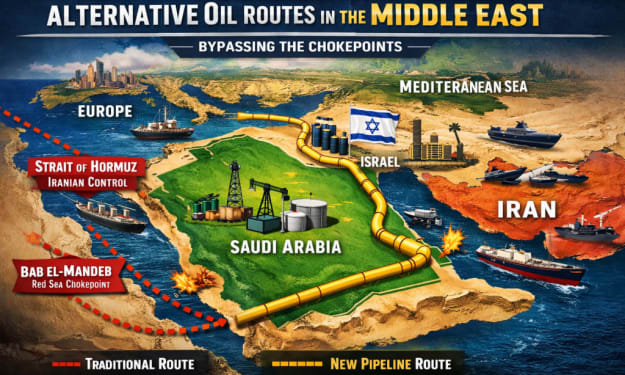
Saudi Arabia East- West Petroline The Middle East has long been the center of global energy politics, with its vast oil and gas reserves shaping not only regional dynamics but also the priorities of major world powers. However, in recent years, a critical question has emerged: should the world continue relying on a few strategic maritime chokepoints for energy transportation, or is it time to develop alternative routes?
By Wings of Time a day ago in Earth
You Should Stop Trying to Be a Better Person
A year ago, I spent two days in the Colombian mountains drinking ayahuasca as part of a spiritual ceremony. An experience that pulled apart every detail of my being and rearranged me in a new sequence. I wish that life became easier after the feat. It didn’t.
By Annaise Michelle8 days ago in Humans


Comments
There are no comments for this story
Be the first to respond and start the conversation.